

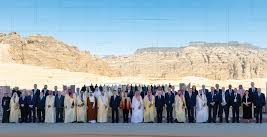
ALULA, Feb 10 (SPA/APP): The second and final day of the second edition of the AlUla Conference on Emerging Market Economies concluded on Tuesday. Hosted by AlUla Governorate and organized by the Saudi Ministry of Finance in partnership with the International Monetary Fund (IMF), the conference brought together a high-level group of economic policymakers, finance ministers, central bank governors, leaders of international financial institutions, representatives of international organizations, and a distinguished group of experts and specialists.
The second day featured a research paper entitled “Fiscal Policy in a Shock-Prone World,” with contributions from Minister of Finance of Saudi Arabia Mohammed Aljadaan; Minister of Finance of Pakistan Muhammad Aurangzeb; Minister of Finance and Coordinating Minister of the Economy of Nigeria Wale Edun; and Professor Antonio Fatas of INSEAD. The discussion was moderated by Chief Economist and Senior Vice President for Development Economics at the World Bank Group Indermit Gill. The session examined approaches to managing fiscal policy in an increasingly uncertain global environment marked by recurrent economic shocks, the importance of balancing spending needs with rebuilding fiscal buffers, and the role of fiscal frameworks in enhancing resilience and sustainability in emerging market economies.
During the session, Minister Aljadaan emphasized that the success of economic reform programs requires a clear vision and a measurable implementation plan that earns citizens’ trust and enables them to plan for the future. He stressed that the speed and quality of implementation are critical to building momentum and credibility, alongside the importance of effective governance, transparency, and continuous performance monitoring. He further explained that adopting a data-driven approach and strengthening institutional capacity are fundamental pillars for achieving productive and sustainable growth, underscoring that the quality of institutions, policies, and technology is the decisive factor in enhancing long-term economic resilience. In his remarks, the minister highlighted Saudi Arabia’s experience with fiscal reforms under Vision 2030, noting that the Kingdom has transitioned from reliance on oil price cycles to a comprehensive fiscal framework that decouples government spending from energy market volatility. This approach ensures the continuity of financing long-term development objectives.
He added that strengthening non-oil revenues, improving spending efficiency, and leveraging digitalization have contributed to reinforcing fiscal stability and achieving sustainability in both the short- and long-term. The panel was followed by an additional panel discussion entitled “Private Sector–Led Growth in Emerging Market Economies: The Role of the State,” featuring President of the Islamic Development Bank Group Dr. Mohammed Aljasser; Minister of Finance and Budget of Senegal Cheikh Diba; and Managing Director for Operations at the World Bank Group Anna Bjerde. The discussion was moderated by Director of the Middle East and Central Asia Department at the IMF Jihad Azour.
The session explored ways to empower the private sector and boost productivity amid constrained fiscal space and rising public debt levels, as well as the impact of industrial and regulatory policies and technological transformations—particularly artificial intelligence—on reshaping investment and growth patterns in emerging economies. The conference concluded with a session entitled “A Pathway Toward Emerging Market Resilience and Economic Transformation,” moderated by Member of the Editorial Board at the Financial Times Gillian Tett. The session featured Managing Director of the IMF Kristalina Georgieva; Minister of Finance of Qatar Ali bin Ahmed Al-Kuwari; Minister of Treasury and Finance of Türkiye Mehmet Şimşek; and Minister of Economy and Finance of Ecuador Sariha Moya.
The discussion focused on the design of macroeconomic and fiscal policies, as well as structural reforms to enhance resilience to recurring shocks and support pathways of economic transformation amid profound changes in the global economy. In their closing remarks, Minister Aljadaan and IMF Managing Director Kristalina Georgieva emphasized the importance of continuing frank and constructive dialogue, strengthening multilateral cooperation, and translating the conference’s outcomes into practical policies that support emerging market economies and amplify their voice in international economic forums. The AlUla Conference on Emerging Market Economies serves as a high-level international platform aimed at deepening international cooperation, coordinating economic policies, and building shared solutions that contribute to more inclusive and sustainable growth, while reinforcing global economic stability.
Final day of 2026 AlUla Conference on Emerging Market Economies concludes
RELATED ARTICLES