Iftikhar Ali UNITED NATIONS, Dec 16 (APP):Pakistan outlined its expectations for the next secretary-general of the UN, emphasizing independence, integrity and sound judgment to deal with growing global challenges. "Leadership for peace also requires a strong and proactive Secretary-General," Ambassador Asim Iftikhar Ahmad, permanent representative of Pakistan to the United Nations, told the UN Security Council on Monday. the present Secretary-General Antonio Guterres’ second term expires at the end of …
Pakistan’s vision for next UN chief: A ‘strong and proactive’ leader
Iftikhar Ali
UNITED NATIONS, Dec 16 (APP):Pakistan outlined its expectations for the next secretary-general of the UN, emphasizing independence, integrity and sound judgment to deal with growing global challenges.
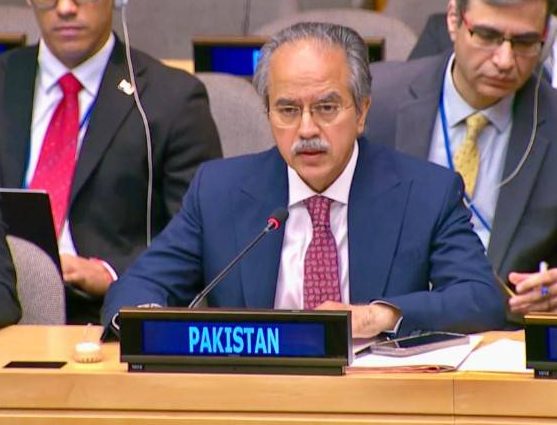
“Leadership for peace also requires a strong and proactive Secretary-General,” Ambassador Asim Iftikhar Ahmad, permanent representative of Pakistan to the United Nations, told the UN Security Council on Monday.
the present Secretary-General Antonio Guterres’ second term expires at the end of next year, and the formal selection process is already under way.
In November, the Presidents of the General Assembly and the Security Council launched the process together, in line with General Assembly resolution 79/327, which emphasizes transparency and inclusivity.
Under the established procedure, candidates are nominated by member states or groups and are required to submit a vision statement, curriculum vitae and campaign financing disclosures. The General Assembly president convenes publicly broadcast interactive dialogues with all candidates, while engaging closely with Member States throughout the process.
As of mid-December, only Rafael Mariano Grossi – the Director-General of the Vienna-based International Atomic Energy Agency (IAEA) – has been nominated by Argentina.
In his remarks during the Council’s debate on ‘Leadership for Peace’, Ambassador Asim Ahmad said that Article 99 of the UN Charter, which grants the secretary-general the power to alert the Security Council to any situation threatening international peace and security, must be used as an early preventive tool, not as a last resort.
“Member States would look for also in the next Secretary-General, who would be expected to strengthen all three pillars of the United Nations equally; and exercise good offices proactively and without fear or favour,” the Pakistani envoy said.
While demanding such high standards in the secretary-general, he said, the member states must also live up to their own obligations, under the Charter, its purposes and principles and particularly Article 25 wherein all UN member States “agree to accept and carry out the decisions of the Security Council.”
“We cannot tie the hands of the secretary-general, violate the Security Council resolutions, and sideline the United Nations, and then expect the secretary-general and the UN to deliver,” Ambassador Asim Ahmad stressed.
The Security Council must also demonstrate leadership through consistency and credibility, entailing greater focus on conflict prevention, addressing the root causes of conflict, as well as strengthening and more effective use of UN’s peacekeeping and peace-building capacities, he said.
Council resolution 2788 reaffirmed the primacy of peaceful settlement of disputes, it was pointed out. These tools must be actively employed to resolve festering conflicts and longstanding disputes, without selectivity and double standards. The Council must help secure compliance with International Court of Justice’s rulings and consider extending the Court’s jurisdiction to all issues on the Council’s agenda.
Pakistan, he said, seeks peace and stability in South Asia, highlighting that Jammu and Kashmir remains one of the oldest unresolved disputes on the Council’s agenda, requiring a just settlement in accordance with the UN Charter, relevant Security Council resolutions, and the will of the Kashmiri people — some thing India continues to violate and deny.
“India’s unilateral suspension of the Indus Waters Treaty – which is a rare and enduring example of successful diplomacy – is yet another blatant breach of international obligations that undermines regional stability, and endangers the lives and livelihoods of millions.”
Underscoring that the Security Council must treat all disputes on its agenda with equal seriousness, the Pakistani envoy said, “When dialogue is rejected or the secretary-general’s good offices are blocked, bilateralism cannot serve as an excuse for inaction.”
The Council, he said, has a clear responsibility to uphold international law and ensure implementation of its own resolutions.
“From Gaza and other conflicts in the Middle East, to Ukraine, to Sudan and other situations in Africa, peace can be realized only with willing and committed parties demonstrating leadership, and readiness to comply with international law,” Ambassador Asim Ahmad said.
“Our collective desire for a more effective, fit for purpose United Nations also requires visionary and responsible leadership.”
He said that adding new individual permanent members to the Council– such as India — will only entrench its paralysis. The Italy/Pakistan-led Uniting for Consensus (UfC) proposal, he said, offers a practical, inclusive and achievable model – based on elected seats that provide for rotation, enhanced regional and cross regional representation and better accountability to the general membership.
‘Reform for all – privilege for none – that is our motto.”
Pakistan, Ambassador Asim Ahmad said, will continue to work with all member states to uphold the UN Charter, advance justice and rule of law, and stand for a vibrant multilateral system that delivers for all – peace, dignity and shared prosperity.
Earlier, Former UN Secretary-General Ban ki-Moon, now an emeritus member of The Elders group, warned that global conditions have worsened since he left office at the end of 2016, marked by deepening confrontation among major powers, eroding multilateralism and conflicts in which civilians continue to pay the highest price.
“This deeply disappointing situation is characterized by confrontation rather than cooperation among major powers,” he told the Council, citing the war in Ukraine, mass civilian casualties in Gaza and weakening international cooperation – even as the global climate crisis accelerates.
The former UN chief said the overall crisis cannot be separated from the Security Council’s own failures.
“The Security Council’s ongoing failure to properly function constitutes the most egregious cause,” he said, highlighting the repeated use of veto by permanent members “to shield themselves, their allies and their proxies from accountability.”
Without meaningful reform, Ban warned, civilians will remain unprotected and impunity will persist. “Without it, the UN risks lurching towards either collapse or irrelevance,” he said.
Turning to the selection of the next Secretary-General, Ban called for a single, non-renewable seven-year term to strengthen the independence of the office.
The current practice of two five-year terms, he said, leaves Secretaries-General “overly dependent on this Council’s Permanent Members for an extension,” even though the arrangement is a convention rather than a requirement of the UN Charter.
“The General Assembly holds the power to set the terms of the appointment itself,” Ban noted, urging member states to use that authority to empower the next UN leader more fully.