
ISLAMABAD, Mar 29 (APP):The economic activity across Uzbekistan has strengthened over the past five years, with more regions showing signs of urban-style development, according to a new analysis by the Center for Economic Research and Reforms (CERR) using satellite-based nighttime light data. The study, which relies on nighttime illumination captured by satellites, found a strong correlation between light intensity and economic performance, suggesting expanding infrastructure and higher productivity in brighter …

ISLAMABAD, Mar 29 (APP):The economic activity across Uzbekistan has strengthened over the past five years, with more regions showing signs of urban-style development, according to a new analysis by the Center for Economic Research and Reforms (CERR) using satellite-based nighttime light data.
The study, which relies on nighttime illumination captured by satellites, found a strong correlation between light intensity and economic performance, suggesting expanding infrastructure and higher productivity in brighter areas, said a release issued here on Sunday.
The CERR said its satellite-based estimates closely align with official figures. Data derived from NASA’s nighttime lights show Uzbekistan’s nominal GDP per capita rose by 80.3% between 2020 and 2025, from $2,090 to $3,887, reflecting an average annual growth rate of 15.8%. Official statistics report a similar increase of 81.8%, with GDP per capita climbing from $2,048 to $3,881 over the same period.
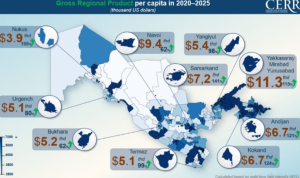
According to the data Urban centers lead growth and the highest growth in gross regional product (GRP) per capita was recorded in the capital, Tashkent, where the figure rose by about $5,000 to reach roughly $9,300 by the end of 2025.Other cities also posted strong performance. In Navoi, GRP per capita reached $9,300, while Zarafshan recorded $7,900 and Samarkand $7,200. Kokand and Andijan both reached $6,700, and cities including Akhangaran, Yangiyul and Bukhara ranged between $5,200 and $5,800.
Regional gains were also notable. GRP per capita increased by about $1,800 in both Tashkent and Navoi regions, reaching around $4,000. In Fergana and Syrdarya regions, the indicator rose by approximately $1,600, to $3,500 and $3,400 respectively.
The data showed smaller cities indicate momentum and the smaller and medium-sized cities also demonstrated solid economic activity. Termez reached $5,100 in GRP per capita, while Margilan and Chirchik were near $5,000. Namangan recorded $4,800, with relatively strong performance also observed in Kagan and Urgench.
District-Level growth accelerates and at the district level, the fastest growth was seen in Mirabad, where GRP per capita increased by $7,100. Yakkasaray and Chilanzar districts followed, with gains of $6,300 and $5,600 respectively. GRP per capita in these districts now exceeds $10,000—nearly three times the national district average.
Other districts showing rapid expansion included Karmana, which saw a 2.5-fold increase, and Yashnabad and Bektemir, each growing 2.4 times. Sergeli, Yangi Hayot and Mirzo Ulugbek districts recorded growth of about 2.3 times.
According to the data Urbanization expanded and satellite data also highlighted accelerating urbanization. The number of territories with high nighttime light intensity—indicative of urban agglomerations—increased from 22 in 2020 to 31 in 2025. Average GRP per capita in these areas rose from $3,800 to $7,000.
Meanwhile, the number of districts with low light intensity dropped from 129 to 85, indicating that 44 districts transitioned toward more urbanized economic structures. In these areas, light intensity more than doubled, while GRP per capita increased from $1,700 to $3,200.
The CERR said the findings demonstrate that satellite-based nighttime light data can serve as a reliable complement to official statistics, offering timely insights into regional economic trends.
The approach can help policymakers identify emerging growth centers and better target infrastructure investment and state support across the country, the report concluded.