
As the holy month of Ramazan continues, markets across the federal capital are witnessing a dramatic surge in crowds shortly before the evening call to prayer.
Pre-Iftar rush for traditional snacks intensifies in capital markets during Ramazan
Hina Durrani
ISLAMABAD, Mar 10 (APP):As the holy month of Ramazan continues, markets across the federal capital are witnessing a dramatic surge in crowds shortly before the evening call to prayer.
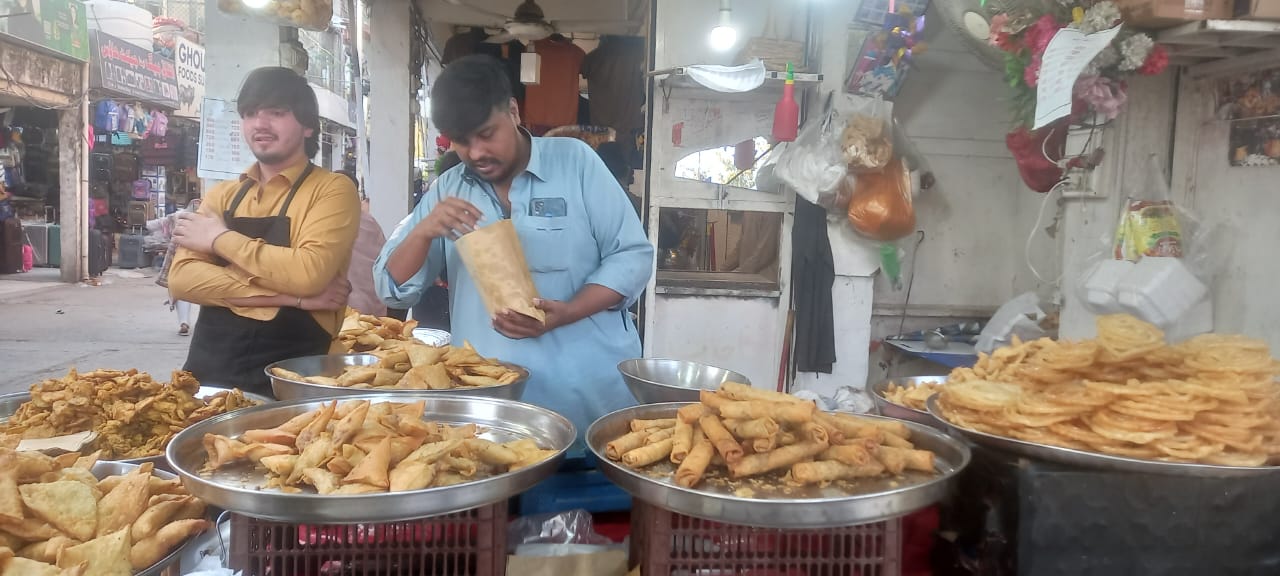
Residents are flocking to popular marketplaces to buy freshly prepared traditional snacks for iftar, creating bustling and sometimes chaotic scenes at food stalls. In the final hour before the Maghrib prayer, long queues form at stalls selling popular Ramazan delicacies such as samosa, pakora and jalebi. These items remain staples for breaking the fast, and their demand rises sharply during the fasting month.
Major commercial hubs including Aabpara Market, Melody Market, markets in Sector G-9, as well as Jinnah Super Market and Super Market become particularly crowded during this period.
Shopkeepers say the sudden rush places immense pressure on vendors who must prepare large quantities of snacks within a short time.
Talking to APP, Sadiq, a traditional snack shop owner at Aabpara Market, said that demand increases sharply just before iftar. “We try our best to serve everyone, but the crowds can sometimes become overwhelming,” he said.
He added that despite concerns about rising inflation and increasing food prices, many residents continue to purchase traditional snacks several times a week during Ramazan.
According to him, pakoras, aloo samosas and jalebi remain the most sought-after items because they are comparatively cheaper than chicken samosas, minced meat samosas and chicken rolls.
Sadiq said pakoras are commonly sold in markets at around Rs700 to Rs750 per kilogram, while aloo samosas are priced between Rs600 and Rs650 per kilogram. Jalebi is also available within a similar price range of Rs600 to Rs650 per kilogram.
Fareed, another traditional snack vendor in Sector G-9, told APP that the rush of customers peaks within the final hour before the Maghrib prayer. He also confirmed that aloo samosas, pakoras and jalebis remain the public’s first choice compared to other traditional snacks.
Meanwhile, buyers say these snacks are an essential part of their iftar table.
Speaking to APP, Samad, a buyer said his iftari feels incomplete without pakoras and samosas. “These traditional snacks are mandatory items on our home dastarkhwan,” he said, adding that the aroma of freshly prepared snacks adds a unique warmth to the Ramazan atmosphere.
For many families, however, freshly fried items are still prepared at home. Ayesha, a housewife residing in Sector F-7, told APP that these traditional snacks remain equally popular among both older and younger generations. She said her family’s dastarkhwan is incomplete without them, adding that she prepares these traditional iftar snacks at home almost every day during Ramazan.