
Dar Monastiri: A historic house in Medina of Tunis now home to National Calligraphy Centre
Dar Monastiri: A historic house in Medina of Tunis now home to National Calligraphy Centre
TUNIS, Mar 10 (TAP/APP): Down a quiet alley in the Medina of Tunis, not far from the mausoleum of Sidi Mahrez, a large green-painted wooden door catches the eye.
Behind this threshold, tucked away in the calm of an old neighbourhood, lies Dar Monastiri (sometimes called Dar Mestiri), a grand early 19th-century residence that today houses the National Calligraphy Centre.
Within the thick walls of this former home of a notable family, the patient gestures of calligraphers now converse with the long history of the medina.
Located at No. 9 Rue Monastiri, the house is part of the rich architectural fabric of the Medina of Tunis, which was inscribed in 1979 on the UNESCO World Heritage List.
Founded from the 7th century around the Great Mosque of Zitouna, the old city contains about 700 historical monuments, mosques, madrasas, funduks, palaces, and aristocratic residences, making it one of the major heritage sites of the Arab-Muslim world.
Moreover, the art of Arabic calligraphy, now taught in this location, was inscribed in 2021 on the UNESCO Representative List of the Intangible Cultural Heritage of Humanity as part of a joint nomination presented by several Arab countries, including Tunisia.
A house gifted to a Tunisian notable
Dar Monastiri was built during the reign of Mahmoud Bey (1814–1824). Historical sources indicate that the house was constructed by Prince Hussein, the Bey’s son, and later gifted to Mohamed Monastiri, a prominent figure in Tunisian society and a major chaouachi (fez craftsman and merchant).
The Tunisian historian and statesman Ahmed Ibn Abi Dhiaf highlighted the role of Monastiri in the capital’s society at the beginning of the 19th century. Upon his death in 1821, the house passed to his son, who continued the family business in the chaouachine souk.
Ahmed Ibn Abi Dhiaf (1802–1874) authored the major historical work Ithaf Ahl al-Zaman, detailing political and social life in Husainid Tunisia and documenting the major families of the capital, including the Monastiri family.
French architect and historian Jacques Revault also studied such urban residences in his reference work Palaces and Residences of Tunis (18th–19th Centuries), initially published in 1971 and reissued in 1983 by the CNRS.
In this 470-page volume, Revault provides a detailed inventory of palaces and grand houses built during the 18th and 19th centuries, analysing the evolution of plans, materials and decorations under the Muradid and Husainid dynasties.
Over time, Dar Monastiri passed through several hands. Part of the property returned to the state, while another portion was acquired by the Fourati family, who carried out major restoration works at the end of the 19th century.
Typical architecture of Medina mansions
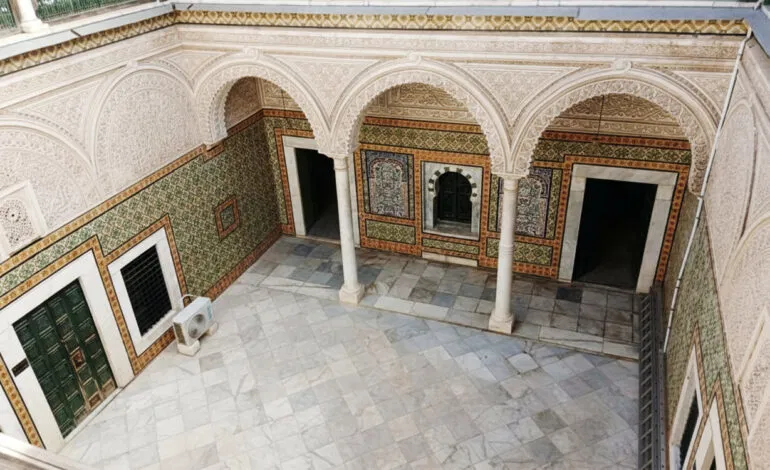
Like most large homes in the old city, Dar Monastiri is organised around a spacious central courtyard, the heart of the house. Living spaces are arranged around this patio, reflecting the characteristic layout of traditional Tunisian homes.
Visitors are first welcomed by a large double-leaf door with a small opening called a Bab el-khoukha, formerly used to enter without opening the main gate.
The house has two floors lined with arcaded galleries. Some rooms follow a T-shaped plan, inspired by the iwan, a widely used architectural form in prestigious Islamic residences. Upstairs, the windows are adorned with mashrabiya, locally called qannariyya, which maintain privacy while allowing air and light to circulate.
The walls are decorated with ceramic tiles in traditional patterns dominated by green and yellow tones. Marble, carved stucco and worked wood complete this decorative ensemble, reflecting Andalusian-Moorish aesthetic influences.
Yassine Mokrani, director of the National Calligraphy Centre and chief heritage curator at the National Heritage Institute, said the house also contained traditional rainwater collection systems.
“The large houses of the medina placed special importance on water management. At Dar Monastiri, cisterns called majels still exist, and there likely was also a well,” he explained.
He added that the thick walls, nearly a meter wide, helped maintain cool temperatures in summer and retain heat in winter.
Historic residence, place of transmission
Classified as a historic monument in 1922, Dar Monastiri served multiple functions during the 20th century. It housed an Institute of Arts and Crafts, then institutions dedicated to traditional arts: the Institute of Arts and Crafts (1924), the Office of Craft Education (1933) and from 1940, the Regional Centre for Tunisian Arts.
Following a major restoration campaign in 1992 by the National Heritage Institute (formerly INAA until 1993), the house regained a cultural purpose. It became the seat of the National Translation Centre, now the Tunis Institute of Translation at the City of Culture and since 2017, it hosts the National Calligraphy Centre.
Today, in the rooms surrounding the courtyard, students of all ages learn the subtleties of this ancestral art. Training spans several years and covers multiple Arabic script styles, including naskh, diwani, thuluth, rqaa, Maghrebi, as well as Islamic ornamentation techniques.
Exhibitions, workshops, and artistic meetings are regularly held to promote the art and adapt it to modern technologies, including digitisation of calligraphy.
Between memory and creation
In the soft light filtering through the courtyard, the silence is sometimes broken by the slide of a reed pen on paper. Where residents of a noble house once lived, the art of the letter is now transmitted.
For the centre’s directors, the goal goes further.
“We are currently working on a project to transform the house into a museum of inscriptions and calligraphic arts,” says Yassine Mokrani.
Like many medina houses, Dar Monastiri also reflects the urban elite lifestyle in 18th and 19th-century Tunis. Two centuries after its construction, the house remains a meeting place of heritage and creation. Behind its large green door, Dar Monastiri continues to tell a story where architecture, urban memory and the art of writing intersect in the heart of the Medina of Tunis.