The Pakistan Agricultural Research Council (PARC) plans to launch a Rs1.3 billion five-year climate-smart project aimed at improving soil fertility and crop productivity across the country
Rs1.3bn project planned to improve soil fertility, crop productivity
ISLAMABAD, Mar 08 (APP):The Pakistan Agricultural Research Council (PARC) plans to launch a Rs1.3 billion five-year climate-smart project aimed at improving soil fertility and crop productivity across the country.
Titled “National Bio-Fertilizer and Composting Program for Improving Soil Health and Crop Productivity,” the initiative will run from July 2026 to June 2031, according to an official document available with Wealth Pakistan.
The project falls under the thematic areas of natural resources, climate-smart agriculture, soil fertility and soil health, integrated nutrient management, biofertilizers and soil microbiology.
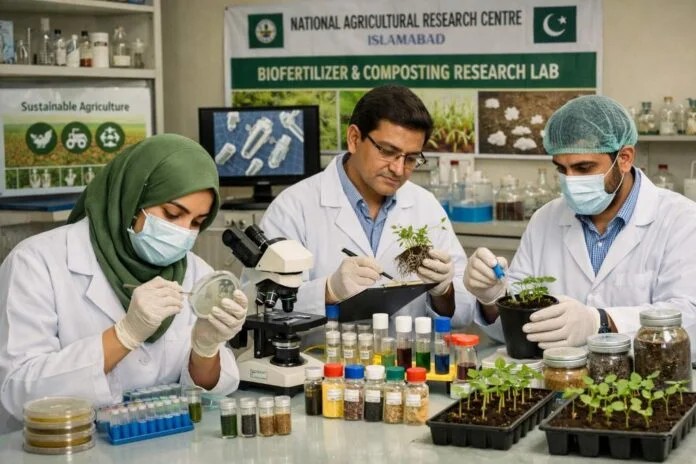
It will be implemented through the Land Resources Research Institute (LRRI) of the National Agricultural Research Centre (NARC), Islamabad, in collaboration with provincial research and extension departments. PARC Agro-Tech Company (PATCO) and private-sector biofertilizer companies will participate under a public-private partnership (PPP) mode.
The initiative aligns with the 5Es Framework, the 13th Five-Year Plan, the UN Sustainable Development Goals (SDGs), and the National Agriculture Innovation and Growth Project (NAIGP). It seeks to promote climate-smart agriculture and regenerative soil health management, reduce chemical dependency, and strengthen farmer resilience and food security.
The program aims to enhance national food security, soil health and climate resilience by scaling up farmer-level adoption of quality-assured indigenous biofertilizers, compost and organic amendments. It will operate through a nationally coordinated, climate-smart and PPP-enabled delivery framework designed to support sustainable and regenerative agricultural systems in Pakistan.
Among the key deliverables, elite Plant Growth-Promoting Rhizobacteria (PGPR) strains will be authenticated, conserved and documented in the National Culture Collection of Pakistan (NCCP). A national quality control and certification system for bio-fertilizers and compost will be used to ensure product standards and build farmer confidence.
Farmers will be provided with standardized integrated nutrient management packages along with application guidelines. Functional public-private delivery partnerships will be established to facilitate access to bio-inputs, while demonstration plots will be established and evaluated across agro-ecological zones to validate climate-responsive nutrient management packages.
The project will also focus on producing and disseminating extension and communication materials and training human resources across public and private sectors to strengthen institutional capacity.
By promoting indigenous bio-input technologies, restoring soil health and improving crop quality, the initiative is expected to contribute to sustainable productivity growth and long-term resource conservation through coordinated national implementation and public-private collaboration.