ISLAMABAD, Jan 1 (APP): Pakistan on Thursday firmly reiterated its support for the unity, sovereignty, and territorial integrity of Yemen, urging all parties to pursue dialogue and diplomacy to achieve a lasting peaceful settlement, while warning against any unilateral actions that could escalate tensions and destabilize the region. Foreign Office spokesperson Tahir Andrabi, in his weekly press briefing, said that last evening, Prime Minister Shehbaz Sharif held a telephone conversation …
Pakistan reiterates support for Yemen’s unity, opposes unilateral steps: FO
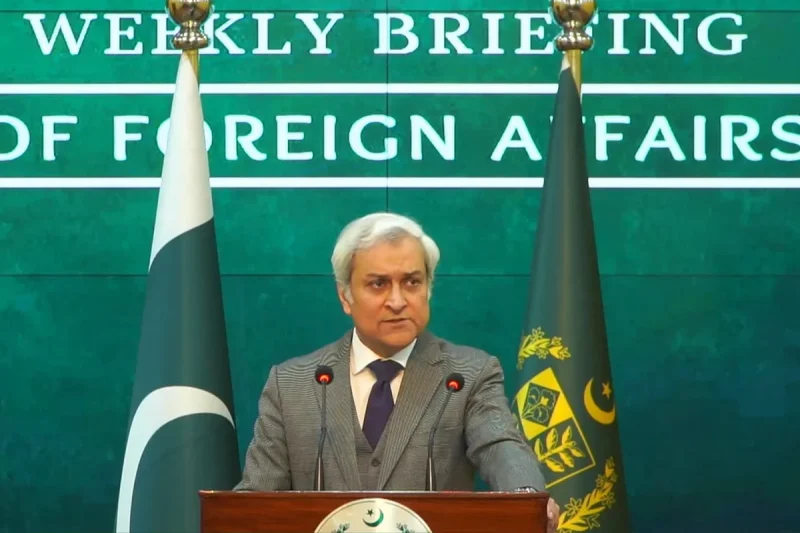
ISLAMABAD, Jan 1 (APP): Pakistan on Thursday firmly reiterated its support for the unity, sovereignty, and territorial integrity of Yemen, urging all parties to pursue dialogue and diplomacy to achieve a lasting peaceful settlement, while warning against any unilateral actions that could escalate tensions and destabilize the region.
Foreign Office spokesperson Tahir Andrabi, in his weekly press briefing, said that last evening, Prime Minister Shehbaz Sharif held a telephone conversation with Prince Mohammed bin Salman bin Abdulaziz Al Saud, Crown Prince and Prime Minister of the Kingdom of Saudi Arabia.
Both leaders reaffirmed their shared commitment to further strengthening of the long-standing fraternal bonds between both countries that had attained new heights during recent months.
The two leaders also discussed and exchanged views on the regional situation and current developments. The prime minister emphasized upon the need to maintain unity and harmony among the ranks of the Ummah, in the midst of various current challenges. While expressing Pakistan’s complete solidarity with the Kingdom, the Prime Minister said that it was imperative to maintain regional peace and stability through dialogue and diplomacy.
Earlier, he said Deputy Prime Minister and Foreign Minister, Senator Mohammad Ishaq Dar also held a telephone conversation Saudi Foreign Minister Prince Faisal bin Farhan. Both leaders exchanged views on the current regional situation and recent developments.
Furthermore, the spokesperson pointed out that the top leadership of Pakistan and United Arab Emirates were also in close contact this week.
President of the United Arab Emirates and Ruler of Abu Dhabi Sheikh Mohamed bin Zayed Al Nahyan undertook an official visit to Pakistan, at the invitation of PM Shehbaz Sharif.
He was accompanied by a high-level delegation, including Ministers and senior officials. The two leaders met in Islamabad and later in Rahim Yar Khan.
During these meetings, views were exchanged on bilateral cooperation and a variety of subjects. The meeting capped off a year of extensive leadership-level engagements between Pakistan and the UAE. The visit of His Highness reflects the depth of bilateral relations between the two countries shared commitment of both sides to further enhancing collaboration in key areas, including trade, investment, energy, development and regional stability.
The spokesperson informed that Speaker of the National Assembly of Pakistan, Sardar Ayaz Sadiq visited Dhaka, Bangladesh, on Wednesday to attend the State Funeral of Former Prime Minster of Bangladesh, Begum Khaleda Zia.
Speaker National Assembly visited the residence of the late former Prime Minister of Bangladesh, where he met her son, Tariq Rehman, and her daughter. He expressed grief and sorrow over the demise of Begum Khaleda Zia and conveyed condolences on behalf the people and leadership of Pakistan.
While in Dhaka, the Speaker National Assembly also met Bangladesh’s National Security Advisor Mr. Khalil ur Rehman, Advisor on Law and Justice, Mr. Asif Nazrul and Acting Chairman of BNP, Mr. Tarique Rahman.
As regards situation in Somalia, the foreign office spokesperson said that Pakistan strongly condemns any attempts to undermine the sovereignty, unity, and territorial integrity of Somalia, and rejects, in this regard, the announcement made by Israel recognizing the independence of the so-called Somaliland region of the Federal Republic of Somalia.
Pakistan reiterates its complete support for the sovereignty, unity, and territorial integrity of the Federal Republic of Somalia, as well as for all efforts aimed at achieving lasting peace and stability in the country.
Pakistan also reiterates its unequivocal rejection of any steps aimed at the forced displacement of Palestinians from their land under any circumstances, and reaffirms its unwavering support for the Palestinian people in their just struggle for self-determination and for a sovereign, independent Palestinian state based on pre-1967 borders, with Al-Quds Al-Sharif as its capital.
Deputy PM Ishaq Dar joined the Foreign Ministers of Algeria, Comoros, Djibouti, The Gambia, Egypt, Kuwait, Iran, Iraq, Jordan, Libya, Maldives, Nigeria, Oman, Palestine, the State of Qatar, Saudi Arabia, Somalia, Sudan, Türkiye, Yemen, and the Organization of Islamic Cooperation, in issuing a joint statement underscored unequivocal rejection of Israel’s recognition of the “Somaliland” region of the Federal Republic of Somalia, condemnation in the strongest terms of such recognition, which constitutes a grave violation of the principles of international law and the United Nations Charter, full support of the sovereignty of the Federal Republic of Somalia, recognition of parts of states constitutes a serious precedent and threatens international peace and security, and violates the cardinal principles of international law and the United Nations Charter, and full rejection of any potential link between such measure and any attempts to forcibly expel the Palestinian people out of their land, which is unequivocally rejected in any form as a matter of principle.
As regards situation in Afghanistan, he said since the closure of the border, Pakistan;s embassy and consulates have constantly been in touch with the Pakistani nationals in Afghanistan, including students, who sought assistance for their repatriation.
“Our Missions are also in contact with the Afghan authorities regarding their safety and wellbeing, and are coordinating with our relevant authorities to ensure their safe return,” he added.
As of now, 15 students and 291 individuals, who were in contact with our Embassy, have safely returned to Pakistan, for which our Embassy undertook requisite coordination with local authorities and offered necessary assistance.
To a question, the spokesperson said Pakistan will continue to adhere to the One-China principle and regard Taiwan as an inalienable part of China. “We urge relevant countries to abide by their historical commitments, take steps to foster peace, security and development in the Taiwan Strait and the broader region and refrain from measures that may aggravate tensions or undermine peace and stability in the region.”
To another question, he said reports regarding Indian plans to construct Dulhasti State-II Hydroelectric Project on the Chenab River raise serious concerns as no prior information or notification was shared with Pakistan with regard to this project as mandated under the Indus Waters Treaty (IWT) of 1960.
He said Pakistan called upon India to urgently return to treaty compliance and respond to the queries raised by our Indus Waters Commissioner in his latest as well as earlier communications.