ISLAMABAD, Jan 8 (APP): Pakistan on Thursday calling out India's continued policies of coercion, extrajudicial killings and marginalisation of minorities, said that no amount of bluster could divert attention or conceal India's role in the disruption of peace, exporting terrorism into Pakistan, and interference in the internal affairs of neighboring states. "New Delhi's fixation on Pakistan cannot conceal its own role as a serial disruptor of peace. India has carried …
No amount of bluster can conceal India’s role as a disruptor of peace, terrorism exporter: FO
ISLAMABAD, Jan 8 (APP): Pakistan on Thursday calling out India’s continued policies of coercion, extrajudicial killings and marginalisation of minorities, said that no amount of bluster could divert attention or conceal India’s role in the disruption of peace, exporting terrorism into Pakistan, and interference in the internal affairs of neighboring states.
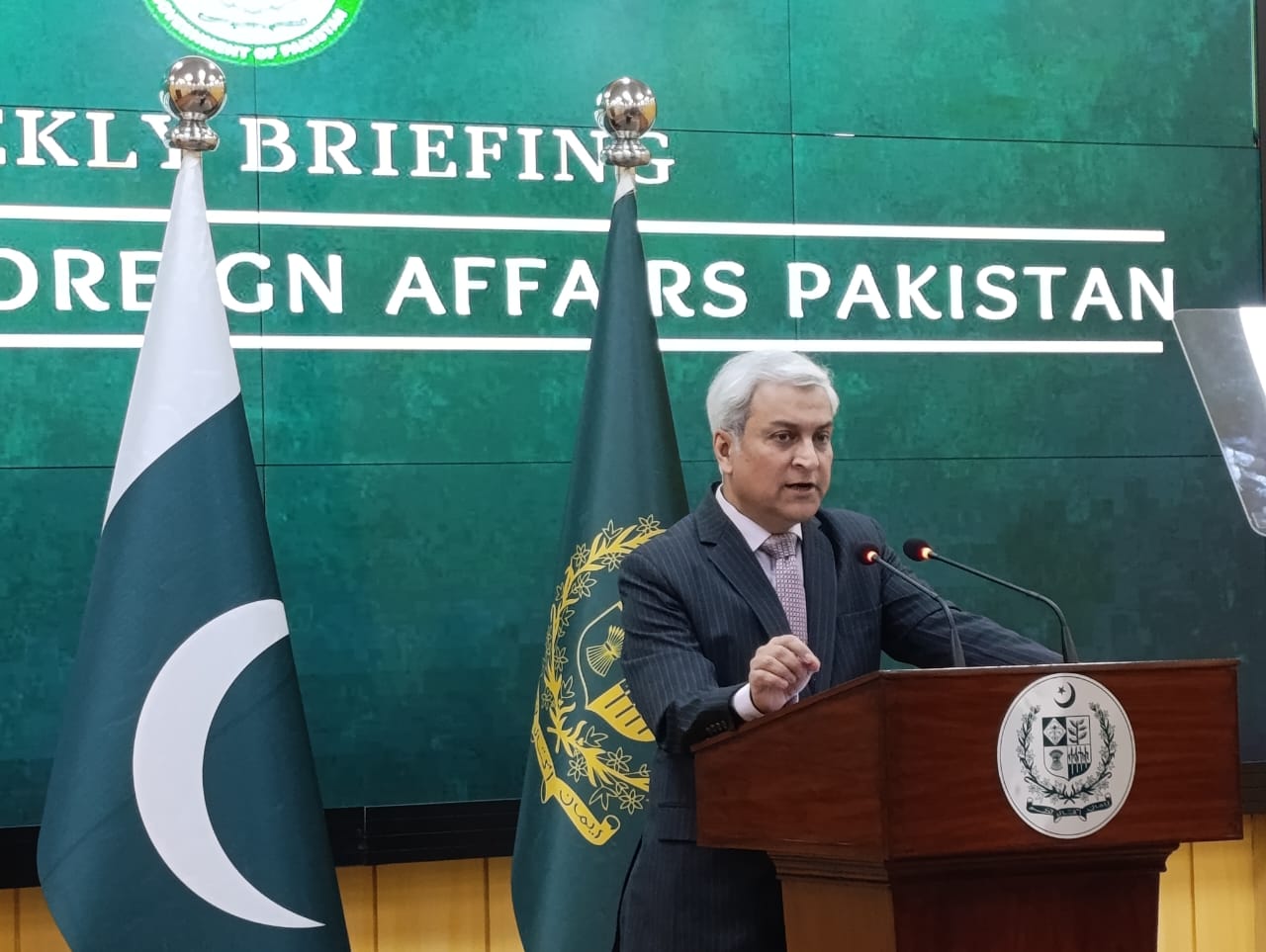
“New Delhi’s fixation on Pakistan cannot conceal its own role as a serial disruptor of peace. India has carried out extrajudicial killings abroad, interfered in the internal political affairs of neighbouring states, exported terrorism into Pakistan…For smaller states in the region, India too has been a source of coercion rather than cooperation while minorities within its borders face escalating intimidation and repression,” Foreign Office spokesperson Tahir Andrabi said in his weekly press briefing.
Rejecting the recent statement by the Indian External Affairs minister against Pakistan, he said that India’s record as a neighbour was marked by the promotion of terrorism and contributions to regional instability and the statement constituted a blatant attempt to divert attention from the recently surfaced documentary evidence indicating that New Delhi sought a third country’s intervention to secure a ceasefire with Pakistan during the May conflict.
The spokesperson also condemned the demolition of Faiz-e-Elahi mosque in India, which reflected a very systemic and deliberate campaign by the RSS-BJP nexus to target and erase the Muslim heritage across India, also referring to the destruction of Babri Mosque in 1992 by extremist mobs.
He told the media that numerous other historic mosques now faced similar threats of desecration or demolition and called upon the United Nations and international community to take serious notice of this alarming rise in Islamophobia, hate speech and hate-motivated violence in India.
The spokesperson highlighted that India had made consistent efforts to silence the genuine leadership of the Kashmiri people and muzzle the media.
“The number of Kashmiri political prisoners in prison is ever-increasing, and a number of political activities have been outlawed by the authorities. The profiling and harassment of innocent Kashmiris, arbitrary detentions, and the so-called cordon-and-search operations have become a norm in the occupied territory.”
He said that India’s illegal and unilateral actions of 5th August 2019 represented a blatant attempt to consolidate the illegal occupation through demographic engineering in IIOJK.
He said that such measures were designed to systematically transform the Kashmiri people into a disenfranchised community in their own homeland, in clear violation of international law and the principles of self-determination.
Discussing the Afghanistan issue, the spokesperson reiterated Pakistan’s demand for a verifiable and written assurance from Afghan Taliban regime that their terrorist outfits and their individual nationals would not be allowed to carry out terror activities inside Pakistan.
He said that despite no such assurance from the Afghan side, Pakistan wished to engage positively with Afghanistan in bilateral and multilateral frameworks, including the trilateral framework with China.
“Our demand is very simple, and it is not something that is against the basic responsibility of any nation-state: that terrorist elements or its own nationals should not be part of terrorism in other countries.”
He said that the bilateral diplomatic channels with Afghanistan were open and the embassies and consulates were functioning to carry out routine diplomatic exchanges.
Asked about the Pakistan-Bangladesh-China mechanism, he said Pakistan looked forward to positive outcomes to promote regional and sub-regional cooperation and that the consultations would continue in the future to strive for outcomes beneficial for the peace, progress, and prosperity.
Coming to Iran, he said that Pakistan had firmly opposed the use of force and escalation against Iran and the imposition of sanctions in the recent past. However, regarding the ongoing protest demonstrations, he said that Pakistan never interfered in the internal affairs of other countries.
Spokesperson Andrabi told the media that Pakistan had very firmly and categorically rejected the recognition of Somaliland territory by Israel or any attempt to seek division of Somalia.
He said that Pakistan had opposed it in national capacity and also in different multilateral forums, including the OIC and the UN Security Council, and would also through the joint statement issued at the level of foreign ministers by a number of African and Middle Eastern countries.
Responding to a query, the spokesperson remarked that Pakistan was committed to protection of Chinese nationals who were here on important economic projects and that the country would continue its projects contributing to relations, and economic development.
Andrabi told the media that Indus Waters Treaty remained a binding international instrument with no provision for abeyance and any project built on all three rivers was subject to scrutiny.
He also apprised the media of Deputy Prime Minister and Foreign Minister Ishaq Dar’s visit to China and his telephonic discussions with foreign ministers of Myanmar, Indonesia, Egypt, Malaysia, Turkiye, UAE and Saudi Arabia and Foreign Advisor of Bangladesh wherein he discussed the regional development and bilateral cooperation while highlighting the need for dialogue and diplomacy in regional and international issues.
He said Minister of Economy of Azerbaijan Mikayil Jabbarov held a telephone discussion with the DPM Dar to discuss the realization of Azerbaijan’s investment of US$2 billion in Pakistan. Both sides agreed to finalize the mechanism in this regard, allowing Azerbaijani investment in the identified sectors of the Pakistan economy, he added.