
ISLAMABAD, Dec 04 (APP): Experts and policy leaders Thursday underscored the urgent need for deeper regional cooperation in South Asia to tackle economic vulnerabilities and mounting climate challenges, as the Islamabad Conclave-2025 continued its second day at the Institute of Strategic Studies Islamabad (ISSI). The Centre for Strategic Perspectives (CSP) hosted Session IV titled “Regional Cooperation on Economy and Climate Change,” featuring an eminent panel of speakers including Haroon Sharif, …
Islamabad Conclave: Experts call for stronger regional cooperation on economy, climate action
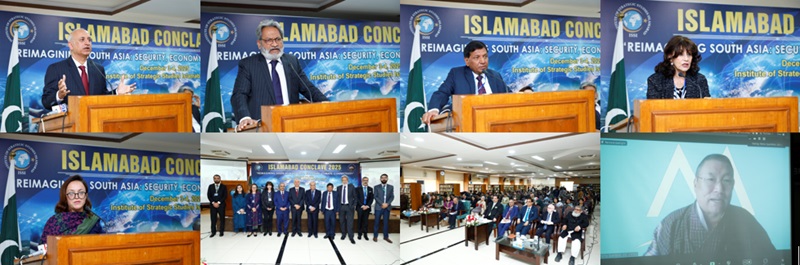
ISLAMABAD, Dec 04 (APP): Experts and policy leaders Thursday underscored the urgent need for deeper regional cooperation in South Asia to tackle economic vulnerabilities and mounting climate challenges, as the Islamabad Conclave-2025 continued its second day at the Institute of Strategic Studies Islamabad (ISSI).
The Centre for Strategic Perspectives (CSP) hosted Session IV titled “Regional Cooperation on Economy and Climate Change,” featuring an eminent panel of speakers including Haroon Sharif, Former Minister of State and Chairman, Board of Investment; Dr. Safdar Sohail, Executive Director, Social Policy Resource Centre (SPRC); Dr. Pema Gyamtsho, Director General International Centre for Integrated Mountain Development (ICIMOD); Dr. Dilli Raj Khanal, Founder Chairman of the Institute for Policy Research and Development (IPRAD); and Ms. Aisha Khan, Chief Executive of Civil Society Coalition for Climate Change (CSCCC).
The session was moderated by Dr. Neelum Nigar, Director CSP at ISSI, said a press release.
The session opened with a compelling and forward-looking keynote address by Haroon Sharif, who urged the audience to rethink South Asia’s future considering global disorder, shrinking development finance and rising regional investment risks. He emphasised that the political issues confronted few countries in the region have prevented the region from benefiting from its economic potential and argued for a brick-by-brick, results-driven approach to cooperation.
Mr. Sharif proposed a framework based on digital cooperation, climate-focused partnerships, and the inclusion of emerging economic actors, such as China and Gulf states. He stressed that bilateral water treaties can no longer address the rapidly changing Himalayan hydrology and advocated for trilateral water-management arrangements. He also called for the creation of a regional climate and development bank, driven by the private sector, to help South Asia navigate the shrinking pool of global climate finance. He closed his remarks with an optimistic message centered on youth empowerment and private sector leadership.
Dr. Safdar Sohail highlighted the deep link between industrial policy and climate action, noting that South Asia cannot move towards regional integration without modernising its domestic industries. He underscored Pakistan’s weak alignment between climate and industrial policy and pointed to global measures like the EU’s Carbon Border Adjustment Mechanism (CBAM) as emerging non-tariff barriers. He stressed the need for regional technology transfer, greener value chains and coordinated industrial transition.
Dr. Pema Gyamtsho drew attention to the severe trans boundary impacts of climate change across the Hindu Kush Himalaya region. He stressed that nature remains South Asia’s most important economic asset and called for integrating natural capital into planning frameworks. He advocated for shared data platforms, joint early-warning systems and coordinated resilience investments that benefit both mountain and downstream communities.
Dr. Dilli Raj shared Nepal’s experience with hydro power exports, carbon markets and community forest management. He noted that despite domestic progress, the gap between national climate commitments and available financing continues to widen. He emphasised the need for regional pathways focused on clean energy transition, green growth and low-carbon industries.
Ms. Aisha Khan highlighted climate change as the region’s most pressing security threat, with melting glaciers, shifting monsoons and water scarcity increasingly overshadowing geopolitical tensions. She warned that unmanaged water stress could escalate into future conflict. She proposed the formation of a South Asian climate agreement and a regional climate finance mechanism, stressing the need to reframe cooperation around human well being and ecological stability.
The discussion was followed by an interactive Q&A session, where participants engaged speakers on water governance, climate resilience and regional cooperation. The session concluded with Ambassador Khalid Mehmood, Chairman Board of Governors, ISSI, presenting commemorative mementos to the speakers, marking the close of a highly engaging and forward-looking session.