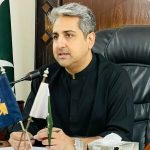
ISLAMABAD, Nov 03 (APP): Federal Minister for Energy Sardar Awais Ahmad Khan Leghari on Monday said that Pakistan’s power sector has entered a new era of structural reforms aimed at ensuring affordability, transparency, and sustainability. He said the government has taken bold steps to reduce electricity prices, modernize the system, and end decades of inefficiency and circular debt accumulation. Addressing a press conference along with Finance Minister Muhammad Aurangzeb, Information …
Historic power sector reforms to reshape Pakistan’s energy future: Leghari

ISLAMABAD, Nov 03 (APP): Federal Minister for Energy Sardar Awais Ahmad Khan Leghari on Monday said that Pakistan’s power sector has entered a new era of structural reforms aimed at ensuring affordability, transparency, and sustainability.
He said the government has taken bold steps to reduce electricity prices, modernize the system, and end decades of inefficiency and circular debt accumulation.
Addressing a press conference along with Finance Minister Muhammad Aurangzeb, Information Technology Minister Shaza Fatima Khawaja, Federal Board of Revenue (FBR) Chairman Rashid Mahmood Langrial and Adviser to the Prime Minister on Privatisation Muhammad Ali, he said the government had inherited a crisis-hit power sector with soaring generation costs, high capacity payments, and an unprecedented level of circular debt.
He noted that the sharp devaluation of the rupee—from Rs100 to nearly Rs300 against the US dollar—along with high interest rates, added about Rs8 per unit to the cost of electricity.
“Despite these inherited challenges, we successfully reduced power tariffs by Rs10 to Rs10.5 per unit within 18 months,” he stated, adding that industrial consumers were now receiving electricity at Rs26 per unit, while commercial tariffs had also been significantly lowered.
He noted that the government has slashed electric vehicle charging tariffs from Rs. 71 to Rs. 39 per unit, while industrial power rates have been cut by Rs. 16 per unit.
Leghari said the government’s foremost priority, under the vision of Prime Minister Shehbaz Sharif, was to provide affordable electricity to the public while stabilizing the sector’s finances.
Leghari said the government has also reduced the circular debt, with a plan to clear the circular debt of Rs1.2 trillion without putting extra burden on the consumers in the next six years.
He said one of the government’s key achievements was ending its role as the sole buyer of electricity — a reform pending for over 20 years. “For the first time in Pakistan’s history, the government has exited the business of buying power.
Industries and institutions will now purchase electricity directly from producers, ensuring fair competition and better prices,” he said, calling it a landmark deregulation step comparable to the telecom sector reforms of the early 2000s.
The minister said that the government’s restructuring drive had significantly reduced distribution losses — from Rs580 billion to Rs193 billion in one year — citing improved governance and professional management at power distribution companies.
He added that depoliticized and merit-based boards had been appointed across all entities, breaking the culture of bureaucratic control and political interference.
Leghari highlighted that 27,000 tube wells across the country were being solarized, with federal and provincial governments sharing the cost — a move expected to save Rs40 billion annually.
He said automation of feeders, transformers, and meters was underway, and within three years, all metering systems would be digitalized, enabling real-time monitoring and consumer convenience through online payment and service apps.
The minister said that the creation of the Competitive Trading Bilateral Contract Market (CTBCM) and the Power Planning and Monitoring Company (PPMC) had institutionalized reforms and brought transparency and efficiency to operations.
“This is the largest energy market reform in Pakistan’s history. Future governments cannot reverse it — they can only build upon it,” he asserted.
He further announced that the government’s Integrated Generation Capacity Plan (IGCEP 2025–34) would guide the next decade’s energy mix — balancing solar, wind, hydel, nuclear, and transmission investments — to prevent future overcapacity and unnecessary expenditures.
“For the first time, power planning is based on data, demand, and sustainability rather than politics,” he remarked.