Chairman of the Kashmir Institute of International Relations, Altaf Hussain Wani, has called for the establishment of an International Commission of Inquiry to investigate crimes against humanity in Indian occupied Kashmir (IOK).
Wani calls for International Commission of Inquiry into crimes against humanity in IIOJK
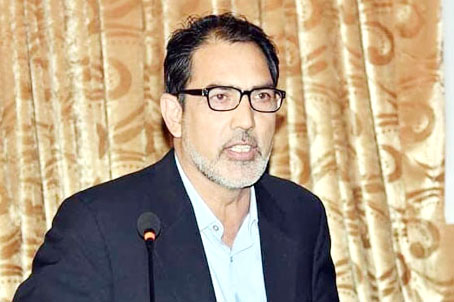
ISLAMABAD, Mar 18 (APP):Chairman of the Kashmir Institute of International Relations, Altaf Hussain Wani, has called for the establishment of an International Commission of Inquiry to investigate crimes against humanity in Indian occupied Kashmir (IOK).
He made these assertions while addressing the 61st session of the United Nations Human Rights Council (UNHRC) during the Item 4 General Debate, where he represented the World Muslim Congress, received a press release here on Wednesday.
Referring to the genesis of the Kashmir dispute, Wani said it was deeply unfortunate that binding United Nations resolutions recognizing Kashmir as a disputed territory have been ignored for more than seven decades.
“The right to the final disposition of Kashmir has been taken away from Kashmiris by force,” he said, adding that what he described as a systematic machinery of terror continues to operate with metronomic precision.
Highlighting what he termed systematic repression, Wani stated that enforced disappearances have resulted in thousands of “half-widows.” He further pointed to the existence of mass graves across the valley, containing the tortured and unidentified bodies of innocent Kashmiris, as evidence of state repression.
He also alleged that pellet shotguns have been deliberately used against children, with hundreds reportedly blinded—an act he said reflects the callousness of the occupying forces. “These are not aberrations but calculated instruments of state policy,” he asserted.
Discussing the economic impact of the conflict, Wani claimed that Kashmir’s natural resources—including rivers, minerals, and forests—are being exploited to benefit the occupying power while imposing engineered poverty on the local population.
He described this as a colonial-style model of resource extraction.
Calling Kashmir an internationally recognized dispute, he emphasized that “sovereignty confers no license for genocide.”
Wani also criticized what he described as the silence of powerful states, saying they often prioritize economic interests over human rights. “Their inaction forges chains of complicity. The impunity granted today becomes tomorrow’s template for atrocities,” he said.
He added that the people of Kashmir have resisted for decades, refusing to surrender their identity or dignity. “They demand only the right to determine their own destiny,” he remarked.
Concluding his address, Wani said, “The mass graves and blinded children demand that witnesses act now—or stand condemned by their own inaction.”