UNITED NATIONS, Mar 11 (APP):Pakistan has underscored the need to address foreign military occupation of parts of Syria, air strikes and terrorism to “enable a conducive environment for resolution of chemical-weapons-related issues" in the country. "The risk of terrorism and presence of foreign terrorist fighters also pose a challenge to the country’s security and affect the verification activities of the Organization for the Prohibition of Chemical Weapons (OPCW)," Ambassador Usman …
Pakistan welcomes Syria’s pledge to implement Chemical Weapons Convention & destroy such munitions
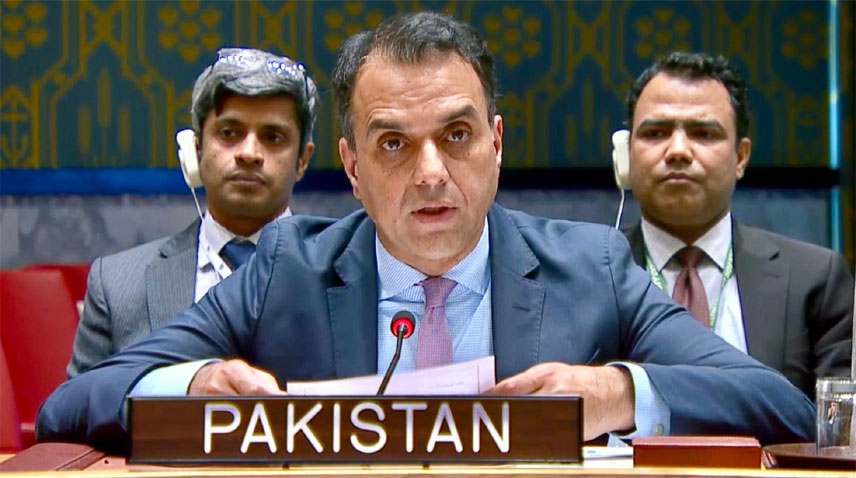
UNITED NATIONS, Mar 11 (APP):Pakistan has underscored the need to address foreign military occupation of parts of Syria, air strikes and terrorism to “enable a conducive environment for resolution of chemical-weapons-related issues” in the country.
“The risk of terrorism and presence of foreign terrorist fighters also pose a challenge to the country’s security and affect the verification activities of the Organization for the Prohibition of Chemical Weapons (OPCW),” Ambassador Usman Jadoon, deputy permanent representative of Pakistan to the UN, told the UN Security Council, which discussed the situation in the Middle East (Syria/Chemical Weapons).
Syria has been mired in conflict since 2011, when protests during the wider Arab Spring escalated into a civil war involving the Government of Bashar al-Assad, opposition groups and various foreign actors. After more than a decade of fighting, the Assad Government collapsed in late 2024, ending his family’s decades-long rule.
Meanwhile, the international community continues to press the new authorities in Damascus for clarity over the country’s past chemical weapons programme under the oversight of the Organization for the Prohibition of Chemical Weapons (OPCW), the body responsible for implementing and enforcing the Chemical Weapons Convention (CWC).
In his comments, the Pakistani envoy appreciated Syrian authorities’s commitment to fully implement the CWC and its cooperation to secure suspected chemical weapons sites and address outstanding issues. The OPCW Technical Secretariat must continue to be enabled to carry out its independent verification to eliminate suspected chemical weapons in Syria and any risks of proliferation, in compliance with the CWC.
Enhancing the capacity of Syrian authorities would contribute to the work of the OPCW including in declaration, investigation, analysis and verification on expedited basis, Ambassador Jadoon said.
“We hope that the continued engagement between the Technical Secretariat and Syrian authorities will further build on the positive momentum to resolve all outstanding issues at the earliest.”
At the same rime, Ambassador Jadoon strongly supported Syria’s unity, sovereignty and territorial integrity, noting that important opportunities have come up to advance reconciliation, recovery, peace and stability in the country.
“It is imperative to turn these opportunities into concrete progress on the ground through inclusive political process, international engagement and support,” he added.
Briefing the 15-member Council, Adedeji Ebo, Director and Deputy to High Representative for Disarmament Affairs, reported that the Office for Disarmament Affairs has been in regular contact with the OPCW Technical Secretariat and he held a meeting last week with Syria’s UN representative.
In this month’s report, the OPCW Technical Secretariat reiterates that, in addition to the 26 declared sites, “information made available to the OPCW suggests that there are more than 100 other sites that may have been involved in the previous Government’s chemical-weapons-related activities”. The Technical Secretariat plans to visit all these locations.
Based on the information gathered through OPCW deployments in 2025, “at least two locations visited by the OPCW could be declarable under the Chemical Weapons Convention”, he said. Unfortunately, further site visits are currently on hold, given the conflict in the region.
However, OPCW teams continue to conduct interviews and review documents until the security situation becomes more permissive, Ebo said.
From 27 to 29 January, he said, the Technical Secretariat and the Syrian National Authority visited a location in the Aleppo area to assess potentially undeclared elements of the chemical weapons programme developed by the previous Government, including “storage containers for chemical precursors and 75 undeclared cylinders”.
The cylinders were no longer present at the site, but, on 29 January, the OPCW team visited a scrapyard and observed pieces that may have been part of the gas cylinders, he said, welcoming the continued cooperation by the Syrian National Authority with the Technical Secretariat.