
Planning minister directs ‘proactive analysis’ of demand & stocks to maintain prices of essential items
Planning minister directs ‘proactive analysis’ of demand & stocks to maintain prices of essential items
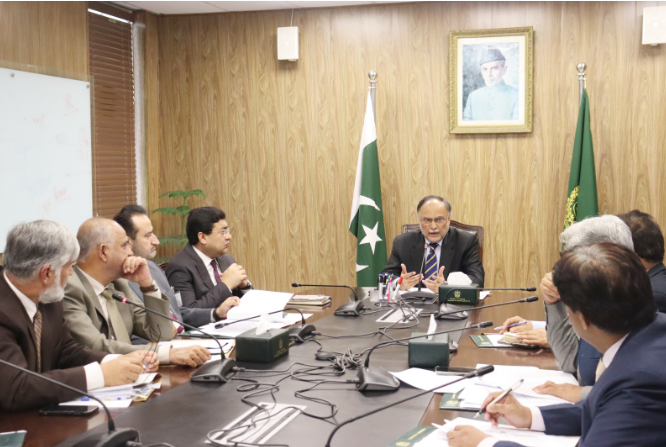
ISLAMABAD, Nov 05 (APP): Minister for Planning, Development and Special Initiatives Professor Ahsan Iqbal on Tuesday directed the quarters concerned to conduct ‘proactive analysis’ of demand and stocks to maintain prices of essential commodities on a regular basis, especially during high-demand seasons like Ramazan and Eid-ul-Azha.
“Preparation for these high-demand seasons should anticipate potential supply pressures to prevent market disruptions and price spikes,” he said while chairing a meeting of the National Price Monitoring Committee (NPMC).
The meeting was attended by senior officials, including Additional Secretary Planning Kamran Rehman, Economic Advisor Dr Imtiaz Ahmed, Chief Statistician Dr Naeem Uz Zafar, Joint Chief Economist, Deputy Commissioner ICT, Deputy Commissioner (MP & FP), and representatives from the Ministry of Food and provincial governments, according to a news release.
The minister also instructed local market committees to play an active role in monitoring demand and supply, ensuring adequate availability of essential commodities.
The NPMC gave every Deputy Commissioner task to maintaining oversight of district-level stock levels to avert shortages.
The committee reviewed recent inflation data, particularly in food and essential commodities, using insights from the Pakistan Bureau of Statistics (PBS) on the Consumer Price Index (CPI).
Ahsan Iqbal emphasized the need for data-driven strategies in price monitoring, advocating for detailed reports on inflation drivers to facilitate targeted interventions.
In October 2024, non-perishable food items experienced a controlled rise of 1.01% as compared to previous month and a decrease of 1.46% if compared to last year October 2023.
Major decrease observed in the prices of wheat flour (-34.73%), sugar (-9.15%) and cooking oil (-10.2%).
Overall, the food inflation reflecting high stability in the prices declined from 28.9% in October 2023 to 2.7% in October 2024 in Urban and declined from 28.6% in October 2023 to 0.6% in October 2024 in Rural area.
Additionally, the transport sector and fuels category saw a declining trend (-6.13%) due to mainly decline in Petrol and diesel (-18.5%) if compared with October last year.
Acknowledging PBS’s capability in providing monthly snapshots of district-level prices, the minister urged provincial chief secretaries to conduct regular price evaluations at the district level in collaboration with PBS.
He emphasized the need to avoid duplicated efforts by coordinating closely with PBS for data-driven decisions and effective price control.
With recent reductions in fuel prices, he underscored the importance of adjusting transport fares to reflect these decreases, ensuring the public benefits from reduced transportation costs across markets.
The committee examined discrepancies between wholesale and retail prices in various regions, with a directive to establish a database for Chief Ministers’ review.
This initiative aims to improve transparency, curb profiteering, and bring greater stability to consumer prices at the local level.
Ahsan Iqbal highlighted the importance of a structured business plan for agriculture, urging the establishment of national production targets to align with domestic needs and export potential. “Each crop should have a clear business model with annual targets, mirroring practices in developed countries.”
Recognizing the need for specialized expertise, he recommended appointing a permanent agriculture economist to guide crop planning and economic projections.
Furthermore, he called for enhancing value addition in dairy and agricultural products, particularly in high-potential items like milk, fish, mangoes and poultry aimed at developing Pakistani brands for both domestic and international markets.
He reiterated the critical role of data analytics in future planning and urged all provincial and federal units to fully utilize PBS data, enabling informed decisions for price stability and productivity improvements across sectors. Efficient data usage, he noted, was essential to achieving economic resilience and supporting the public amidst inflationary challenges.