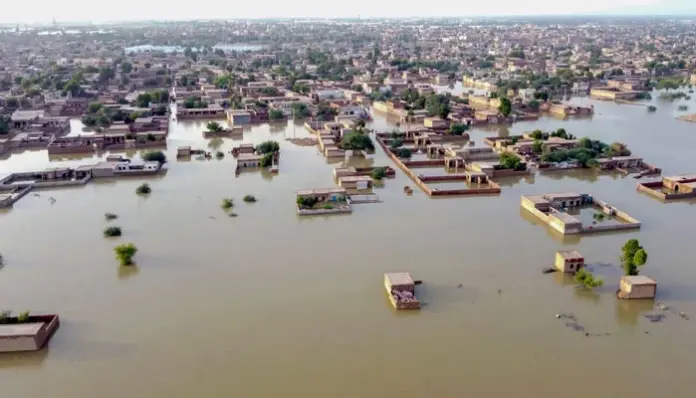
ISLAMABAD, Aug 23 (APP): The experts at a stakeholder dialogue advocating the importance of data for development, and resilience on Friday underscored that urban centers of the country are facing increasing risk of growing vulnerability due to climate disasters amid rising trends of urbanization and poor land use planning.
The Sustainable Development Policy Institute (SDPI), United Nations Population Fund (UNFPA), and Forman Christian College University (FCCU) organised a dialogue titled ‘Data for Development (D4D) Climate Change, Mega Cities and Urban Floods.
Chairman Public Accounts Committee (PAC), Punjab Assembly, MPA Ahmed Iqbal says that not only policymakers but every citizen is facing the brunt of climate change.
“Climate change is a reality and it’s a young people’s issue as the more younger an individual is the more the impacts of climate change would be faced by him or her,” he added.
Lahore, he said is the biggest mega urban center in Punjab and it’s the center of policy making and decisions of the government. “Apart from that Lahore is facing massive risk of climate disasters whereas rural to urban shift is also increasing in the province. Many villages in the province have been drowned due to recent monsoon rainfalls,” Ahmed Iqbal said. He suggested that the provincial government should think of innovative incentives like tax rebates for green roof surface households, and enhanced funding for rainwater harvesting recharging wells to control urban flooding. But, without data, there is no possibility to achieve any outcome or objective in the realm of climate governance, he added.
Dr Abid Suleri, Executive Director, SDPI says plastic pollution is a crucial part of urban flooding as in developing countries plastic bags are choking the drainage systems leading to urban flooding. “We are living in unprecedented times and witnessing abnormal rain as many megacities across the world are receiving a year’s rainfall in 3-4 days. The temperature in the Federal Capital is three degrees higher on average than the past 52 years average,” Dr Suleri said.
Dr. Jonthan Addleton Rector, FCCU said data for development and decision-making is crucial amid climate change and urban flooding hazards. He mentioned that the urban flooding aspect in Lahore was common, and it was not a theoretical issue for Pakistan as it had received disastrous floods in the past.
Tania Durrani, Development Professional at UNFPA claimed that the institute is working on core areas of population management, reproductive health, ending child marriages and gender disbalance, and reaching out to the most vulnerable groups mainly women, children, and persons with disabilities. She underlined that the agency is working with diverse stakeholders and academia to generate data that can influence programs and policies in cross-sectoral domains as gender-segregated data is important to ensure inclusive development initiatives.
Dr Sajid Amin, Deputy Executive Director, SDPI while introducing the D4D initiative said no development is possible without efficient data and information, whereas the role of Federal and Provincial governments is very important in data development with the latter sharing the most burden of responsibility due to implementation prerogative enshrined under the constitution. He added that under the D4D initiative, the basic purpose was to build capacity of the public sector to develop the ability to create, use, and integrate data into policy designs.
Dr Sana Bashir, Deputy Secretary, Environment Prediction Department provided a comprehensive presentation on the efforts of the department in generating and collating the data on climate and its implications on decision-making efforts.
Irfan Ali Khan, DG Provincial Disaster Management Authority (PDMA) Punjab in his keynote address said urban flooding has been a serious risk in the major urban centers of the country and the province. “Rapid urbanization in the last two decades and poor land use planning was the core of the issue of urban flooding. In 2022, Pakistan witnessed the most devastating floods of its history that inflicted massive life, property, and infrastructure losses. There were numerous cases of structural collapses due to 30% above normal monsoon rainfall this year,” he said. He informed that at the PDMA level, urban flooding had emerged as a challenge, whereas the provincial government is utilizing all available resources to enhance preparedness against monsoon rainfall.
Muhammad Omar Masud CEO, Urban Unit says, that the cities across Pakistan are mostly unplanned which would allow climate change to massively impact cities and a large population residing in it. There was data present in silos across various sectors of the country but there were issues of data coordination, sharing, and collation with a culture of resistance towards data sharing as a weakness, he said.
Dr. Rabiya Chaudhry Assistant Professor, CPPG, FCCU said urban flooding is a pluvial flood caused by rainfall and is independent of seas and rivers whereas in Lahore it was because of heavy rainfall during monsoon season.
She underscored that average rainfall has not increased but the pattern has changed as Lahore can accommodate 40mm of rainwater per day and on 26th June 2024 there was 161.8 mm of rainfall which was four times more than the capacity of Lahore, in July 2023, there was a 206mm rainfall took place. “Due to more expansion of road infrastructure and tree cutting the city has become a heat sink, whereas the population statistics are surging with 25,000-30,000 people entering Lahore every month which is burdening the existing housing and municipal facilities in the mega city,” she added.
Dr. Waqas, Pro-Rector BUITEMS said Balochistan province has a scattered population, however, its mega urban center of Quetta is facing similar challenges like that of faced by Lahore and Karachi. “It is facing plastic pollution, no waste management, and urban issues. However, there is a lack of planning, reliability, and authenticity of data, and integrated platforms that demanded data collection, integrated data set with availability to all departments to ensure development through data,” he said.
Dr. Sikandar Hayat Dean, Social Sciences in his vote of thanks said climate change-induced challenges are becoming increasingly urgent and demanding prompt action from all stakeholders to address the risks.