Sports festival at Shahnaz Sheikh Hockey Stadium to continue till June 12
RAWALPINDI, Jun 02 (APP): A sports festival started here on the directives of Commissioner Rawalpindi Division Engineer Aamir Khattak at Shahnaz Sheikh Hockey Stadium would continue till June 12.
According to a district administration spokesman, the festival was organized in collaboration with Municipal Corporation and District Sports Department.
The festival kicked off on Friday would continue till June 12 at the Shahnaz Sheikh Hockey Stadium, Rawalpindi and Hockey, Football, Taekwondo, Badminton, MMA (International Event), a demonstration of pentathlon, kung fu, gymnastics and other games would be organized under the festival.
The organization of the sports festival is being appreciated by the citizens and they urged the administration that such healthy activities should regularly be organized.
11 temporary cattle markets to be set up in Rwp district to facilitate citizens
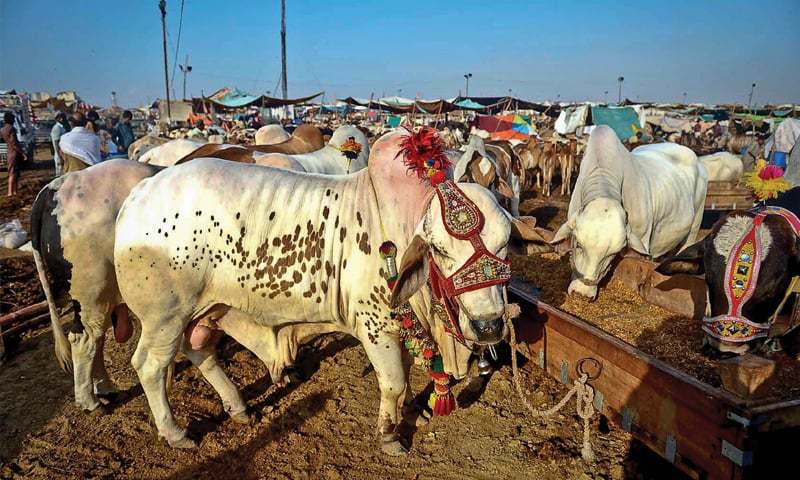
RAWALPINDI, Jun 02 (APP): District administration Rawalpindi is finalizing all the arrangements to set up 11 temporary cattle markets in connection with Eid-ul-Adha in different tehsils of the district.
According to a district administration spokesman, all possible facilities would be provided in the cattle markets which would be fully functional 10 days before Eid-ul-Azha.
Three cattle markets would be established in Cantt areas at Bhatta Chowk near Koh Noor Mill, Al-Haram City Mouza Misriot and Gulistan Colony near National Park Rawalpindi.
A cattle market would be at Khayaban-e-Sir Syed, Sector 2 in city area while a cattle market would also be established at Rawat in Saddar division area.
A cattle market would be in Tehsil Gujar Khan at Majeed Mor outside Prism Town main GT Road, he said adding, two cattle markets would be established in Tehsil Taxila at New Sharif Hospital main GT Road and HIT near Sunday Bazaar in Taxila Cantt.
Two mandis of the sacrificial animals to facilitate the residents of Tehsil Kallar Syedan and Kahota would also be set up, he added.
He informed that a temporary cattle market would be established in connection with Eid-ul-Azha at Mangal Bypass cattle sale point in Tehsil Kallar Syedan while a mandi would be in Tehsil Kahota at Sakhi Sarwar Tingi Road.
The Rawalpindi Cantonment Board (RCB) has auctioned fee collection the cattle market in Bhatta Chowk for Rs109.9 million.
The entry fee for sacrificial animals such as cows, bulls and camels in the market has been fixed at Rs3,000 each, and for goats and sheep at Rs2,000 each.
According to a RCB spokesman, a total of 20 contractors participated in the auction, while Riaz Hussain won the contract with the highest bid compared to last year.
He said the auction was held in a transparent manner and that the contractors were informed about the facilities to be provided by the civic body. He said the contractor would collect the entry fee from the cattle sellers in the market.
“A Rs3,000 fee has been fixed for the entry of big animals and Rs2,000 for goats and sheep. RCB will provide all facilities in the biggest cattle market of the twin cities of Rawalpindi and Islamabad,” he said.
The market would be set up on modern lines where, besides water, veterinary doctors would be available to check the health of the animals.
The RCB would form teams to check illegal cattle markets in the cantonment areas, he said, adding that no vendor would be allowed to bring sacrificial animals to residential areas.
The sale and purchase of sacrificial animals on roads and streets would be banned, and all-out efforts would be made to keep the cantonment area neat and clean during Eid-ul- Azha days, he added.
He said officials concerned had been directed to strictly implement standard operating procedures (SOPs), warning that action would be taken against vendors if they violated the orders.
/395
Ban on plastic bags to be enforced from June 5
Gwadar to become internationally acclaimed world-class port city: Ahsan Iqbal
BEIJING, June 2 (APP): Federal Minister for Planning, Development, and Special Initiatives, Ahsan Iqbal said that Gwadar will become an internationally acclaimed world-class port city, which will have tremendous opportunities for its people.
“We hope that Gwadar will become an internationally acclaimed world-class port city, which will have tremendous opportunities for its people,” he told Xinhua while applauding the development of Gwadar Port under the China Pakistan Economic Corridor (CPEC).
Terming Gwadar as a very important and strategic port in this region, he said that China has shown its remarkable contribution and the development of different regions of Pakistan including Gwadar under the China Pakistan Economic Corridor.
“In Gwadar, we have seen that China has not only developed the port facility but also has contributed towards socio economic development of the people,” he added.
Ahsan Iqbal said that China has set up a state of the art modern hospital for the people of Gwadar who have as good facilities in that hospital as big cities like Karachi or Lahore.
Similarly, it has helped set up a technical training institution. It has also helped poor people with solar panels to provide them electricity and has also undertaken other initiatives to improve the lives of the local people.
“So, we really appreciate that China has contributed immensely to the uplift of Gwadar, but it is just the first steps go other port has a long way to go,” he added.
He remarked that in partnership with the Gwadar and in partnership with China, we hope that Gwadar will become an internationally acclaimed world class port city, which will have tremendous opportunities for its people.
Ahsan Iqbal pointed out that China has also given scholarships for the youth of Gwadar who are studying in Chinese universities. “So, I think China’s contribution and Gwadar has been very valuable and uplifting the lives of people and region and we appreciate very much.
The minister also appreciated that China is sharing its success, not just with Pakistan, but with other countries also, to help them improve their infrastructure to help them improve their socio-economic development.
Launched in 2013, the CPEC, a flagship project of the China-proposed Belt and Road Initiative, is a corridor linking Gwadar Port in southwest Pakistan’s Balochistan province with Kashgar in Northwest China’s Xinjiang Uygur Autonomous Region, which highlights energy, transport, and industrial cooperation in the first phase, while the new phase expands to the fields such as agriculture and livelihood, among others.
APP/asg
China’s Chang’e-6 lands on far side of moon to collect samples
BEIJING, June 2 (APP): China’s Chang’e-6 probe landed on the far side of the moon on Sunday at 6:23 a.m. Beijing Time, aiming to collect samples from the South Pole-Aitken (SPA) Basin within two days, which will be brought back to Earth, according to the China National Space Administration (CNSA).
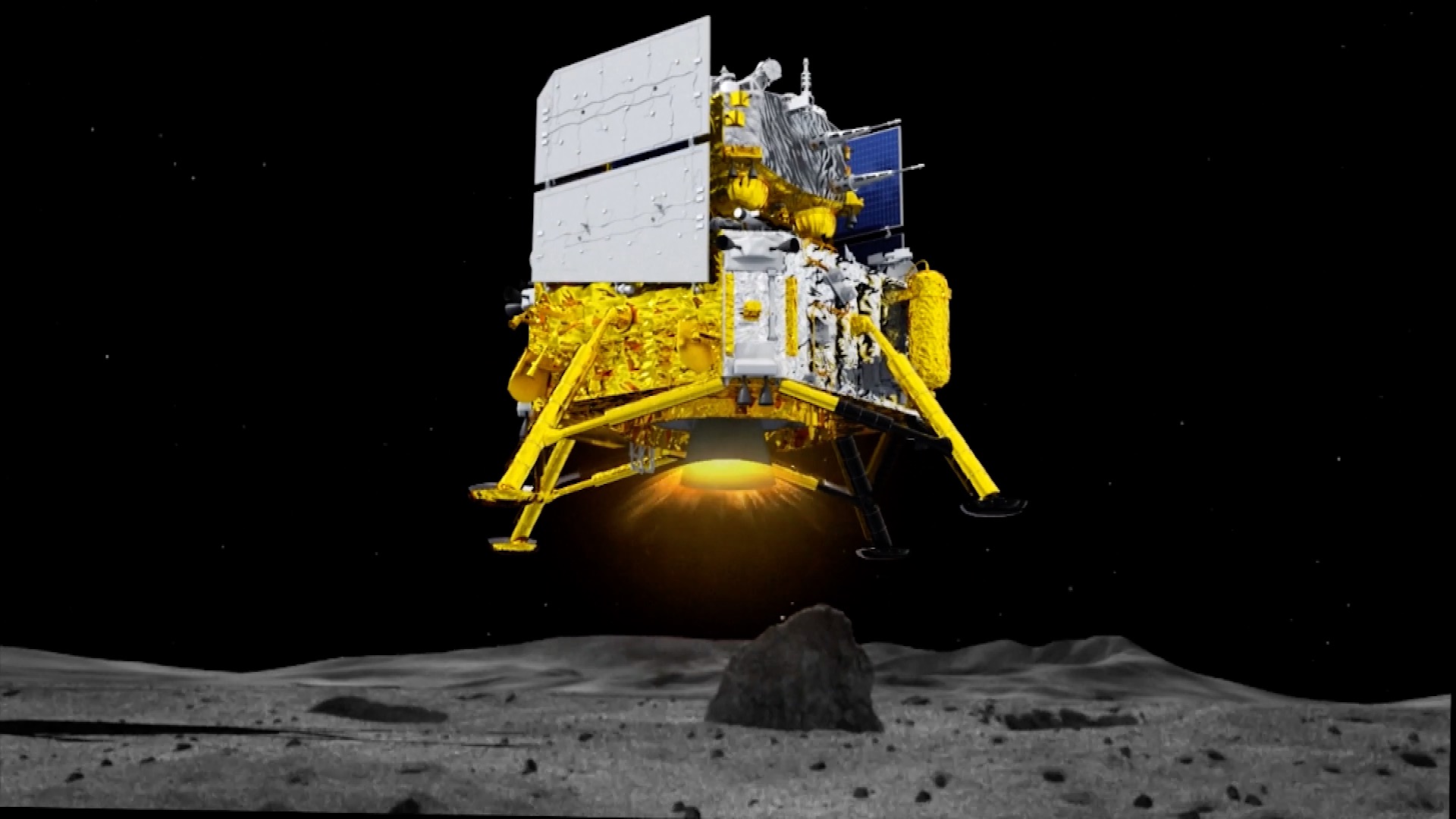
Supported by the Queqiao-2 relay satellite, the lander-ascender combination of the Chang’e-6 probe landed at the designated landing area in the SPA Basin. The mission has made technological breakthroughs, including lunar retrograde orbit design and control technology. It will go on to complete key tasks such as the intelligent, rapid sampling from the lunar far side and lunar surface take-off, said the CNSA.
The probe of Chang’e-6, which is named after the Chinese moon goddess, consists of an orbiter, a returner, a lander and an ascender. Since its launch on May 3, it has gone through various stages such as Earth-moon transfer, near-moon braking, lunar orbiting and landing descent. The lander-ascender combination separated from the orbiter-returner combination on May 30.
Lunar landing
The landing site of the Chang’e-6 is at an impact crater known as the Apollo Basin, located within the SPA Basin. The choice was made for the Apollo Basin’s potential value for scientific exploration, as well as the conditions of the landing area, including communication and telemetry conditions and the flatness of the terrain, said Huang Hao, a space expert from the China Aerospace Science and Technology Corporation (CASC).
At 6:09 a.m. on Sunday, the lander fired its 7,500-newton-thrust engine to slow down and began to descend from about 15 kilometers above the lunar surface. In this process, the cameras on the lander snapped pictures of the landing area and transmitted them to computers on the lander to identify possible hazards on the surface, such as large rocks, so that the craft could maneuver to avoid them.
At about 100 meters above the lunar surface, the combination suspended its descent and hovered for a moment to conduct accurate detection of smaller obstacles and determine the final landing spot before continuing to descend at a slower, steady speed, said the CNSA.
The Chang’e-6 probe faces a different terrain to the Chang’e-5 sample mission. To sample-retrieve from the lesser-known far side, the probe needs a relay satellite for communication and needs to be even more efficient and time-sensitive.
“Though the far side of the moon is more rugged, we can choose a relatively better place to land,” Lu Yuntong from the China Aerospace Science and Technology Corporation told CGTN.
Sampling process
Due to the moon’s obstruction, the Earth-moon communication window period on the far side of the moon, even with the help of the Queqiao-2 relay satellite service, is still shorter than that on the near side.
Chang’e-6 is poised for a faster sampling process compared to its predecessor. It’s expected to take roughly 14 hours, a significant reduction from the 22 hours required by Chang’e-5. About 1,000 instructions were sent during the entire sampling process of Chang’e-5, while for Chang’e-6, the number is expected to be reduced to about 400.
As it is scheduled to complete sampling around two days after landing, Chang’e-6 has adopted two methods of moon sampling, which include using a drill to collect subsurface samples and grabbing samples on the surface with a robotic arm. To guarantee a smooth sampling process on the moon, the Chang’e-6 probe development team, led by space expert Jin Shengyi from the CASC, built a meticulous simulation lab in advance.
The lab replicates the lunar landing site, complete with environment, rock distribution and lunar soil conditions based on Chang’e-6’s exploration data. By meticulously simulating the environment, the team can develop and verify sampling strategies and equipment control procedures, ensuring the accuracy of instructions sent to the probe.
In a major leap for lunar exploration, Chang’e-6 boasts an intelligent sampling process. This allows the probe to autonomously execute instructions and make real-time decisions based on sensor data, reducing the need for constant communication with Earth.
Essentially, Chang’e-6 can break down complex instructions into smaller actions, verify their success using on-board sensors, and adjust its approach as needed without waiting for further commands from mission control. This significantly streamlines the sampling process and minimizes delays caused by Earth-moon signal lag.
APP/asg

Real estate – Paying price of an economic gimmickry
By Muhammad Aftab Zahoor
ISLAMABAD, Jun 2 (APP): Billions of rupees black money was thrown to the real estate basket when former Premier Imran Khan announced incentives for tax evaders, paving way for whitening their black money and resultantly creating an artificial boom in this sector.
Seeing the market dynamics hundreds of thousands common people with moderate income also stepped in having a desire to buy some property for their kids and future needs. But, they were mistaken as the bulk investors sold out their properties to individual buyers and made their way leaving them in turmoil.
If some invested their retirement dues, the others invested their savings or the provident fund money – they were accumulating penny after penny over the decades with an innocent desire of getting their children married after earning some profit by selling their plots.
But, swayed by desire to have an abode, they fall prey to real estate tycoons least knowing about their exploitive tendencies and plans to suck their hard earned money.
Some developers and builders described the PTI era boom in real estate as a bubble that when burst, washed away the belonging of hundreds of thousands small investors leaving them in dire desperation.
“This policy of the previous government was a severe blow to real estate sector as the tax evaders escaped by whitening their money and faulty policies supplemented by economic recession struck billions of rupees of common people,” said a builder Falak Khan. “The previous government ruined real estate sector. The artificial bubble has burst leaving hundreds of thousands investors in lurch.”
He opined that a gradual development in this sector could have ensured sustainability. “But, abruptly forging ahead has trapped local investors as well as overseas Pakistanis. Therefore, the government should seriously look into this crisis and bail out small investors.”
Seeing the series of events, one can easily understand how the poor people are deprived of their money. Firstly, there is a bobby trap of small down or advance payment; then an affordable installments payment plan and promises of early delivery of plots.
But, when there is good response in buying files, the society owners oversell files meaning that more files than the actual land acquired for a society. Once the bulk stock of files is sold out, they themselves float rumors that society does not have required land that result in panic selling of files by the investors.
Here step in the cronies of developers who artificially down the prices and buy back these files on lesser rates for the same developer, inflicting loss on average investors.
For example if somebody has paid Rs 600,000 for a file, its market value is dropped to 20 to 40 percent and files are bought back by the same societies through their front men, eating up this 20 to 40 percent hard earned money of small investors and discard oversold files. Then, the actual buyers in accordance with acquired land remain in field and start paying installments.
Then comes the second phase wherein buyers are charged in the name of revised land rate, development charges and plots allocation in different sectors. Faulty balloting mechanism by many societies on a pick and choose basis also affect common investors.
“This is an engineered propensity. All this is done by a few property giants willfully to eat up poor people money,” said a real estate agent Aamer Chaudhry. “These societies keep changing their policies, perplexing the buyers as well as agents.”
“This is a vibrant sector and can contribute well to national economy if the major players in real estate and the corrupt government officials are reigned in properly,” he remarked. “After agriculture and industrial sectors, this sector was an equal hope for common people and low income groups. But, its recession has left them in a miserable condition.”
The most painful segment of the story is that some developers who launch a housing society, does not have land compatible to sold out files as many among them purchase small patch of land, construct an attractive entrance and some development to attract investors.
Then after selling files they purchase the remaining land with the investor’s down payment money and except the initial investment on small patch of land, they extract rest of money for land purchasing from small investors. This vicious circle keeps benefitting the rich and inflicting losses on common investor as in many cases they are totally deprived of their money when the developers vanish from the scene.
“Certain modalities must be specified for real estate sector ensuring that no small investors are trapped again by property tycoons,” said an investor Asif Mahmood. “If after every few years, people will keep suffering massive losses in this sector, it will shake their confidence. Where should we go after investing money in these societies and then keep waiting for years for plots.”
“Every society must bound to legally acquire land, restricted from files over selling, introduce affordable payment plans without hidden charges, judicious balloting and on time development and possession,” he added.
This gloomy picture calls upon the federal and provincial governments to lay down a strict mechanism for developers, societies’ owners and real estate agents by completely overhauling the rules and laws for this sector to save the hard earned money of small investors.
APP/maz (APP Feature Service)
MM-1 – A leap forward to regain past glory
By Shumaila Noreen
ISLAMABAD, Jun 2 (APP): The successful launch of a new satellite PakSat MM-1 by Pakistan Space and Upper Atmosphere Research Commission (SUPARCO) is hoped to prove a stepping stone towards digitalizing Pakistan and pave way for future space explorations.
The satellite launched with support of China under the National Space Program 2047 would revolutionize communication infrastructure in Pakistan for regaining the past glory of launching its first rocket in space in 1960’s.
On July 07, 1962, Pakistan launched the first rocket known as “Rehbar-I” in space – a two staged solid fuel rocket after that made the country first in Islamic world, third in South Asia and 10th in the entire world to launch a vessel into outer space.
However, the country could not keep up with the exemplary initiative taken in 1960s apparently due to lack of political will or paucity of resources – lagging behind in this race. But, now once again it has embarked on this journey to push country forward into modern digital world.
“For now, Pakistan achieved the goal of sending its satellite to space in collaboration with other countries. But, days are not far off when it will send its own independent mission to space” said Dr. Khurram Khurshid, Head Electrical Engineering Department, Institute of Space Technology (IST). “Engineers and SUPARCO team are making concerted efforts to materialize this dream.”
Emphasizing to educate new generation in space technology traits, its applications and usage for our development, he said, the country needs more engineers, technicians and experts in this field.”
Dr Khurram informed that newly launched satellite MM-I will provide communication services like broadband internet, TV broadcasting, media and telecommunication. “It is set to be positioned in a geostationary orbit 36,000 kilometers above Earth and will play an important role in promoting economic activities besides e-commerce and e-governance.”
The satellite PakSat MM1 – conceived to meet growing needs of country in broad spectrum of communication and connectivity – was launched from Xichang Satellite Launch Center (XSLC), China. This project is a hallmark of technological cooperation between People’s Republic of China and Pakistan.
Based on advanced communication technologies, the satellite will digitally transform Pakistan by contributing in establishing a sophisticated communication network to meet growing demand of telecom sector, high speed internet and seamless connectivity.
According to SUPARCO, “this high-power multi-mission satellite will provide communication services in C, Ku, Ka Bands and SBAS services in L Band and various communication services like broadband internet, TV broadcasting, Mobile bank –hauling and VSAT connectivity.”
“The primary objective of launching PAKSAT MM-1 satellite is to strengthen Pakistan’s communication infrastructure and broaden the horizons for connectivity, serving the un-served Tele-education, E-health/Tele-medicine, E-governance and E-commerce by transforming Pakistan into a digital powerhouse,” remarked Project Manager MM-1, SUPARCO, Dr. Usman Iftikhar.
“As communication infrastructure plays a pivotal role in any country’s progress, therefore, we hope this satellite to improve connectivity to country’s remote areas. This is a communication satellite successfully sent to Geostationary Orbit,” he added.
This advanced satellite, developed by Pakistani scientists and engineers through relentless effort, marks a major step forward in the nation’s aspirations to enhance connectivity across all regions.
After a recent successful lunar mission, the introduction of Paksat MM1 reflects nation’s growing expertise in space technology.
“This satellite will help provide high-speed internet services and ensure connectivity even in the far-flung areas of Balochistan and Gilgit-Baltistan,” stated Director SUPARCO, Atiqur Rehman.
“With its deployment, we hope to address the issues of digital divide in different regions, improve TV broadcasting, cellular phone and broadband service across Pakistan. Its service would start in August,” Atiqur Rehman informed.
Earlier, Pakistan’s historic lunar mission iCube-Qamar (ICUBE-Q) was launched on May 03 on board China’s Chang’E6 from Hainan with this satellite mission marking Pakistan’s first lunar exploration effort and a significant milestone for country’s space endeavors.
The satellite iCube-Q was designed and developed by Electrical Engineering Department of the Institute of Space Technology (IST) in collaboration with China’s Shanghai University SJTU and Pakistan’s national space agency SUPARCO.
Weighing about 7kg, this satellite successfully captured and transmitted its inaugural images from lunar orbit, providing a unique perspective of moon’s surface.
According to SUPARCO, three types of satellites are essential for any country – firstly for communication, secondly for remote sensing and reconnaissance and thirdly for navigation.
These satellites are incredibly beneficial for humanity in communication, navigation, weather forecasting, earth observations, scientific research, disaster management, remote sensing and telemedicine besides advancing scientific knowledge and benefitting humanity in different arena of life and well-being of people.
As the country has revived its space program, no matter even if with the support of scientists from other countries, our policy makers must know that there is no dearth of talent in Pakistan if our emerging scientists are provided proper opportunities to excel – they will prove to be outstanding and compatible to known world scientists. What we need is the targeted approach, result oriented policies and conducive environment for our geniuses to flourish.
APP/snk/maz (APP Feature Service)