KARACHI: September 27 –

APP43-270924
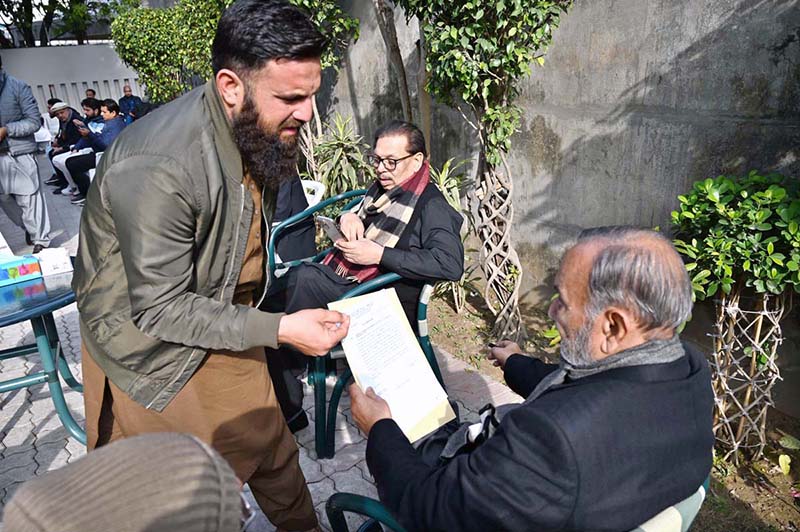
KARACHI: September 27 – President Asif Ali Zardari offering condolences to the family members of Deputy Commissioner Zakir Baloch Shaheed.


APP43-270924
KARACHI: September 27 – President Asif Ali Zardari offering condolences to the family members of Deputy Commissioner Zakir Baloch Shaheed.
ISLAMABAD, Sep 27 (APP): Minister for Planning, Development and Special Initiatives Professor Ahsan Iqbal has lauded all-weather friendship between Pakistan and China, stressing the need to follow the Chinese model of national development.
“Peace, consistency of policies and implementing reforms in all sectors are prerequisites for progress and development of any country and we can learn this from China,” he said while addressing a ceremony held to mark the National Day of China, a news release said on Friday.
The ceremony was organized by China Global Television Network and featured folk performances by cultural troupes from Pakistan and China.
Acknowledging China’s role in Pakistan’s national development, the minister said China brought investment in Pakistan when no country was willing to make investment in the country.
He said a number of projects were started in the country under the banner of China Pakistan Economic Corridor (CPEC).
Reflecting on China’s remarkable rise over the past few decades, Ahsan Iqbal praised the country’s ability to lift 800 million people out of poverty in just three to four decades—an achievement unprecedented in human history.
He emphasized that China’s success lies not only in its modernization but also in its preservation of a unique cultural identity.
“China’s success has shown that modernization does not have to come at the cost of losing one’s cultural roots,” he remarked.
China’s distinctive approach—what the minister called the “Chinese style of development”—has allowed it to forge its own path, independent of Western models of democracy and capitalism.
This, he suggested, offered a powerful lesson for Pakistan, adding”every country can find its own way to prosperity, shaped by its unique culture, history, and circumstances.”
Central to Ahsan Iqbal’s speech was his role in the China-Pakistan Economic Corridor (CPEC), a flagship initiative under China’s Belt and Road Initiative (BRI).
He reflected on his pride in transforming CPEC from a concept on paper into a $25 billion reality within just three years.
The impact of CPEC has been profound: from building thousands of megawatts of electricity-generating capacity that helped end Pakistan’s chronic power shortages to creating modern motorways, fiber optic networks, and transforming Gwadar into a bustling port city.
However, he cautioned against complacency, recalling the damaging consequences of political instability and policy reversals in Pakistan.
He recounted how irresponsible statements and scandalizing of Chinese investments led to a loss of investor confidence, with many opting to invest in other countries like Cambodia instead.
NEW YORK, Sep 27 (APP): Prime Minister Shehbaz Sharif on Friday asked the Afghan Interim Government to take effective action to neutralize all terrorist groups on its soil, especially those responsible for cross-border terrorism against neighbouring countries.
“These include ISIL-K (Daesh), the Al-Qaeda-affiliated TTP/Fitna al-Khawarij, Majeed Birgade, BLA and others”, the prime minister said in his address to the United Nations General Assembly (UNGA).
At the same time, he said,”We endorse and share the international expectation, that the Afghan Interim Government would respect human rights, including the rights of women and girls, and promote political inclusion.”
He emphasized that Pakistan sought the earliest possible normalization of the situation in Afghanistan and it also joined the UN’s appeal for $3 billion in humanitarian assistance to the millions of suffering Afghans.
UNITED NATIONS, Sep 27 (APP): Prime Minister Muhammad Shehbaz Sharif on Friday slammed India’s ‘classical settler-colonial project’ in the Indian Illegally Occupied Jammu and Kashmir (IIOJK) by seizing land, settling non-Kashmiris, and threatening the Muslim-majority population’s autonomy and cultural identity.
Such hackneyed Indian tactics employed by all occupying powers, had historically failed and would fail again in Jammu and Kashmir, he said in his address to the 79th Session of the United Nations General Assembly (UNGA).
The prime minister emphasized the need for India to uphold its commitments and work toward a peaceful resolution, ensuring the people of IIoJK can exercise their fundamental right to self-determination.
He reaffirmed Pakistan’s solidarity with the Kashmiri people, praising their unwavering resolve against India’s imposed identity and oppression. He emphasized that Burhan Wani’s legacy ignited the struggle, reminding that every statistic represented a “life affected, a dream delayed, and hope lost”.
Similar to the people of Palestine, he said, the people of Jammu and Kashmir had been striving to attain their freedom and right to self-determination.
“Instead of moving towards peace, India has backtracked from commitments to implement the Security Council resolutions on Jammu and Kashmir,” he said, adding that the resolutions mandated a plebiscite to enable the people of Jammu and Kashmir to exercise their fundamental right to self-determination.
Condemning India’s actions in IIOJK, the prime minister stated that since August 5, 2019, India had taken unilateral and illegal steps to impose a so-called “Final Solution” on the region.
“This has led to a surge in human rights abuses, with 900,000 Indian troops terrorizing the population, imposing prolonged curfews, and engaging in extra-judicial killings and abductions of young Kashmiris.”
Prime Minister Shehbaz expressed concern over India’s escalating military buildup, targeted at Pakistan, emphasizing its aggressive war doctrines that entail surprise attacks and limited wars under the nuclear umbrella.
He said that India had rejected Pakistan’s proposals for a mutual Strategic Restraint Regime, and its leadership had repeatedly threatened to cross the Line of Control and seize Azad Kashmir.
He categorically warned that Pakistan would respond “vigorously and decisively” to any Indian aggression, utilizing all its capabilities.
He emphasized that for durable peace, India must reverse its unilateral measures taken since August 5, 2019, and engage in dialogue to resolve the Jammu and Kashmir dispute as per the UN Security Council resolutions and the wishes of the Kashmiri people.
He said the illegal occupation created a fresh hell, every day, in the killing fields of Palestine, and in occupied Jammu and Kashmir.
ISLAMABAD, Sep 27 (APP): Pakistan’s Supreme Audit Institution (SAI) on Friday elected as a member of the Governing Board of the Asian Organisation of Supreme Audit Institutions (ASOSAI) (2024-27) at the latest assembly in New Delhi India.
On the final day of the 16th ASOSAI Assembly held in New Delhi from 21 – 27 September, the country’s SAI, the Office of the Auditor General of Pakistan, became a member of the governing board for the organisation.
Despite not a single member of the office being allowed to participate in the assembly, Pakistan managed to secure the membership due to the efforts of Auditor General of Pakistan Muhammad Ajmal Gondal as he continued to lobby hard for the coveted position. For months, the Audit team of AGP remained in close contact with other Asian countries’ Supreme Audi Institutions. The election stands as proof of the global standing of Pakistan’s SAI.
Ensuring public accountability and fiscal transparency in regards to governmental operations is the organisations directive. This is done in order to minimize the possibility of waste and fraud.
The ASOSAI, which consists of 48 SAIs, is one of the regional sub groups of the International Organisation of Supreme Audit Institutions (INTOSAI).
It may be mentioned here that Pakistan failed to secure the membership in 2018.
The Governing Board is an important component of the organisation that draws policies of the institution in accordance with the rules and regulations.
The organisation acts as a centre of information as well as a regional link providing members with the opportunity to exchange ideas and experiences in the field of public audit.
Conferences and seminars become the site of collaboration for members, promoting understanding and cooperation between the various institutes. Members also undertake the publication of research papers in the realm of auditing and related fields.
NEW YORK, Sep 27 (APP): Prime Minister Shehbaz Sharif on Friday said that Pakistan’s economy had shown significant signs of recovery, with inflation dropped to a single digit due to the government’s tough but necessary actions.
“We have taken difficult but necessary decisions that have rescued our economy from collapse; restored macroeconomic stability; controlled fiscal deficits; strengthened our reserves. As a result, inflation has come to a single digit,” the prime minister said in his address to the United Nations General Assembly (pm at).
He emphasized that since assuming his office in March this year, the progress and prosperity of the country’s 240 million people had been his singular focus.
Owing to the fact that Pakistan was situated at the crossroads of South and Central Asia, and the Middle East, it had prioritized geo-economics and regional connectivity to secure win-win outcomes for the people, he added.
As regards progress on the landmark China-Pakistan Economic Corridor (CPEC), PM Shehbaz said that its second phase had been successfully launched.
Through the Special Investment Facilitation Council (SIFC), “we are mobilizing investments in resilient infrastructure, renewable energy, minerals, sustainable agriculture and technology. This will herald a new era of development and modernization,” he added.