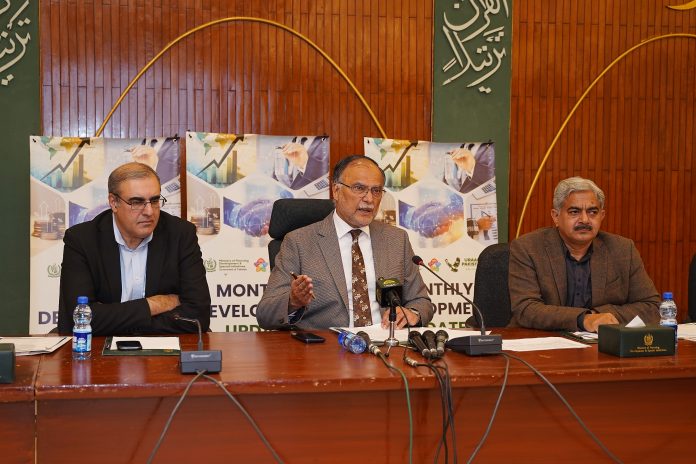
ISLAMABAD, Dec 18 (APP):Federal Minister for Planning, Development and Special Initiatives Professor Ahsan Iqbal on Thursday said Pakistan’s economy demonstrated clear signs of stabilization during July to November of the current fiscal year 2025-26, supported by prudent macroeconomic management and targeted development initiatives.
Talking to the media while referring to the Ministry’s Monthly Development Update for December 2025, the minister said key macroeconomic indicators reflected recovery and improving confidence across multiple sectors.
“During the first five months of the current fiscal year, Pakistan’s economy has moved towards stability, laying the foundation for sustainable and inclusive growth,” he said.
He said inflation moderated to an average of around five percent during July–November, compared to 7.9 percent in the same period last year, despite temporary pressures arising from flood-related disruptions.
“The easing of inflation has provided relief to the public and created a more predictable environment for businesses and investors,” he added.
Highlighting industrial performance, Ahsan Iqbal said Large-Scale Manufacturing (LSM) recorded growth of 4.1 percent, indicating a recovery in industrial activity.
He said improved energy availability, better supply chain conditions and enhanced business sentiment contributed to the turnaround.
On fiscal performance, the minister said the Federal Board of Revenue (FBR) collected Rs 4,733 billion during July–November, showing a growth of 10.2 percent.
He said steady revenue growth underscored improved tax administration and strengthened fiscal discipline.
Discussing the external sector, he said performance remained mixed, as goods exports faced constraints due to supply-side disruptions, while services exports, particularly IT, recorded strong gains.
IT services exports rose by 19 percent to $1.8 billion, he said, describing the sector as a key driver of future export-led growth.
Workers’ remittances, he added, increased by 9.3 percent to $16.1 billion, strengthening foreign exchange inflows and supporting overall stability. Financial markets, he noted, maintained a stable sentiment during the period.
On development spending, the minister said Rs 196 billion were sanctioned under the development budget for the quarter, against which Rs 92 billion had been utilized, with infrastructure projects accounting for the bulk of expenditures. He added that foreign-funded projects also progressed, with Rs 12.8 billion spent out of Rs 25.1 billion sanctioned.
Ahsan Iqbal said that during November 2025, the Central Development Working Party (CDWP) approved 10 development projects across priority sectors, while six major projects were referred to the Executive Committee of the National Economic Council (ECNEC).
He said improved project scrutiny and the elimination of non-essential expenditures resulted in savings of Rs 3.3 billion during July–October 2025.
He said the approved initiatives were expected to generate 994 immediate jobs, with an estimated 24,859 direct and 40,873 indirect employment opportunities overall, alongside enhanced skills development and inclusive growth outcomes.
The minister said key initiatives during the period included the mandatory adoption of the Green Building Code for all future development projects to ensure environmental sustainability, establishment of new facilities at Karakoram University, and international collaborations under the Uraan Pakistan initiative to promote research, innovation, trade and technology.
He added that partnerships with leading global universities, including Oxford and Cambridge, were being pursued to strengthen Pakistan’s knowledge economy.
He further said under the IT industry revival plan, more than 20,000 youth were being trained in advanced technologies, which would lead to the creation of over 14,000 new jobs.
“With fiscal stability, focused development initiatives and strengthened project oversight, Pakistan’s development outlook remains optimistic,” Ahsan Iqbal said, adding that the government was committed to sustaining reforms that support long-term, inclusive and resilient growth.