By Saeed Rahman LARKANA, Jun 16 (APP):In the bustling streets of Larkana and the quiet, hallowed courtyards of shrines in Kamber-Shahdadkot, an ancient melody still lingers. Here, amid the chaos of modern life, one can still stumble upon the haunting strains of the surando—a bowed fiddle that has been the heartbeat of Sindhi folk music for centuries. These players, emerging from diverse communities, are the last living links to a …
Strings of Eternity: the fading fiddlers of Larkana Sindh
By Saeed Rahman
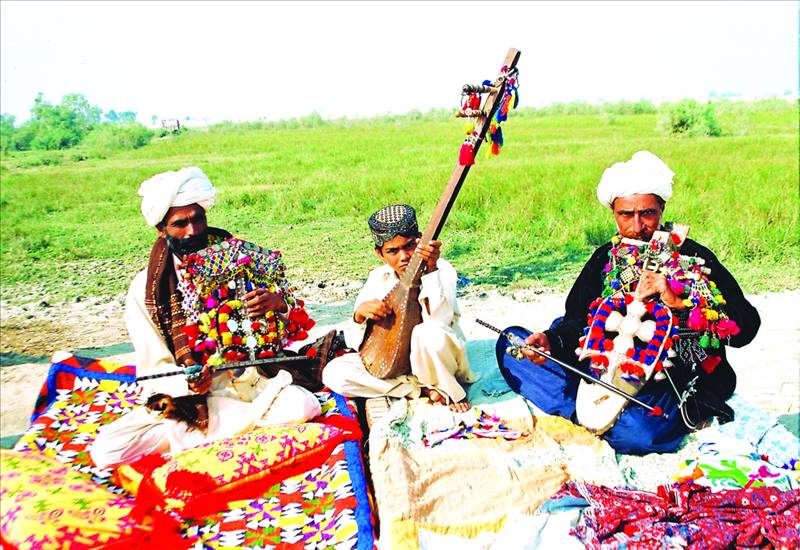
LARKANA, Jun 16 (APP):In the bustling streets of Larkana and the quiet, hallowed courtyards of shrines in Kamber-Shahdadkot, an ancient melody still lingers. Here, amid the chaos of modern life, one can still stumble upon the haunting strains of the surando—a bowed fiddle that has been the heartbeat of Sindhi folk music for centuries.
These players, emerging from diverse communities, are the last living links to a glorious past. Yet, it is the Manganhar musicians who have become the most visible faces of this tradition, their tunes rising from street corners, while the Mianwal Faqirs—devout followers of the Kalhora Sufi order remain the quiet custodians of sacred sound, their music echoing through the domes of ancient shrines.
Over time, the Manganhars have evolved beyond their traditional roles. While they remain fixtures at Sufi shrines, their music now accompanies the full spectrum of rural life—from the joyous celebrations of childbirth and marriage to intimate family gatherings. Their drums (dhuls) beat at ceremonies, and their songs fill the air at festive melas. Yet, in the city of Larkana, a special breed of Manganhars persists, carrying the weight of their ancestors’ legacy without the safety net of royal patronage. Among them, two names shine with particular brilliance: Roshan Faqir Manganhar and Ghazi Faqir Shar—masters whose paths I crossed repeatedly during my deep dive into Sindh’s surando traditions.
Roshan Faqir Manganhar entered my life in the same year, 2009, When he passed away in 2014, he left behind a rich legacy—not merely of music, but of a devoted school of students ready to carry his bow forward.
Roshan Faqir: The Street Musician with Royal Blood
Roshan Faqir Manganhar was born in 1935 in the small village of Burai Sheikh, near Larkana. His lineage was steeped in musical aristocracy; his ancestors were court singers for the princely state of Khairpur. At the tender age of twelve, he took up the surando under the tutelage of his father, Faiz Muhammad—himself an accomplished maestro who had learned the art from his own father, Lal Bakhsh Manganhar.
Lal Bakhsh was a consummate musician who flourished during the reign of Mir Ali Nawaz Khan Talpur (1921–1935), a ruler whose passion for the arts transformed Khairpur into a cultural magnet. Musicians traveled from as far as Gwalior to settle there, drawn by the Nawab’s generous stipends. Lal Bakhsh was among the fortunate recipients of this royal patronage. The family’s prestige continued with Timu Khan and Yar Ali, who earned renown as court musicians for Mir Ali Murad Talpur. Timu Khan was particularly celebrated for his renditions of classical ragas such as Kohiyari, Bhairavi, Kamod, Suhni, and Sasui—each note a testament to the family’s virtuosity.
But the days of royal courts are long gone. For Roshan Faqir, the streets of Larkana became his stage. Since 1980, he roamed the city with his surando, bringing solace and joy to ordinary folk. Yet, when I spoke with him, he confessed with a heavy heart that the audience for folk music was dwindling. “Few people care to listen to the surando anymore,” he admitted. Despite this grim reality, his optimism never wavered. He continued to teach with unwavering dedication, nurturing talents like Qadir Faqir, Yar Muhammad in Larkana, and Gul Muhammad Manganhar (known as Shadan Faqir) in Shahdadkot.
His art was recognized by Radio Pakistan Hyderabad, where he performed frequently. He also traveled across Sindh, playing at the shrines of Pir Sher, Yousaf Shah Jilani, Arab Shaheed, Miran Shah, Shah Baharo, Qaim Shah Bukhari, Mian Jan Mohammad Kalhoro, and Mian Shahal Muhammad Kalhoro. But despite these performances, the earnings were meager.