
LAHORE, Nov 24 (APP):As World AMR Awareness Week (November 18–24) concludes today, Pakistani polymath Prof Dr Aurangzeb Hafi has issued a stark warning: unregulated sewage disposal is quietly fuelling antimicrobial resistance (AMR), contaminating drinking water and poisoning the air people breathe. Released by Asia & Oceania Post-Doctoral Academia (AOPDA) under the week's theme, "One Health, One Action: Prevent AMR Now", the special investigative and policy report revisits what Prof Hafi, AOPDA's …
Prof A Z Hafi stresses reconceptualizing and fundamentally rebuilding sewerage systems from ground up to defuse AMR
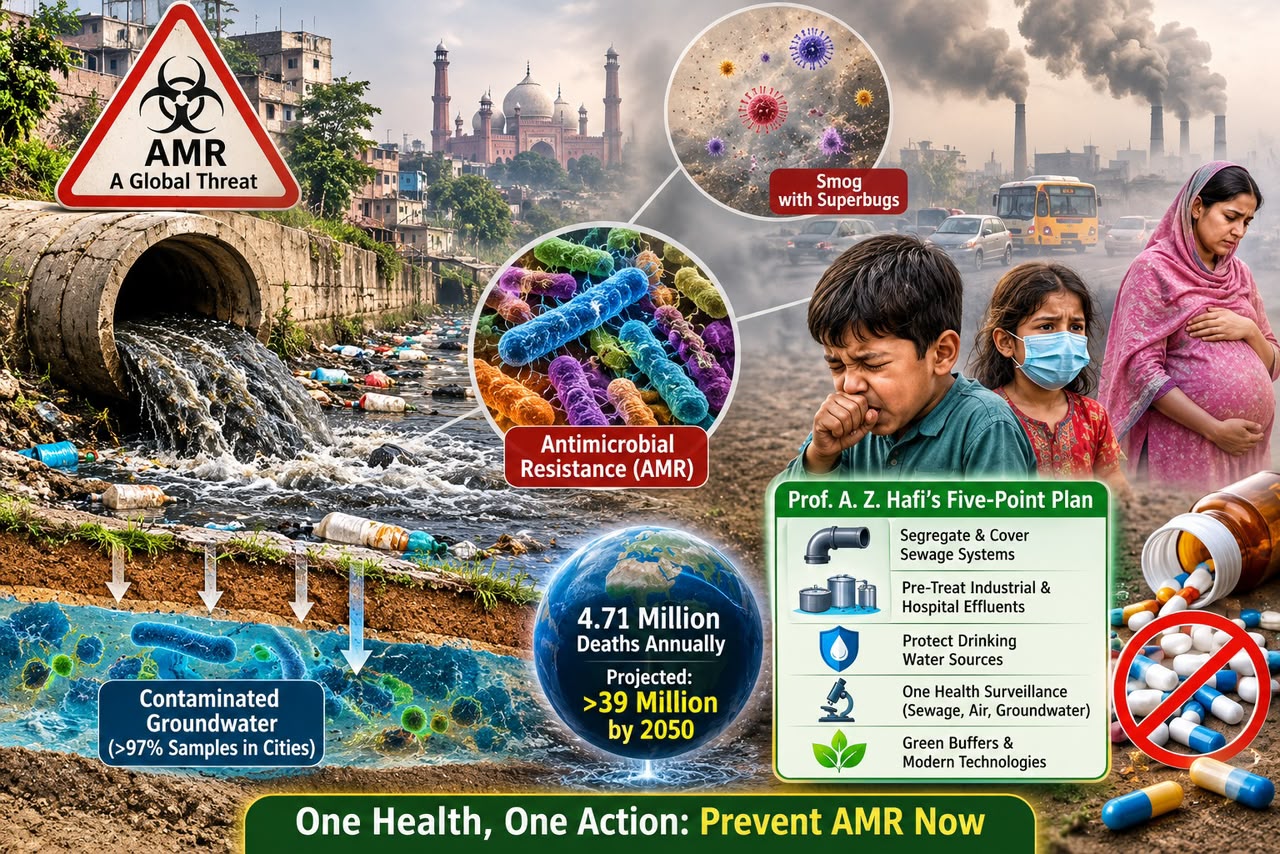
LAHORE, Nov 24 (APP):As World AMR Awareness Week (November 18–24) concludes today, Pakistani polymath Prof Dr Aurangzeb Hafi has issued a stark warning: unregulated sewage disposal is quietly fuelling antimicrobial resistance (AMR), contaminating drinking water and poisoning the air people breathe.
Released by Asia & Oceania Post-Doctoral Academia (AOPDA) under the week’s theme, “One Health, One Action: Prevent AMR Now”, the special investigative and policy report revisits what Prof Hafi, AOPDA’s Principal Investigator, calls a ‘Toxic Time Bomb’ ticking beneath our feet and inside our lungs. He has raised the alarm for over two decades on UNESCO-affiliated and international scientific platforms including the Higher Education Commission of Pakistan.
The report’s central argument goes beyond cracked pipes. Countries with separate lines for human excreta, domestic washing water and industrial and hospital effluent mainly face the problem of leakage. But in Pakistan, India, Bangladesh and other countries without such separation, everything flows together through the same open canals and underground drains.
Prof Hafi calls these networks “faulty by design”: vast mixing chambers where pathogens, pharmaceutical residues, heavy metals and chemical solvents blend, spread through neighbourhoods and seep into the soil. Patching individual leaks, he says, cannot correct a flaw built into the system.
The report describes a “Lethal Tetragonal Pollution System” in which sewage threatens water, air, soil and human health, all at once. In the air, turbulence and decomposing waste release contaminated droplets that, once evaporated, leave fine particles carrying bacteria and viruses, while dried sludge turns into toxic dust carried by wind and traffic. Ammonia from decomposing waste can also react with vehicle and industrial emissions to form secondary particulates that feed urban smog.
Underground, the picture is grimmer still. Groundwater assessments cited in the report found Shiga toxin-producing ‘Escherichia coli’ in more than 97 per cent of samples drawn from depths of 100 to 120 feet in major urban centres, including Lahore. Heavy metals such as lead, chromium and arsenic can help sustain resistance, because genes for metal and antibiotic resistance may sit together on the same plasmids, allowing resistance to persist even where antibiotics are absent. Once aquifers are contaminated, the report warns, the damage may last for decades.
For people, the danger is often invisible. Individuals may carry resistant microbes without symptoms, only to face serious infection during surgery, cancer treatment or illness, and children and pregnant women are especially vulnerable, with risks ranging from stunted growth to pregnancy complications. AMR is already associated with 4.71 million deaths a year and is projected to directly claim more than 39 million lives by 2050, nearly 90 per cent of them in low- and middle-income countries. The report argues that curbing antibiotic misuse will not be enough unless governments also fix the prevailing sewage-drainage systems and the consequential environmental conditions in which resistant organisms thrive.
To that end, Prof Hafi calls for a Global Hydro-Detoxification Initiative and, for countries with combined sewage-drainage systems, a phased move towards segregated networks. His “AZH Penta-archic Modus Operandi” sets five priorities. It begins with mandatory segregation and covering open sewage tunnels and canals with reinforced concrete culverts, adding vegetative buffers and repairing pipes with trenchless technology, and moves on to mandatory pre-treatment of effluent from hospitals, pharmaceutical units, tanneries and metal-processing industries. It further proposes protective sanitary zones around drinking-water sources, One Health surveillance of sewage canals, airborne particles and groundwater linked to WHO’s Global Antimicrobial Resistance and Use Surveillance System (GLASS), and monitoring for heavy metals and genetic markers such as class 1 integrons, so that threats are caught early.
AOPDA urges governments, municipal authorities, health bodies and development-financing agencies to treat sewerage system, environmental protection and antimicrobial stewardship as one policy framework. Prof A. Z. Hafi was named “Man of the Year 2003 in Interdisciplinary Sciences” by the International Scientific Council and ranks among the ‘Top of the Top Ten’ global icons in Impact Hallmarks’ merit indexing.
The report concludes that failure to modernise sewage infrastructure and protect groundwater will undermine decades of progress in public health reforms and transformation in modern medicine