
Punjab Chief Minister Maryam Nawaz Sharif has said governments that perform well should be allowed to complete their five-year terms, arguing that the lack of policy continuity in Pakistan remains a major hurdle to development.
CM Punjab says policy continuity vital for Pakistan’s development
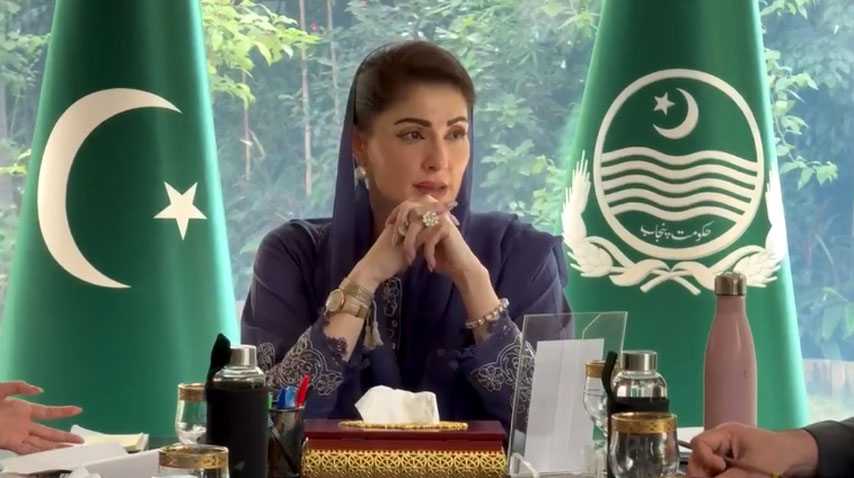
LAHORE, Oct 02 (APP): Punjab Chief Minister Maryam Nawaz Sharif has said governments that perform well should be allowed to complete their five-year terms, arguing that the lack of policy continuity in Pakistan remains a major hurdle to development.
Addressing a delegation of the National Command Authority Senior Officers Leadership Course here on Friday, she said Pakistan’s “excellent image and new face” had emerged before the world during its recent war with India, adding that the army and other security institutions were rendering valuable services for the country’s defence.
The chief minister said good governance and performance were essential to tackling internal security threats. “We are Pakistanis first, regardless of whether we belong to Punjab, Khyber Pakhtunkhwa, Balochistan or Gilgit,” she said, stressing the need for continuity in national policies.
She said Punjab’s governance standards had improved because the Pakistan Muslim League-Nawaz had remained in government in the province for longer periods. While claiming that terrorism had been brought under control in Punjab, she acknowledged that the threat had not disappeared and said the provincial government remained prepared for possible attacks.
The chief minster said the province had previously had around 70 areas regarded as “no-go areas”, but claimed that there was no such area now. “I am responsible for the safety of 140 million people, so I had to take decisions that had not been taken before,” she said.
She said the government had strengthened security infrastructure, particularly in border areas, by establishing fortified check posts and providing weapons and night-vision cameras. She also highlighted round-the-clock surveillance to detect terrorist activity.
The chief minister said the Punjab government had established separate groups for administration and law and order and that special attention was being given to crimes against women and children.
She said the government had dismissed around 1,000 police and revenue officials as part of measures against corruption and claimed that sustained action had created a fear of the law among officials demanding or accepting bribes.
On policing and surveillance, CM Punjab said the Safe City Authority, initially established in Lahore during the tenure of former chief minister Shehbaz Sharif, was now operating in 40 districts. Cameras were being used not only for security monitoring but also to identify garbage and other civic problems, she added.
The chief minister said the government had established virtual police stations for women unable to visit police stations, particularly victims of domestic violence, claiming that hundreds of thousands of cases had been dealt with through the system.
She also cited the ‘Apni Chhat, Apna Ghar’ housing programme, saying the UN-Habitat had included it among the five best housing projects globally. According to her, 130,000 houses had been completed while another 100,000 were under construction. The government, she said, had set a target of constructing 500,000 houses in five years.
The chief minister said the Punjab government had created a socioeconomic registry covering the province’s population and developed a “Punjab One Map” system providing access to different categories of data.
Discussing public transport and infrastructure, she said electric buses were now operating in small and large cities, with the fare fixed at Rs20 irrespective of fluctuations in petrol and diesel prices. She said more than 40,000 kilometres of roads had been constructed or repaired and decades-old sewerage lines were being rehabilitated.
She said residents were receiving medicines for heart disease, hypertension and diabetes at their homes, while 4.3 million services had been delivered at people’s doorsteps through the ‘Maryam Ki Dastak’ initiative.
The chief minister claimed that Punjab had planted five crore trees and that measures to control smog had produced results. She said industrial chimneys were being monitored through live cameras and artificial intelligence was being used to identify areas affected by smog.
On healthcare, she said all 15,000 children who had been awaiting cardiac surgeries in Punjab had now been operated upon, adding that children from other provinces had also received free treatment.
She said young people had been provided loans ranging from Rs1 million to Rs20 million for self-employment, while farmers were receiving interest-free loans for fertiliser, seeds and pesticides for Rabi and Kharif crops. She also claimed that 30,000 tractors had been provided to farmers.
The chief minister said five lakh young people had been trained in market-oriented skills and that emergency facilities and cardiac catheterisation laboratories were being established in every district.
Referring to criticism of her government, CM Punjab Maryam Nawaz said there were occasions when she had to choose between “protecting myself or protecting the people”, adding that she had prioritised the public.
She said she had no personal grievances against anyone and did not seek credit for herself. “I ensure 100 per cent merit in Punjab and neither accept recommendations nor do people now approach me with recommendations,” she said.
The delegation was briefed by Chief Secretary Zahid Zaman Akhtar on matters relating to the Punjab government. Participants of the leadership course, including officials from Khyber Pakhtunkhwa, praised the provincial government’s public service initiatives, saying people in KP also viewed Punjab’s performance with interest.

