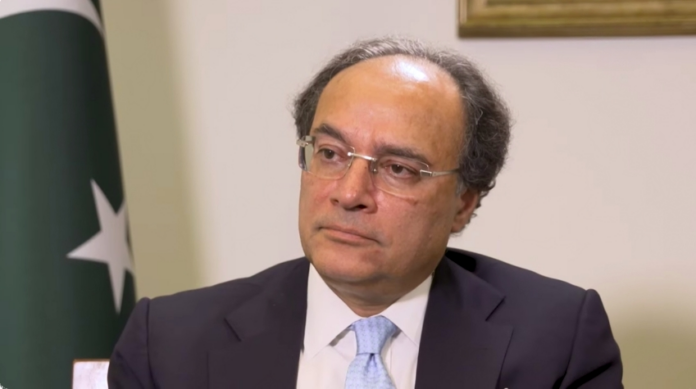
ISLAMABAD, Jun 11 (APP): Federal Minister for Finance and Revenue, Senator Muhammad Aurangzeb on Tuesday said that despite challenges, the country had made significant progress in achieving macroeconomic stability, with a remarkable 30 percent growth in revenue collection, a reduced current account deficit, reduction in inflation and a stable currency.
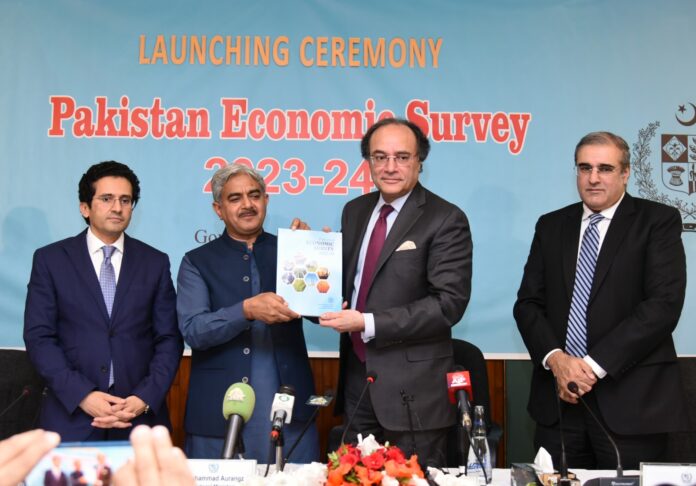
Addressing a press conference at the launching ceremony of Economic Survey of Pakistan 2023-24, the minister said, this situation indicated a remarkable turnaround from a precarious economic situation, characterized by a 0.2% GDP contraction, 29% rupee depreciation, and a shrinking foreign exchange reserves, which had declined to just two weeks’ worth of import cover.
He said, despite challenges in the large-scale manufacturing (LSM) sector due to interest rates and energy issues, the country’s GDP growth had found a silver-lining in the agriculture sector, which had been boosted by bumper crops.
He said, the agriculture and the dairy and livestock sector were expected to remain a key driver of growth in the years to come.
Finance Minister Muhammad Aurangzeb said the economic journey of Pakistan in the current fiscal year commenced under the leadership of Prime Minister Shehbaz Sharif before caretaker administration, who took the bold step of approaching the International Monetary Fund (IMF) and singing of 9-month Standby Agreement, which was very important part of the progress the country had been witnessing today.
He said had it not been signed, the situation would have been very different and there would have been discussions on economic figures in a very different context. He said the decision of going to IMF had proven fruitful for the country’s economy.
He was of the view that successful conclusion of the IMF’s Stand-By Arrangement (SBA) had also restored the confidence in Pakistan’s economy.
Talking about future programme with the Fund, the minister said Pakistan and IMF have had a productive and constructive dialogue during the fund’s recent visit. He said, the successful conclusion of the Stand-By Arrangement (SBA) has demonstrated Pakistan’s commitment to discipline, which had been acknowledged by the IMF.
He said, the dialogue focused on the constructive nature of Pakistan’s reform agenda, which the government had pledged to continue.
He said the programme with IMF, was for the benefit of Pakistan to improve its economy. “This is Pakistan’s programme, which was being aided, supported, and funded by the IMF.” The key areas of focus include enhancing tax revenues, improving the complex energy equation, and implementing power sector reforms besides privatization of state-owned enterprises (SOEs).
He said, the discussion with IMF were progressing positively, with both parties committed to working together to achieve Pakistan’s economic goals.
The minister said the country’s Current Account Deficit (CAD) had also seen a significant reduction, from an estimated $6 billion to just $200 million. “The country has even experienced a current account surplus for three months adding the surplus is expected during the month of May as remittances stood at $3.2 billion during the month.”
He said the currency had stabilized and inflation had come down, leading to a reduction in policy rates by State Bank of Pakistan adding market rates had responded positively, with foreign buying returning to the market.
The currency had stabilized due to a series of administrative measures taken by the caretaker government, including the crackdown on Hundi-Hawala, smuggling, and the regulation of transit trade to Afghanistan.
Additionally, he added, the State Bank of Pakistan’s structural interventions had successfully eradicated speculation in the market, contributing to the currency’s stability.
The finance minister expressed optimism about Pakistan’s economic growth, citing the agriculture and IT sectors as critical pillars. He noted that the two sectors were within the government’s control and could be improved to increase yields.
He also highlighted the potential of dairy and livestock exports, which needed to be exploited.
The minister said measures were being taken to check leakages at the Federal Board of Revenue (FBR) and reduce human intervention through digitalization.
He estimated power theft at Rs 500 billion and announced plans to improve corporate governance in distribution companies (Discos), which would be privatized. A law had already been passed by the Parliament to facilitate the process.
On inflation, the minister attributed the easing of inflation to administrative measures and reduction in global commodity prices.
To a question, he expressed confidence in managing the economy in 2024-25, citing plans for rollovers and commercial bank borrowing. He said the government would prioritize repayment of loans, following the same pattern as was done in the fiscal year 2023-24.
The minister expressed the intention to issue an inaugural panda bond during the ongoing calendar year to diversify the funding base.
To a question on the Public Sector Development Programme (PSDP) funding, he said high-impact value projects would be funded through the Programme.
Speaking on the occasion, Minister of State for Finance and Revenue Ali Pervaiz Malik emphasized the importance of anchoring economic stability, stressing the need to move forward in partnership with the International Monetary Fund (IMF).
He praised Prime Minister Shehbaz Sharif’s commitment to protecting vulnerable sectors from additional burdens, noting that the government was working tirelessly to enhance revenues through documentation.
He said the prime minister was cognizant of the damages suffered by the agriculture sector and had pledged compensation for the affected farmers.
The minister acknowledged that capacity payments were sovereign commitments and expressed optimism about resolving such issues through negotiations.
According to the Economic Survey, the real fiscal and external sectors as well as financial markets had demonstrated resilience and steady improvement.
In the fiscal year 2023-24, Pakistan’s GDP (gross domestic product) increased by 2.38 percent, with strong growth in the agriculture sector which expanded by 6.25 percent as compared to 2.27 percent growth in the last year.
Both the industrial and services sectors grew by 1.21 percent.
The GDP, valued at current market prices, reached Rs 106,045 billion (US $ 375 billion), with a 26.4 percent increase from the previous year’s Rs 83,875 billion (US$338 billion).
The per capita income rose to US$ 1,680, from US$ 1,551 in the previous year, driven by the improved economic activity and a stable exchange rate.
The investment-to-GDP ratio for the FY 2023-24 remained 13.14 percent, a decrease from 14.13 percent in FY 2022-23, attributed to a global slowdown, political instability in the country along with restrictive macroeconomic policies. Gross Fixed Capital Formation (GFCF) stood at Rs 12,122.5 billion, an 11.4 percent increase over the FY 2022-23.
Both private and public investments grew by 15.8 percent and 18.2 percent, respectively. Nevertheless, the national saving rate remained steady, recorded at 13.0 percent in the FY 2023-24.