Home Blog Page 96

AGPR calls on CJP as online billing payment in SC on card

0
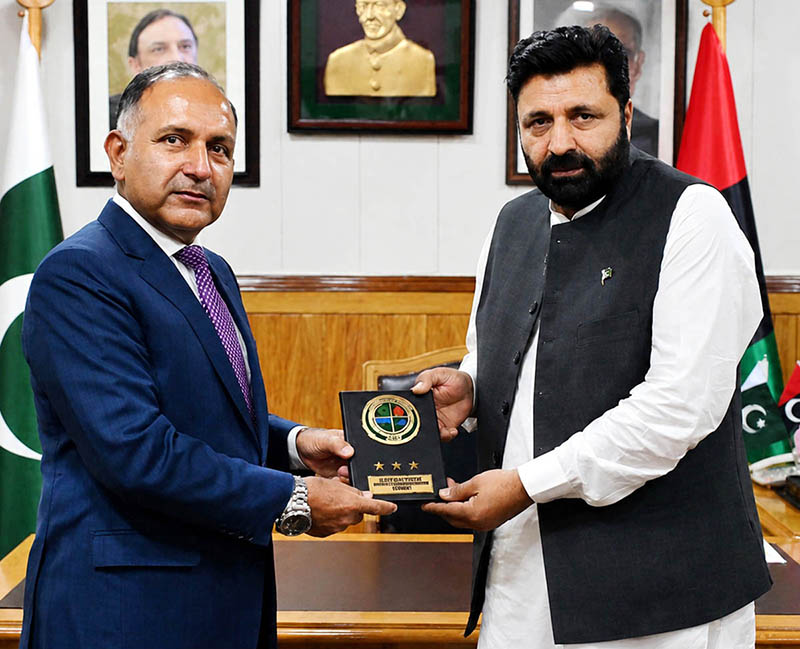
ISLAMABAD, Dec 20 (APP):Accountant General Pakistan Revenues (AGPR) Kamran Rashid called on the Chief Justice of Pakistan on Monday and briefed him on key initiatives aimed at advancing the digitalization of government payments.
During the meeting, the AGPR informed the Chief Justice that implementation of an Online Billing Solution for the Supreme Court of Pakistan has been initiated and is expected to become operational within a fortnight.
The new system is designed to significantly expedite expenditure-related payments while eliminating reliance on manual bills and cheques.
The Chief Justice appreciated the initiative taken by AGPR and assured full institutional support, stating that strengthening financial management systems at the Supreme Court remains among his key priorities.
He also issued necessary instructions to the relevant sections to ensure the effective and timely implementation of the project.
The Chief Justice further expressed his desire that the initiative be extended to the High Courts as well, subject to the approval of the respective Chief Justices.
Emphasizing broader financial reforms, the Chief Justice stressed the need to digitize receipt-side financial instruments through fintech-enabled solutions.
He said that such measures would facilitate litigants and other stakeholders by enabling the digital deposit of court fees, securities, and related payments.
He underscored that these initiatives should be pursued in coordination with the State Bank of Pakistan to ensure secure, standardized, and transparent financial transactions.
On the occasion, the Accountant General Pakistan Revenues also presented a commemorative shield to the Chief Justice of Pakistan.

Hijab snatching: Tarar calls out India’s moral bankruptcy, polarisation & extremism

0

ISLAMABAD, Dec 20 (APP): Minister for Information and Broadcasting Attaullah Tarar has strongly criticised India over a hijab-snatching incident in Bihar, calling it a reflection of rising Islamophobia and intolerance.

In an interview with WE News English, Information Minister said a deeply unfortunate incident had come to light, pointing to the case of a Muslim medical graduate allegedly forced to remove her veil.

He said India was “suffering from moral bankruptcy, extreme polarisation and violent extremism,” adding that such conduct by a senior political leader was “highly condemnable.”

Tarar further described the incident as emblematic of escalating Islamophobia, driven by propaganda and distorted narratives.

He noted that Foreign Office had formally condemned the incident, which prompted a diplomatic response from Islamabad.

Emphasising that there could be “no justification” for such an act, Tarar said such episodes should not be viewed in isolation, as they are often tied to organised propaganda and distorted narratives amplified through digital platforms. Arguing that such incidents are often accompanied by organised propaganda and distorted narratives, amplified across digital platforms.

The Minister said Pakistan has been subjected to sustained information warfare from India, especially during periods of heightened tension between the two nuclear-armed neighbours. He argued that misinformation and exaggerated claims are increasingly deployed to shape both domestic and international opinion.

Referring to the confrontation earlier this year, which Pakistan officially termed Marka-e-Haq, Tarar said the information sphere emerged as a key battleground, alongside diplomatic and military pressures.

He alleged that false and misleading claims circulated widely from Indian media and online sources during the crisis.

Tarar said India’s lack of a coordinated information strategy allowed inaccurate reports to circulate, ultimately undermining New Delhi’s international credibility.

He contrasted this with Pakistan’s approach, which he said centred on the timely release of verified information. Tarar noted that during the confrontation, Pakistan pursued a unified communication strategy, coordinating efforts between the prime minister’s office, the Foreign Ministry, the Information Ministry and the military’s media wing, ISPR.
He said the prime minister publicly offered a fair and impartial investigation into the Pahalgam incident and that diplomatic engagement was pursued in parallel with regular media briefings. Information, he said, was shared in real time across institutions and provided promptly to Pakistani broadcasters and international media organisations.

Tarar praised Pakistan’s media for responsibly broadcasting official information, adding that international outlets leaned on Islamabad’s account of events as it was backed by verifiable facts.

Domestically, he said Pakistan’s government stressed political unity during the crisis, while India’s political polarisation undermined the coherence of its messaging.

Tarar said Pakistan relied heavily on digital tools to counter misinformation. As Indian authorities restricted Pakistani YouTube channels and commentators, Pakistan responded by placing paid digital advertisements inside India, allowing Pakistani content to reach Indian audiences directly.

He noted that content showcasing Pakistan’s armed forces garnered millions of views and sparked debate in India over the prominence of Pakistani narratives on local platforms. According to Tarar, the episode demonstrated the limitations of digital censorship in an interconnected media environment.

He said the government activated its fact-checking mechanisms to counter inaccurate reporting.

According to Tarar, the Ministry of Information has established official “fake news buster” social media accounts and a dedicated verification cell that monitors digital platforms, identifies false content and issues corrections.

Verified information, he said, is disseminated through social media, electronic media and directly to international wire services.
He added that officials remain in regular contact with correspondents from global news agencies, to ensure timely clarification and accurate reporting.

Regarding Government information policy and digital department Tarar said these responses are part of a broader restructuring of Pakistan’s information and communication policy.

He said the government created Pakistan’s first official digital communication department after amending administrative rules and creating new positions.
The department, he said, functions as a central hub equipped with digital monitoring systems, content production facilities, a podcast studio and in-house teams of digital media specialists and influencers.

Its role is to monitor narratives, coordinate messaging and disseminate verified information quickly during both routine governance and crisis situations.

He described the department as a “nerve centre” that proved particularly effective during the confrontation with India by allowing different state institutions to operate under a single communication framework.

Tarar emphasized that the government’s strategy represents a clear break from past administrations, which, he noted, leaned heavily on traditional press briefings and and reactive communication strategies.

He said earlier governments lacked a permanent digital footprint and responded to crises on an ad hoc basis. The present strategy, he added, prioritises proactive digital engagement, institutional coordination and rapid fact-checking as core elements of governance.

Tarar said the information policy is aligned with the government’s wider objectives, including diplomacy, economic recovery and international image management. He called for a coordinated global response to misinformation, arguing that disinformation, Islamophobia and digital propaganda are transnational challenges.

He added that Pakistan intends to keep pressing these concerns at multilateral platforms such as the United Nations and the Organisation of Islamic Cooperation, calling for common standards, stronger international collaboration, and greater accountability from social media companies.

Tarar stressed that Pakistan views effective communication and credible information management as vital tools for safeguarding national interests and advancing its position internationally.

FIA offloads two passengers over fake Spanish visas at Islamabad Airport

0
ISLAMABAD, Dec 20 (APP):The Federal Investigation Agency (FIA) Immigration thwarted an attempt by two passengers to travel abroad on forged travel documents and offloaded them at Islamabad International Airport.
An official told APP on Saturday that FIA Immigration officials detected the suspicious documents during immigration clearance and offloaded two passengers, identified as Waheed Murad and Arsalan Razzaq, who were travelling to Spain on flight QR-633.
The official said both passengers belong to Rawalpindi. During scrutiny, their passports were found bearing fake Spanish visas, following which they were stopped from travelling.
He added that the two passengers were subsequently shifted to the Anti-Human Trafficking Circle (AHTC), Islamabad, for further legal action and investigation.
Further investigation is underway to ascertain the source of the forged visas and identify any facilitators involved, the official added.

A nation silenced in Kashmir while the world watches

0
By Maryam Shah
ISLAMABAD, Dec 20 (APP):On International Human Solidarity Day, political observers, human rights advocates and Kashmiri representatives on Saturday warned that India’s policies in the Indian illegally occupied Jammu and Kashmir (IIOJ&K) amounted to a systematic, state driven assault on the region’s identity, faith, population structure and political future, carried out since August 2019 through legal, administrative and military actions, raising urgent concerns about global accountability, international law, and the credibility of the world’s human rights system.
International Human Solidarity Day is meant to reaffirm a universal principle” injustice anywhere challenges the conscience of humanity everywhere”. This year, its observance has once again focused attention on Kashmir, where despite unprecedented digital access and global connectivity, a sustained campaign against an entire population continues with little effective international response. Human rights defenders say Kashmir today represents one of the clearest failures of collective global responsibility in modern times.
Analysts stressed that what was unfolding in the IIOJ&K is not routine governance or short term security management. It reflects a coordinated and deliberate state policy designed to reshape the region’s political and social reality. India’s actions extend beyond military control into demographic change, ideological influence, suppression of dissent and the steady erosion of internationally recognized rights.
At the center of this approach lies demographic change, described by experts as the most dangerous and irreversible aspect of the crisis. Since the removal of the region’s special constitutional status, major changes to land ownership, domicile, and employment laws have enabled the settlement of non local populations while steadily weakening the rights of indigenous Kashmiris. Observers warn that these measures are intended to alter the population balance and permanently undermine the Kashmiri demand for self determination.
The experts emphasize that this was not a conflict fought only with weapons. It is a silent structural campaign that transforms societies from within. Demographic change, they noted, is not temporary repression but a long term strategy that reshapes political outcomes without public consent or participation.
Alongside population changes in Indian occupied Kashmir, restrictions on religious freedom have intensified. Mosques face frequent closures, congregational prayers are limited, and major religious gatherings including Friday prayers and Eid celebrations are often curtailed under security justifications.
 At the same time, critics point to the growing visibility of Hindutva ideology through official narratives, public symbolism, and administrative decisions.
Rights advocates argued that this imbalance is deliberate. It reflects an effort to weaken the Muslim identity of Kashmir while promoting a state supported ideological framework. According to rights assessments, this goes beyond intolerance and represents ideological control enforced through policy and power.
Equally concerning is the systematic suppression of media and civil society. Kashmir has become one of the most restricted environments for journalism anywhere in the world. Independent reporters operate under constant pressure, facing surveillance, questioning, arrests, and legal cases. Media outlets struggle under censorship and administrative restrictions that limit their ability to report freely.
Repeated internet shutdowns, among the longest recorded globally, have further isolated the region. Media watchdogs state that these shutdowns are not isolated security measures but part of a broader effort to control information, restrict documentation of abuses, and promote a narrative of normal conditions that does not reflect reality on the ground.
On a daily basis, life in Kashmir unfolds under heavy military presence. Routine cordon and search operations, night raids, detentions, enforced disappearances, and collective punishments have embedded fear deeply into society. Mental health experts warn of long lasting psychological effects, particularly on young people growing up amid uncertainty and constant surveillance.
Observers describe this environment as a form of psychological pressure designed not only to prevent resistance but to normalize silence. The objective, they argue, is not simply territorial control but the gradual exhaustion of public will.
 Lack of accountability  makes the situation more troubling in an era of abundant evidence. Satellite imagery, digital records, legal documents, and eyewitness testimonies are widely available. Despite this, international responses remain limited. Legal experts note that when violations face no consequences, they gradually become accepted practice.
Human Rights activists emphasize that responsibility does not lie solely with governments or international bodies. Media professionals, academic institutions, political actors and civil society groups worldwide share a moral duty to document events accurately and raise their voices. Silence or artificial neutrality, they warned, only strengthens injustice.
History, analysts caution, does not forgive indifference. Nations face moments when delay determines destiny. Kashmir, they argue, stands at such a moment where unity must replace division, clarity must replace ambiguity, and voice must replace fear.
The message echoed on International Human Solidarity Day is clear. The Kashmir crisis is no longer a distant political dispute. It has become an existential struggle involving identity, faith, and survival. Calls continue for independent international investigations, accountability for population changes and rights violations, restoration of civil freedoms, and concrete steps toward honoring the Kashmiri people’s right to self determination.
Global community’s silence today is not neutrality. It is complicity. In a digital age where injustice is visible in real time, history will judge not only the actions of the powerful but also the choices of those who remained silent.

ICT Police put three dacoit gang members behind bars in snatching, robbery cases

0
ISLAMABAD, Dec 20 (APP):Islamabad Capital Territory (ICT) Police arrested three members of an organised dacoit gang involved in motorcycle snatching and robbery incidents during an operation carried out in the limits of Sangjani Police Station.
An official told APP on Saturday that police teams apprehended the suspects and recovered snatched motorcycles worth millions of rupees along with weapons and ammunition used in the commission of crimes.
The arrested suspects were identified as Bilal, Adnan and Shahid, who were involved in multiple cases of motorcycle snatching and street crime. Several cases have already been registered against them at different police stations.
The official said the accused were part of a well-organised group targeting citizens and depriving them of their valuable belongings. Further investigations are underway to trace other accomplices and recover additional stolen property.
SSP Operations  Qazi Ali Raza said that all legal requirements would be fulfilled to ensure exemplary punishment for the arrested criminals. He added that strict action would continue against organised and active gangs involved in robbery and snatching.
SSP reaffirmed that ICT Police remain fully committed to protecting citizens’ lives and property and that operations against criminal elements would continue across the federal capital.

Exports growth vital for Pakistan’s economic development: Prime Minister

0
LAHORE, Dec 20 (APP):Prime Minister Muhammad Shehbaz Sharif has said that a sustained increase in exports was essential for Pakistan’s economic development and long-term stability.
He expressed these views while chairing a review meeting on domestic exports on Saturday.
The prime minister emphasized that the government was committed to providing all possible facilities to businessmen and exporters to enhance export volumes and strengthen the national economy.
The PM stressed that priority work must be carried out to promote small and medium-sized enterprises (SMEs),noting that the expansion of the export sector would not only boost foreign exchange earnings but also create more employment opportunities across the country.
PM Shehbaz Sharif directed the federal ministers for commerce,industry and production and national food security to personally visit exporters in various industrial and commercial cities to understand their issues and ensure timely resolution.
He also underlined the need to further strengthen coordination with the provinces to promote cold chain systems and other sectors linked with industry and trade.
During the meeting,the PM was briefed on the exports and imports of the ongoing fiscal year 2025–26 so far,along with measures being taken to improve export performance.
The meeting was attended by Federal Minister for Commerce Jam Kamal Khan,Federal Minister for Finance and Revenue Muhammad Aurangzeb, Federal Minister for National Food Security Rana Tanveer Hussain, Minister of State for Finance and Railways Bilal Azhar Kayani, Advisor to the Prime Minister Haroon Akhtar and other senior government officials.

Iqbal’s universal message provides common lingual ground for strengthening Pak-Tajikistan ties: Pak envoy

0
By Shams Abbasi
Dushanbe , Dec 20 (APP):Ambassador Extraordinary and Plenipotentiary of the Islamic Republic of Pakistan to the Republic of Tajikistan Muhammad Saeed Sarwar said that Dr. Allama Muhammad Iqbal’s universal message provided common lingual ground to Tajikistan and Pakistan through universal message for strengthening their bilateral relation.
Iqbal’s Universal message is also significant not only for regional integration but provides common ground at different spheres for strengthening the bilateral relations between two sides.
Iqbal’s universal message provides common lingual ground for strengthening Pak-Tajikistan ties: Pak envoy
Ambassador Extraordinary and Plenipotentiary of the Islamic Republic of Pakistan to the Republic of Tajikistan Muhammad Saeed Sarwar said this while addressing the “Iqbal Days Ceremony organized by Tajik National University, the Ministry of Foreign Affairs, the faculty members of the Department of Asian and European Languages, and the Pakistan Study Center to pay tribute to the great thinker, philosopher, political leader, and poet of the East, Dr. Allama Muhammad Iqbal.
“I would like to express my heartfelt gratitude to the university administration and all of you for organizing this event. The Embassy of Pakistan is committed to further promoting academic and educational ties between the two countries” he said.
The Ambassador said that “We also have a lot of commonalities in our faith, history, culture and literature are intertwined.”
Iqbal’s universal message provides common lingual ground for strengthening Pak-Tajikistan ties: Pak envoy
The Ambassador said that Pakistan was among the first countries to recognize Tajikistan’s independence and establish diplomatic relations with it.
Pakistan and Tajikistan have strong historical, cultural, social, linguistic and religious ties and there has been a regular exchange of visits at the leadership level.
In May this year, the Prime Minister of Pakistan, Muahammad Shehbaz Sharif  visited Tajikistan and last week , the Minister of Culture of Tajikistan inaugurated the Tajik Cultural Week in Islamabad, he said.
The envoy said that this is a historic occasion as for the first time, the Tajik Cultural Week is being celebrated in Pakistan and this reflects the growing people-to-people and cultural ties between the two countries.
 It is a great honor for me to participate in this event. Allama Muhammad Iqbal was not only a poet, scholar, and philosopher, but above all, he was a visionary leader, he said.
He said that the message of his poetry is acquiring more depth and spirituality with time because it is not just emotional or temporary words, but is based on intellectual and universal principles.
Iqbal’s universal message provides common lingual ground for strengthening Pak-Tajikistan ties: Pak envoy
He pondered the issues that confront us all: the purpose of life, freedom and determination, change and perseverance, the conflict between reason and emotion, and the struggle for survival and progress.
He always considered knowledge as the basis of power and progress. For him, spiritual awakening alone is not enough; it is also necessary to embrace modern sciences and research. This message is extremely important in today’s era, when the world is moving towards a knowledge-based economy.
 He sought the well-being of all humanity and his words are not only for Muslims, but are a source of guidance for every religion and every person, he said.
The envoy said that Allama Muhammad Iqbal’s philosophy is based on an Islam that is dynamic, evolving and adaptable to the needs of the times.
He believed that Islam has the power to inspire and develop the human spirit, and its teachings are a source of light, guidance and strength for the modern world.
The Ambassador said that this concept makes him a great intellectual leader not only for South Asia but also for the Islamic world.
Iqbal considered the youth as the real capital of the nation and taught them the lesson of lofty aspirations, self-confidence and courage through the symbol of the eagle and the youth close to him are the architects of the nation’s future.
He said that Iqbal likened the youth to eagles, who are lofty and seeker of lofty goals and his poems are still a source of continuous inspiration and guidance for the younger generation.
Iqbal’s message is not limited to the individual self but also emphasizes the building of the collective self and in today’s era, when societies are divided and in chaos, Iqbal reminds us that collective unity is the real strength. Iqbal’s message is full of hope and courage.
He reminds us that despair is disbelief: and hope is the real capital of life. Iqbal is not a hopeless person. If there is a little moisture from his cultivated fields, this soil is very fertile.
According to his vision, “our beloved country “Pakistan” came into being and he was the driving force behind the freedom movement and his vision of establishing a separate Muslim state had a profound impact on the political outlook of South Asia. It is a matter of pride for us that in Tajikistan, Allama Iqbal is known as “Iqbal Lahori”.
In concluding remarks he said that  “I am grateful to the Rector of Tajik National University, the Ministry of Foreign Affairs, the faculty members of the Department of Asian and European Languages, and the Pakistan Study Center for organizing this event to pay tribute to the great thinker, philosopher, political leader, and poet of the East, Dr. Allama Muhammad Iqbal.

Imran Khan, Bushra Bibi awarded 17 years jail sentence each in Toshakhana-II case

0
By Wasim Kambo
ISLAMABAD, Dec 20 (APP):A special court on Saturday announced 17 years jail term each to PTI founder Muhammad Imran Khan Niazi and his wife Bushra Bibi in Toshakhana-II case.
Special Judge Central Shahrukh Arjamand pronounced the verdict in the case in the presence of Imran Khan and Bushra Bibi at Central Jail Adiala.
In written verdict the court said that the prosecution was successful in proving its case and both the accused were found guilty of the crime.
The PTI founder was sentenced to 10 years in prison under Section 409 and 7 years under the Prevention of Corruption Act upon being found guilty.
Bushra Bibi would also face 17 years jail sentence. The court also imposed a fine of Rs 16.425 million on each accused; failure to pay will result in an additional 6 months in prison.
According to the written verdict, considering the age of the founder and the fact that Bushra Bibi is a woman, both were given the minimum punishment. The period of detention of the criminals has also been included in the sentence.
It may be noted here that the court had recorded the statements of a total of 21 witnesses and heard the arguments of the parties.
The court had indicted the two accused last year in December in the said case; however, both denied the charges.
The Federal Investigation Agency (FIA) had alleged that the accused had misused their position during their tenure. They were gifted a Bulgarian Jewelry set during an official visit to the Kingdom of Saudi Arabia in May 2021.  The accused kept the set in personal custody instead of submitting it to the Toshakhana.
During the investigation, it was proved that the accused, in collusion and malice, charged a very low price for the said jewelry set, resulting in a loss of Rs. 32.851 million to the national exchequer.
After the verdict, both the accused were taken into custody by the FIA Anti-Corruption Circle Islamabad and transferred to Adiala Jail to ensure implementation of the court orders.
Muhammad Afzal Khan Niazi, Deputy Director FIA Anti-Corruption Circle Islamabad and Shams Gondal, SHO FIA Anti-Corruption Circle Islamabad appeared before the special court on behalf of the FIA during this day hearing.
It should be noted that on July 13, 2024, NAB arrested Imran Khan and Bushra Bibi in Adiala Jail in the Toshakhana II case.
Both remained in NAB custody for 37 days. After the investigation was completed, NAB filed a reference in the case in the Accountability Court on August 20. Later, the case was shifted to the FIA.

Tajikistan Amb. calls on DPM/FM Dar

0

ISLAMABAD, Dec 20 (APP): Ambassador of Tajikistan to Pakistan Sharifzoda Yusuf Toir, Saturday, called on Deputy Prime Minister/Foreign Minister, Senator Mohammad Ishaq Dar.

The ambassador thanked the DPM/FM for his support in organizing the first Tajik Culture Week in Pakistan, Foreign Office Spokesperson said in a press release.

Conveying Pakistan’s strong desire to enhance Pakistani multi-faceted bilateral relations with Tajikistan, the DPM/FM said that he looked forward to a number of high-level engagements with Tajikistan in 2026 and underscored the need to develop close cooperation between private sectors of the two nations to enhance Pakistan-Tajikistan bilateral trade to US$500 million.

Mohsin Naqvi visits Railways Ministry

0

ISLAMABAD, Dec 20 (APP): Federal Minister for Interior Mohsin Naqvi Saturday visited the Ministry of Railways, where he was warmly received by Federal Minister for Railways Muhammad Hanif Abbasi.

During the visit, the two ministers held an important meeting to discuss matters related to Pakistan Railways, with a special focus on the ongoing reform agenda, said a news release.

Hanif Abbasi briefed the minister on the major and transformative changes introduced in the railway sector during 2025, aimed at improving efficiency, governance and service delivery.

The meeting reviewed steps taken to enhance the overall railway system, including measures for providing better facilities to passengers, upgrading infrastructure and modernizing operations.

Both sides also discussed issues related to security, operational efficiency and institutional reforms, and agreed to strengthen mutual cooperation in these areas.

Mohsin Naqvi appreciated the reform initiatives undertaken by the Ministry of Railways and lauded the progress made under the current leadership.

He expressed confidence that these measures would significantly improve the performance of Pakistan Railways.

Both ministers reaffirmed their commitment to modernizing Pakistan Railways on contemporary lines, with the objective of making it a safe, efficient and passenger-friendly national institution.