
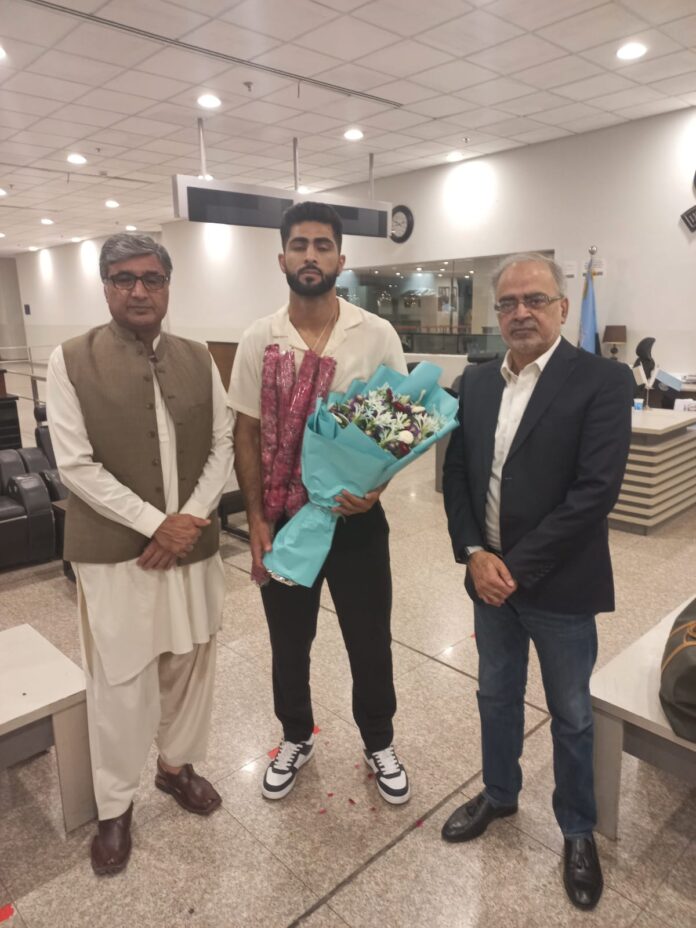
ISLAMABAD, Sep 22 (APP): Shahzaib Rind, the newly crowned World Karate Combat Light Heavyweight Champion was accorded a hero’s welcome upon his return to Pakistan from Singapore on late Saturday.
Secretary Ministry of Inter-Provincial Coordination Nadeem Irshad Kayani, Additional Secretary Zahoor Ahmed, Deputy Director General Pakistan Sports Board (PSB) Shahid Islam, officials of Prime Minister’s Youth Programme, former Deputy Mayor Islamabad Zeeshan Ali Naqvi and a large crowd of enthusiastic fans greeted him at Islamabad International Airport with warm applause and cheers.
Shahzaib won Karate Combat KC-49 Championship, overpowering Brazilian fighter Luiz Victor Rocha in Singapore in an intense bout on Wednesday. He remained unbeaten throughout the tournament, making history as the first Pakistani to win a major world championship in the martial arts.
Shahzaib has previously won the Combat League in the United States. He is also a six-time national champion.
His victory has sparked national pride, with fans waving flags and chanting slogans in celebration of his remarkable achievement.
The Ministry of IPC and PSB officials lauded Shahzaib’s hard work, discipline and dedication, crediting him for bringing pride to the nation.
Speaking to the media, Shahzaib expressed his gratitude to his supporters, the PSB and his training team for helping him achieve this milestone. “This victory is not just mine but belongs to the whole nation,” he said, visibly moved by the outpouring of support.
He said right from the outset he was sure to emerge victorious. “This is just a beginning. I’m determined to continue winning the titles and bring laurels for my country,” he added.
Shahzaib Rind receives heroic welcome after clinching world title
EDF Board approves 20 proposals of worth Rs 8.5 bn for textile, Agri, global branding
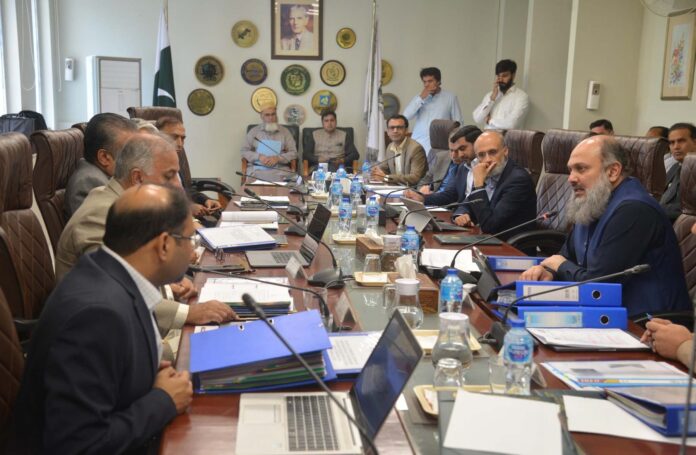
ISLAMABAD, Sep 22 (APP): In a significant move to bolster Pakistan’s export sector, the Export Development Fund (EDF) has approved 20 proposals of worth Rs 8.5 billion for initiatives targeting textiles, agriculture, gems and jewelry, defense, and global branding.
This was approved during the 85th meeting of the Export Development Fund (EDF) Board under the chairmanship of Minister for Commerce Jam Kamal Khan, said a news release here on Sunday.
The Board approved 20 out of the 29 financial proposals by participating in Expo 2025 in Osaka Japan.
The minister highlighted the potential available in the reformed EDF for boosting the Pakistan exports by channelizing the money into various activities as per needs of the exporters and creating facilitative mode at the national level for value addition, research & development, increasing compliance as per global requirement, upgradation of the export infrastructure and marketing/branding of the country’s potential in the international arena.
The Board was apprised that EDF has made drastic reforms during the recent times which include notification of EDF as autonomous body, amendment in the EDF Act for direct transfer of Export Development Surcharge to EDF Public Account, digitalization of revenue collection system with the help of State Bank of Pakistan (SBP) and Pakistan Single Window (PSW).
The board was informed that a detailed activity has been initiated with the help of FCDO Remit Project for development of Vision, Mission and Future Strategy of EDF while a Chartered Accountancy Firm has also been hired to restructure EDF as an organization for efficient, effective and transparent utilization of the fund and its impact assessment.
Chairman EDF Board directed to form various committees from amongst the EDF Board members to overlook research & development, training, technology enhancement, international outreach for assisting the Board to adopt forward-looking proactive approach.
The EDF Board also directed to share details of proposed EDF-PSW MoU in the next meeting for proper analysis of the Board.
The intent of the MoU is to create two-way direct communication between EDF and exporters using PSW platform for need analysis, impact assessment, market intelligence and sectoral/regional/ geographic tagging of exporters for targeted information sharing.
The projects included various marketing interventions such as holding of international level exhibitions inside Pakistan such as Texpo 2025 by TDAP, IDEAS by DEPO, Gems & Jewelry Show by FPCCI, OIC-Conference and WEXNET targeting Women empowerment by Trade Development Authority of Pakistan (TDAP).
These exhibitions will not only support Pakistani exporters to exhibit their products but will be used as branding activities for Pakistan across the globe.
The project funding includes facilitation to international buyers through provision of best hospitality and arrangement of B2B meetings for best match-making.
The Board also approved projects linked to research & development and technology acquisition which included opening of UNIDO assisted International Technology Promotion Offices at TUSDEC, Disease Diagnostic Research Centre for Mango at Sindh Agriculture University, Tando Jam, Design Centre at Pakistan Institute of Fashion Design, Lahore as well as establishment of Solar Tunnel Dryer for Exportable Dried Chilies at Umer Kot, Mirpur Khas and Badin.
The Board also approved funding for completion of first Expo Centre in Peshawar to provide a platform for hosting international level exhibitions for entrepreneurs of Kyhber Pakhtun Khwa.
This was the first meeting after the notification of the new Board which was recently constituted last month comprising of ex-officio members of commerce ministry, finance ministry, industries ministry, SBP and TDAP with representation of 15 members from Private Sector.
The new Board provides diverse regional and sectoral representation to the private sector and includes Presidents of Chambers of Federation of Pakistan, Karachi, Lahore, Sarhad, Quetta, Sialkot and Chairman of Associations from value-added textiles, agriculture, livestock, chemical and engineering sector.
The Board also includes sector leaders such as Bilal Tata from Tata Best Foods, Aamir AllahWala from Tecno Group, and Ms. Mehreen Obaid from Towellers Limited representing women led export enterprises.
Chairman EDF Board informed the members of the EDF Board that next meeting of the EDF Board will be re-convened as soon as possible to consider the remaining proposals.
He also committed to hold EDF Board meetings more frequently for channelizing the Fund resources into awaited productive interventions leading to export development from across Pakistan.
OGDCL, Chinese CCDC sign MoU for shale , tight gas development in Pakistan
Pakistan’s earns $286 million from IT services’ export during July 2024

ISLAMABAD, Sep 22 (APP): Pakistan earned US $286.395 million by exporting different Information Technology (IT) services in various countries during the first month of the current fiscal year 2024-25.
This shows a growth of 33.84 per cent as compared with the US $ 213.980 million earned through the provision of services during the corresponding period of the last fiscal year 2023-24, the Pakistan Bureau of Statistics (PBS) reported.
During the month under review, the computer services grew by 44.14 per cent as it surged from US $172.680 million last year to US $248.899 million during July 2024.
Among the computer services, the exports of software consultancy services witnessed an increase of 47.38 per cent, from US $58.425 million to US $86.103 million this year while the export of hardware consultancy services, however, decreased by 30.68 per cent, from US $0.440 million to US $0.350 million.
The export of repair and maintenance services surged by 1302.14 per cent from US $0.035 million to US $0.490.75 million whereas the export and imports of computer software services also increased by 1.08 per cent, from $50.327 million to $50.868 million.
In addition, the exports of other computer services also witnessed a growth of 75.14 per cent from US $63.453 million to US $111.131 million.
Meanwhile, the export of information services during the month under review also increased by 47.50 per cent growing from US $0.300 million to US $0.442 million.
Among the information services, the exports of information-related services up by 12.34 per cent, from US $0.114 million to US $0.128 million whereas the exports of other information services rose by 69.05 per cent, from US $0.186 million to US $0.314 million.
The export of telecommunication services decreased by 9.62 per cent as these came down from US $41 million to US $37.053 million, the data revealed.
Among the telecommunication services, the export of call centres services increased by 33.61 per cent during the month as its exports increased from US $15.993 million to US $21.367 million whereas the export of other telecommunication services decreased by 37.27 per cent, from US $25.007 million to US $15.686 million during this year, the PBS data revealed.
The unseen costs of air pollution in Pakistan’s rural life, agriculture
By Andleeb Khan
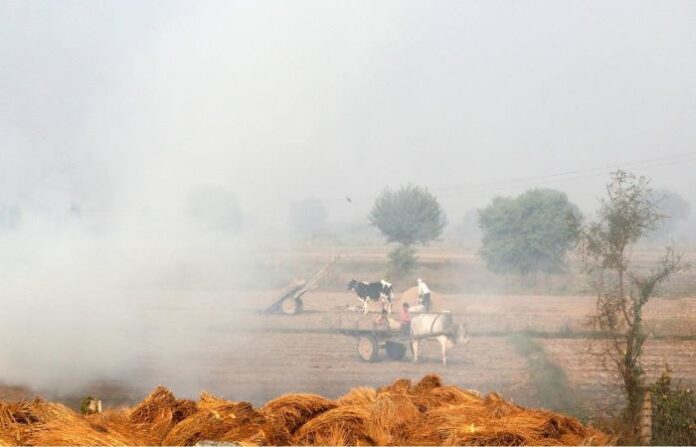
ISLAMABAD, Sep 22 (APP): Air pollution is often perceived as an urban issue, yet its impact on rural areas is just as severe, quietly undermining traditional ways of life. In Pakistan’s countryside, pollution from agricultural practices, waste burning, and traditional cooking methods increasingly harms both health and the environment.
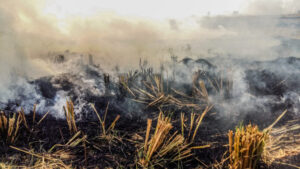
In an interview with APP, Dr. Naseer Memon, a climate expert, highlighted that the consequences of air pollution are profound, leading to respiratory and heart diseases while posing economic challenges that threaten the sustainability of rural lifestyles. Agriculture, which contributes about 24% to Pakistan’s GDP and employs nearly 40% of the labor force, is seriously threatened by this issue.
Dr. Memon noted that while city dwellers contend with smog from industries and traffic, rural communities face a different kind of pollution. Many villages rely on traditional cookstoves and three-stone fires, burning biomass fuels like wood and crop residue, which emit harmful fine particulate matter and toxic gases, including carbon monoxide.
Dr. Fareed Soomro, a health expert at Fatima Clinic talking to this scribe, highlighted the dangers of fine particulate matter in an interview, noting that exposure can lead to low birth weight, developmental issues, and increased risks of preterm birth. Pregnant women exposed to pollutants face heightened risks of miscarriage and complications like pre-eclampsia. For the elderly, who often have pre-existing conditions, air pollution exacerbates chronic respiratory and heart diseases, straining rural healthcare systems.
Dr. Amina, a pulmonologist, responding to a question from this scribe emphasized the seriousness of air pollution: “Chronic exposure can lead to respiratory issues like asthma, COPD, and lung cancer. Rural populations using hazardous cooking methods face unique risks. Immediate action is necessary to protect these communities and prevent worsening respiratory diseases.”
Pollutants from traditional cooking practices harm health and contribute to environmental degradation, negatively impacting agricultural productivity. Studies show that air pollution can reduce crop yields by 10-30% for staple crops like wheat and rice, vital to Pakistan’s food security. Increased particulate matter hinders photosynthesis and degrades soil health, resulting in less resilient crops.
A report from the Pakistan Meteorological Department noted that changing weather patterns, worsened by air pollution, are causing erratic rainfall and rising temperatures, threatening agricultural output. Cotton, a major cash crop, is particularly sensitive to air quality; pollution can reduce fiber quality and yield, affecting farmers’ incomes and the textile industry.
Tackling air pollution in rural areas requires comprehensive action. Climate expert Naseer Memon suggests enforcing emission standards and promoting cleaner technologies in both urban and rural settings. He emphasizes adopting improved cookstoves and alternative fuels to reduce indoor air pollution.
Memon also advocates for better waste management, including banning open burning of trash and crop residues, and promoting biodegradable materials and recycling to lower pollution levels. Education campaigns raising awareness about air pollution’s health risks and encouraging practices like carpooling can also help.
The impact of air pollution on rural Pakistan is a crisis that remains largely overlooked, with devastating effects. Environmental degradation exacerbates climate change, impacting agriculture through erratic weather, diminishing water resources, and reducing crop yields. Deforestation for firewood strips land of natural defenses, making communities more vulnerable to floods and droughts.
Lumberdar Raja Tasdique, a known farmer from Gujar Khan, shared his concerns, “After two decades in this community, I’ve watched air pollution suffocate our crops and way of life. Soil health is declining, making it harder to grow produce. We’re seeing more respiratory issues, especially among children and the elderly. When pollution thickens the air, it harms our entire community. We need to prioritize clean air for our health and the future of farming.”
“As a villager, I’m deeply worried about the health of my family, especially my 70-year-old mother, who struggles with respiratory issues. It’s heartbreaking to see her suffer because of the rising air pollution that we have no control over. Our community didn’t create this problem, yet we bear the burden. We lack the resources and knowledge to combat these challenges effectively. We need support and education on cleaner practices and technologies. It’s crucial for our health and future that we find ways to address this pollution together” Ghulam Murtaza a student and resident of Daultala village sharing his ordeal with this scribe remarked.
World leaders set to discuss raging conflicts, Global South’s concerns over poverty, inflation & debt
By Iftikhar Ali
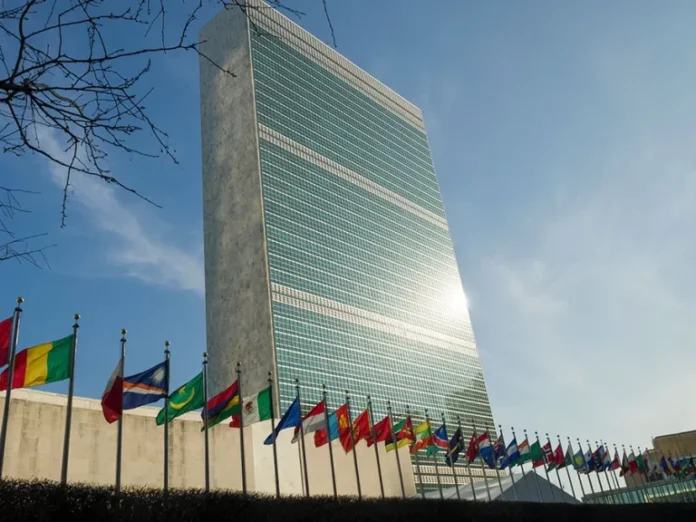
UNITED NATIONS , Sep 22 (APP): Pakistan’s Prime Minister Shehbaz Sharif will join world leaders at the United Nations next week to deliberate on key international issues, as wars in the Middle East and Europe threaten to spread with no end in sight and to address Global South’s concerns over increasing poverty, inflation and debt burden, while impacts of climate change worsen.
More than 130 heads of state/government will attend the high-level segment of the UN General Assembly’s 79th session beginning on Tuesday, Sept 24.
“We see out-of-control geopolitical divisions and runaway conflicts — not least in Ukraine, Gaza, Sudan and beyond,” U.N. Secretary-General Antonio Guterres told reporters at a news conference ahead of the annual debate.
Those three wars are set to dominate the agenda — both in world leaders’ speeches before the assembly and at numerous side meetings
Getting to a cease-fire in Gaza is even more urgent now that Israel has turned its guns towards its northern border with Lebanon in pursuit of its object to destroy Hezbollah. Earlier this week, Israel’s detonations of hand-held devices by Hezbollah members left 37 dead and a hundred more injured that outraged most of the world.
Meanwhile, hundreds of New York Police Department (NYPD) personnel on Sunday began erecting roadblocks and checkpoints around UN Headquarters in Manhattan to turn the area into a high-security zone to protect the visiting world leaders.
PM Shehbaz Sharif is scheduled to arrive in New York tomorrow at the head of the Pakistan delegation to UNGA. He will address the Assembly on September 27.
In his address, the prime minister will highlight Pakistan’s perspective on a range of international and regional issues of concern, including the Jammu and Kashmir dispute.
Before leaving Islamabad for London on his way to New York, PM Shehbaz Sharif posted on social media platform X (formerly Twitter), stating that he anticipates a “busy week full of engagements”.
“During our interactions, we will address global issues, promoting peace, development and climate action. I will represent Pakistan’s perspective to the world, advocate our interests and strengthen international partnerships,” he added.
On the sidelines of the UNGA session, the prime minister is scheduled to attend several high-level meetings, including
discussions on existential threats posed by sea level rise and the UN Security Council’s Open Debate on Leadership for Peace.
He will also have several bilateral meetings with world leaders and a call on the UN chief.
One of his most watched bilateral meetings will be with Dr. Muhammad Yunus, head of Bangladesh’s new caretaker government, amid dramatic improvement in Islamabad-Dhaka ties following the ouster of PM Sheikh Hasina that has sent shock waves across India.
US President Joe Biden, as leader of the host country, will be the second speaker on Tuesday, the opening day of the annual gathering of world leaders who take the pulse of the planet and tackle global challenge.
This year’s theme for the session is n“Leaving no one behind: acting together for the advancement of peace, sustainable development and human dignity for present and future generations.”
“We hope that the 79th UNGA session, preceded by the Summit of the Future, will spur renewed international solidarity and cooperation to meet the challenges of our times and promote peace, progress and prosperity across the globe,” Pakistan UN Ambassador Munir Akram said, while noting that the meeting was taking place at an important juncture.
“The international security environment is tense and turbulent,” Ambassador Akram said in an interview with APP special correspondent at the UN.
“Global economic trends are also negative, constraining economic and social progress in the developing countries,” the Pakistani envoy said, adding, “The adverse impacts of climate change are become more acute.”
“Pakistan will enhance its focus on advancing sustainable development as well as international peace and security through the UN platform to works towards a more equitable and just international order,” Ambassador Akram said.
Several top-level meetings happening during the General Assembly focus on priorities of developing countries in Africa, Latin America and Asia: climate, health, financing for development, and how to get the Sustainable Development Goals – a global “to do” list created in 2015 – on track.
In a series of briefings, UN officials have said that efforts to address Global South needs, including tackling poverty and diseases and improving access to clean water and energy, are trailing far behind the target that U.N. member countries have set for themselves through the SDGs.
Israeli Prime Minister Benjamin Netanyahu and Palestinian President Mahmoud Abbas are addressing the General Assembly on Sept 26 as the conflict rages on
Several new leaders will make their debut at this year’s gathering, including British Prime Minister Keir Starmer and Iranian President Masoud Pezeshkian.
This will be Biden’s final time at the General Assembly podium.
APP/ift
Two killed in motorcycle-trawler collision in Kashmore

Hundreds of global artists to perform in “World Culture Festival Karachi”
KARACHI, Sep 22 (APP): A 5-day “World Culture Festival Karachi” (WCFK) will be held at the Arts Council of Pakistan from September 26 to 30 in which over 250 global artists to perform.
According to the Arts Council of Pakistan’s social media post, the Festival hosted by Arts Council of Pakistan will commence on Thursday (September 26) in which 250 artists from 35 countries across all continents would showcase the best talent in music, theatre, dance and the fine arts.
ACP president Syed Ahmed Shah said WCFK is a grand celebration of the Arts Council of Pakistan, Karachi’s efforts of cultural diplomacy.
This festival is the grandest global artistic gathering ever hosted in Pakistan.
The event is set to bring together over 250 artists from over 35 countries to showcase the best talent in music, theatre, dance and fine arts in a manner never seen before, ACP post stated.
Meanwhile, Rafaele Giovanola, a Swiss born American choreographer said in a social media post that Germany will be represented by Cocoon Dance at the Festival on September 27.
She appealed the art lovers to attend the World Culture Festival and enjoy the cultural performances presented by the Cocoon Dance Company as well as other artists.
IRSA releases 196,600 cusecs water
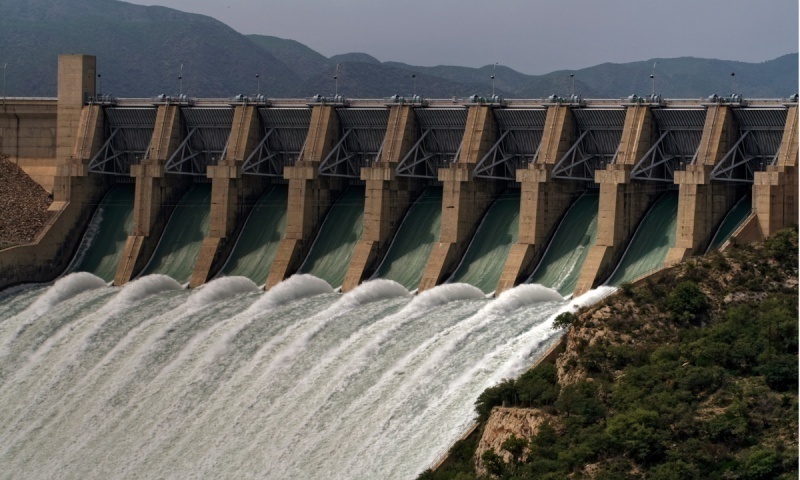
ISLAMABAD, Sep 22 (APP): Indus River System Authority (IRSA) on Sunday released 196,600 cusecs water from various rim stations with inflow of 138,300 cusecs.
According to the data released by IRSA, water level in River Indus at Tarbela Dam was 1538.86 feet and was 140.86 feet higher than its dead level of 1,398 feet. Water inflow and outflow in the dam was recorded as 81,400 cusecs and 110,000 cusecs respectively.
The water level in River Jhelum at Mangla Dam was 1222.85 feet, which was 174.85 feet higher than its dead level of 1,050 feet. The inflow and outflow of water was recorded 15,300 cusecs and 45,000 cusecs respectively.
The release of water at Kalabagh, Taunsa , Guddu and Sukkur was recorded as 91,100, 110,100, 89,000 and 37,800 cusecs respectively.
Similarly, from River Kabul, a total of 17,900 cusecs of water released at Nowshera and 4,200 cusecs released from River Chenab at Marala.
Research on new seeds imperative to enhance agriculture productivity
By Iftikhar Ahmad
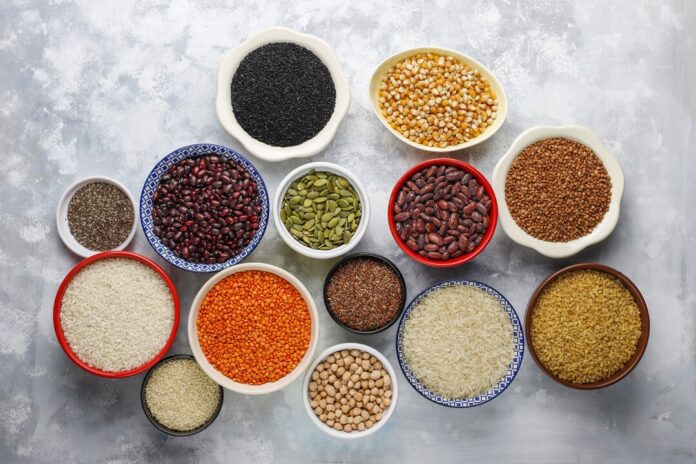
FAISALABAD, Sep 22 (APP): In a rapidly changing world and mounting population pressure, countries like Pakistan shall have to embark on strategies aiming at generating new seed varieties for enhanced productivity and compatibility to climate change effects.
Although research and development of seeds is a continuous ongoing and tough process, yet it is imperative to enhance agriculture produce to cater to food requirements of burgeoning population and achieve the goals of food security and national progress and prosperity.
Immediately after independence, per acre yield of wheat in the country was only 15 maunds which pressured the government as well as scientists’ to research and develop high-yielding and disease-resistant varieties to ensure adequate supply of wheat and make the country self-reliant in this basic staple food.
MaxiPak was the first seed to revolutionize wheat production and Nuclear Institute for Agriculture & Biology (NIAB) developed cotton variety NIAB-78 that ruled around two decades giving maximum yield of 14 billion bales.
Thereafter, a number of research institutes were established with dedicated task of seed research and development and our scientists developed a large number of seed varieties for different climatic zones.
Very recently, the Cotton Research Institute Sakrand has developed three new cotton varieties including one non-BT (CRIS 644) and two BT varieties (CRIS 674 and CRIS 682).
Similarly, University of Agriculture Faisalabad (UAF) recently developed soybean seed that is suitable for local farming and would help Pakistan to curtail import of soybean and locally meet soybean needs.
“Only the UAF soybean variety can help country save $1.5 billion spent on import of edible oil,” said Prof Dr Iqrar Ahmad Khan, Vice Chancellor (VC) UAF. “We have produced 50 new high-yielding varieties of different crops, fruits and vegetables during last three years.”
Recently, he informed that UAF developed two high-yielding sugarcane varieties including Insect-resistant transgenic sugarcane (CABB-IRS) and Herbicide-tolerant transgenic sugarcane (CABB-HTS). “These varieties carry superior traits like input-responsiveness, early maturing (suitable for plantation even after wheat in the months of April and May), top borer-resistance, herbicide-tolerance and high-number of tillers.”
“These varieties are second in the world and first in Pakistan and would help boost up sugarcane productivity manifold,” he added.
Similarly, Ayub Agricultural Research Institute (AARI) scientists have so far developed more than 700 seed varieties of different crops including 103 varieties of wheat and barley, 75 of cotton, 35 of rice, 29 of sugarcane, 48 of maize and millets, 51 of pulses, 57 of oilseeds, 47 of fodder, 83 of vegetables and 159 varieties of fruits.
“Now, AARI scientists are striving hard to surpass the yield barriers and their efforts are to move from green revolution to the gene revolution,” stated a spokesman of Ayub Research Institute.
He informed that at the time of independence, the country’s wheat production was 2.63 million tons that has now increased by ten times. “AARI scientists are also working to develop new seed varieties by keeping in view the facts of 2050 when we would need 37 million tons of wheat to feed an approximately 334 million population.”
Similar situation is with cotton varieties and other crops. Cotton varieties are now catering the need of textile industry with more than 1000 ginning factories, 400 textile mills, 7 million spindles, 27000 looms in the mill sector, more than 25000 looms in nom-mill sector, 700 knitwear units, 4000 garment units, nearly 1000 ginners and 5000 oil expellers.
Although AARI varieties are playing a pivotal role in increasing agricultural productivity in the country in general and in Punjab in particular, yet our scientists are trying their optimum best to develop new varieties to meet our needs for the next 50 to 100 years.
Muhammad Akhtar, a progressive farmer has appreciated these efforts stating that our research institutes have developed seeds of more than 1000 high-yielding varieties that are sufficient to meet our domestic needs.
But, he was critical of exploiters and usurpers who hinder on way to reaching these benefits to farmers and agriculturists. “The real problem lies with enforcement of law as exploiters in our society who provide substandard, mixed or spurious seeds to farmers just to mint money.”
He urged the government to promulgate and implement laws to regulate the business of seeds and allied requirements, award punishment to substandard seed suppliers and save farmers from such cheaters. “The research of our institutes and hardworking scientists would go in vain if a proper mechanism of disbursing certified seeds to farmers is not put in place.”
Since, the research and development process takes a decade to develop required-seed varieties, therefore, our scientists must also concentrate on producing pests resistant and climate change efficient seeds and also use latest techniques like genetic mapping and Artificial Intelligence for better results. Economic aspect must also be another area of focus for them to develop seeds with a futuristic vision and for a particular environment to avert attack of specific diseases.
In this scenario, what is direly needed is to ensure a mechanism where quality seed reaches the farmers and the notorious market players are taken to task for an ultimate agricultural and economic growth and meet the most daunting challenge of food security.
APP/iah/maz (APP Feature Service)