Bus hostess killed, 14 passengers injured
Romanian Embassy to arrange Christmas Carols concert in Islamabad
Pakistan pushes for ‘serious dialogue’ to end Congo conflict as situation deteriorates
By Iftikhar Ali
UNITED NATIONS, Dec 13 (APP): Amid a rapidly deteriorating situation in eastern Democratic Republic of Congo (DRC) stemming from intensified fighting and mass displacement, Pakistan has urged parties to the conflict — Congolese military and Rwanda-backed M23 rebels– to engage in “serious dialogue” and fulfill their obligations under various agreements aimed at bringing peace to the region.
“We call for an immediate ceasefire, and complete cessation of hostilities,” Ambassador Asim Iftikhar Ahmad, permanent representative of Pakistan to the UN, said in a speech to the UN Security Council, which was convened to discuss the situation in DRC on Friday.
Describing the situation in DRC as “volatile”, the Pakistani envoy pointed out that M23 rebels continue their territorial expansion, including the recent takeover of the strategic City of Uvira. Despite the signing of the recent Washington Agreement, he said that M23 continues to receive external support, stressing that commitments undertaken must be implemented.
As a result, MONUSCO, the UN peacekeeping force in DRC, is under strain, he said. Ambassador Asim Ahmad condemned restrictions that leave nearly 40 per cent of the Mission’s area under M23 control and prevent civilian protection.
“M23 must allow MONUSCO to perform its mandate assigned by this Council,” he said, adding that MONUSCO must be given mandates that are realistic, achievable and aligned with realities on the ground.
Referring to MONUSCO’s budget cuts that led to the reduction of troops from 11,500 to only around 8,234 on the ground, the Pakistani envoy said, “This stark mismatch between the Mission’s responsibilities and shrinking resources must be urgently addressed to ensure that (the force) can effectively deliver on the tasks entrusted to it”.
Pakistan, as one of the largest troop-contributing countries to South Kivu, had earlier cautioned that the withdrawal from South Kivu was premature and might create a security vacuum. Regrettably, he added, that assessment has proven correct. “This also underscores the need to meaningfully consult those who serve on the ground. Decision-making on mandates and adjustments must better integrate the views of troop- and police-contributing countries and field leadership.”
In this regard, the Pakistani envoy said, the peace processes must strive to address the root causes of the conflict in the DRC for lasting peace and stability. “It is essential that all peace initiatives remain mutually reinforcing, and regionally-supported, backed by the Security Council, and grounded in safeguarding the sovereignty and territorial integrity of the DRC.”
Earlier, US Ambassador Mike Waltz told the Council that, having brought Rwanda and DRC together in Washington to sign a peace agreement just last week, the Government was “incredibly disappointed” in Kigali’s actions in recent days in support of the M23 rebels, which they fully control.
Jean-Pierre Lacroix, head of UN Peace Operations, warned that the offensive has revived “the spectre of a regional flare-up with incalculable consequences,” saying the territorial expansion of AFC/M23 and the weakening of the DRC Government’s authority in eastern areas threaten national unity, sovereignty and territorial integrity.
He said recent diplomatic breakthroughs – including the Washington Accords signed on 4 December between DRC and Rwanda, and the Doha Framework Agreement in November between DRC and the M23 – had generated genuine hope for de-escalation.
But persistent ceasefire violations and renewed fighting now risk unravelling that progress.
“The growing gap between political commitments and their effective implementation on the ground undermines the credibility of peace processes and fuels the sense of abandonment felt by civilians,” Lacroix said.
As violence escalates, the UN peacekeeping mission MONUSCO remains a central – and increasingly strained – pillar of civilian protection in eastern DRC, just days before the Security Council is set to decide on the renewal of its mandate.
Lacroix told Council members that MONUSCO continues to provide direct physical protection to around 100,000 displaced people living near its bases, particularly in North Kivu and Ituri, through daily patrols, early-warning systems and close engagement with communities.
He said the mission has adopted a more preventive posture, focusing on deterrence, rapid response and sustained presence around displacement sites where armed groups operate in proximity.
However, he cautioned that MONUSCO’s ability to carry out its mandate is being increasingly constrained. Restrictions imposed by AFC/M23 on freedom of movement, fuel supplies, water and electricity – along with the continued closure of Goma airport – are limiting mobility, delaying rotations and hampering humanitarian access.
At the same time, funding shortages and reductions in uniformed and civilian personnel, linked to the UN’s broader liquidity crisis, are affecting the mission’s rapid response capacity and operational reach.
Lacroix stressed MONUSCO’s role in protecting civilians and supporting de-escalation remains essential, warning that “diplomatic progress must now translate into real improvements on the ground.”
The humanitarian toll is mounting. Hospitals and clinics across North and South Kivu are struggling to cope with a steady influx of wounded civilians amid acute shortages of staff, medicines and equipment.
Dr Javid Abdelmoneim, emergency medicine doctor and international president of Médecins Sans Frontières (MSF), said health systems in eastern DRC are “collapsing” under the combined impact of violence, mass displacement and shrinking humanitarian access.
“MSF teams continue to witness staggering levels of violence, displacement and deprivation,” he said. “This crisis is not easing.”
Large-scale Murree winter preparedness exercise launched to bolster emergency response
Pakistan Russia Eurasia Forum 2025 to be held in Moscow, Russia on Dec 16
FMs of Islamic countries reaffirm vital role of UNRWA
ISLAMABAD, Dec 12 (APP): The Foreign Ministers of Pakistan, Egypt, Indonesia, Jordan, Qatar, Saudi Arabia, Türkiye, and the United Arab Emirates Friday, reaffirmed the indispensable role of the United Nations Relief and Works Agency for Palestine Refugees in the Near East (UNRWA) in safeguarding the rights and well-being of Palestinian refugees.
In a joint statement, the foreign ministers said, “For decades, UNRWA has carried out a unique mandate entrusted to it by the international community, providing protection, education, health care, social services, and emergency assistance to millions of Palestinian refugees in its areas of operation, in accordance with UN General Assembly Resolution 302 (1949). The adoption of the UN General Assembly resolution to renew UNRWA’s mandate for an additional three years reflects international confidence in the vital role played by the agency and the continuity of its operations.”
The ministers condemned the storming of the UNRWA headquarters in the Sheikh Jarrah neighborhood of East Jerusalem by Israeli forces, as this attack represented a flagrant violation of international law and the inviolability of UN premises, which constituted an unacceptable escalation, and violated the advisory opinion of the International Court of Justice dated 22 October 2025, which clearly stated that Israel, as an occupying power, is under an obligation not to impede the operations of UNRWA and, on the contrary, to facilitate them.
In light of the unprecedented humanitarian crisis in the Gaza Strip, the ministers underscored the essential role UNRWA played in delivering humanitarian assistance through its network of distribution centers, ensuring that food, relief items, and necessities reach those in need fairly and efficiently, in accordance with Security Council Resolution 2803.
UNRWA’s schools and health facilities remain a lifeline for refugee communities in Gaza, continuing to provide education and essential primary health care under extremely challenging conditions, which contributes to the implementation of President Trump’s Plan on the ground and enables the Palestinian people to remain in their land and rebuild their homeland, they added.
The ministers stressed that UNRWA’s role was irreplaceable.
“No other entity possesses the infrastructure, expertise, and field presence required to meet the needs of Palestinian refugees or to ensure continuity of services at the necessary scale,” they added.
They said, “Any weakening of the agency’s capacity would have grave humanitarian, social, and political repercussions across the region. ”
Accordingly, the ministers called upon the international community to ensure sustainable and adequate funding for UNRWA, and to provide the agency with the political and operational space needed to continue its vital work “in all five fields of operations”.
“Supporting UNRWA is a cornerstone of maintaining stability, preserving human dignity, and upholding the rights of Palestinian refugees until a just and lasting solution to their plight is achieved in accordance with international law and relevant United Nations resolutions, including UN General Assembly resolution 194,” they added.
DPM arrives in Abu Dhabi
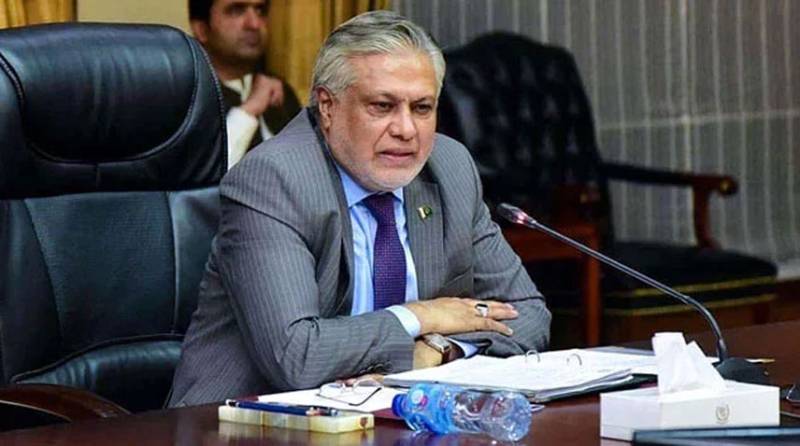
ABU DHABI, Dec 12 (APP): Deputy Prime Minister/Foreign Minister Senator Mohammad Ishaq Dar Friday arrived here, from where he will depart for Bani Yas to attend the 16th Bani Yas Forum (12–14 December 2025).
He was received at the airport by the UAE Royal Protocol representative and Pakistan’s ambassador to the UAE, Shafqat Ali Khan and senior officials.