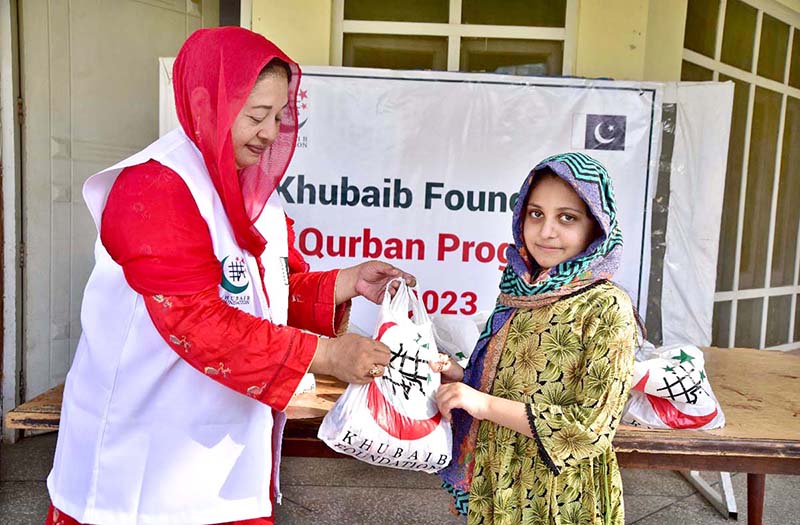
Principal Khubaib Girl School & College, Sarwat Ansar distributing meat among the deserving people donated by Zakaat Foundation America at Khubaib Girls School & College on the 2nd day of Eid-ul-Adha
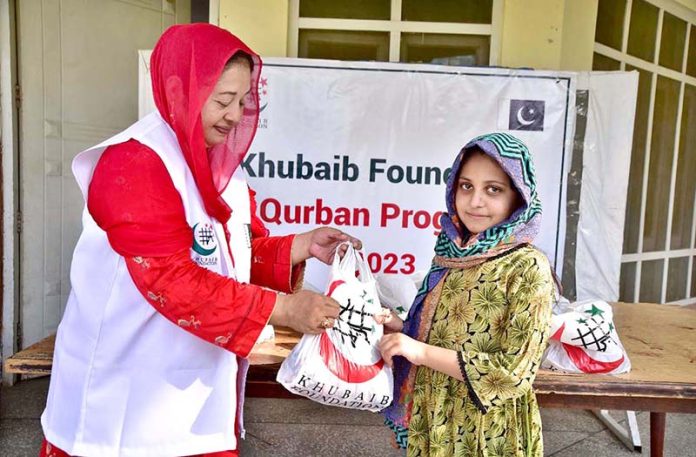
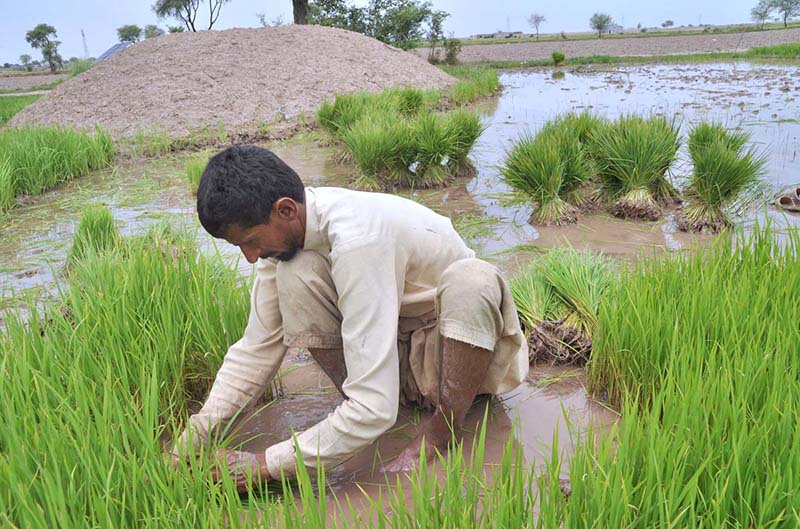
A farmer extracting rice crop seedlings in their farm field at Moza Boori
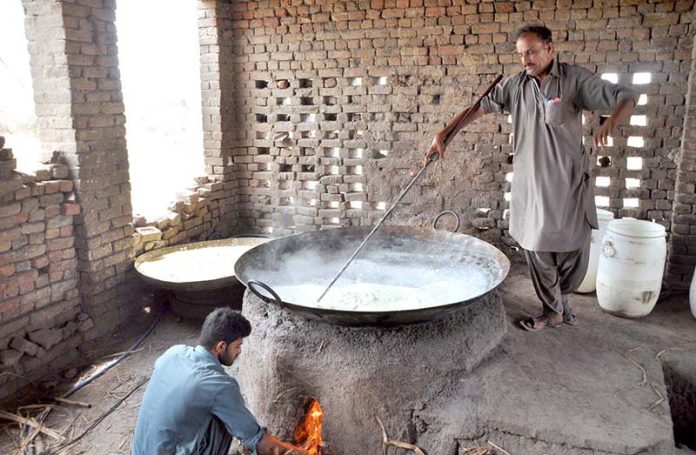
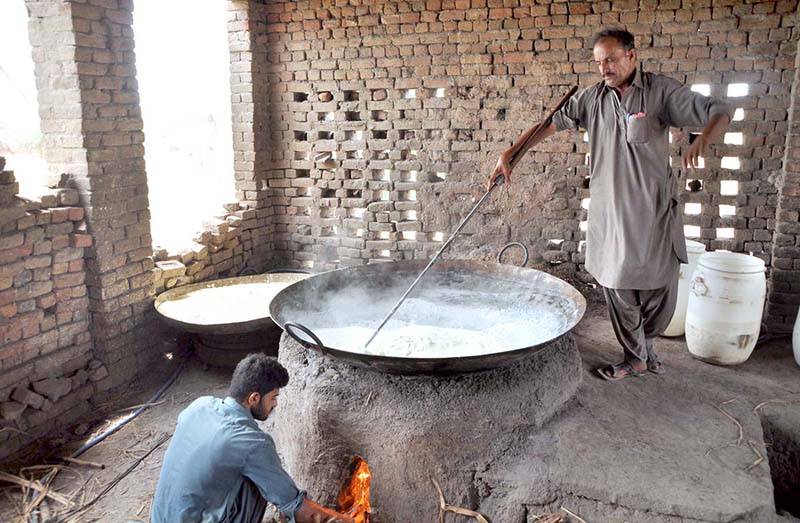
People sacrificing animal on the 2nd day of Eid-ul-Adha
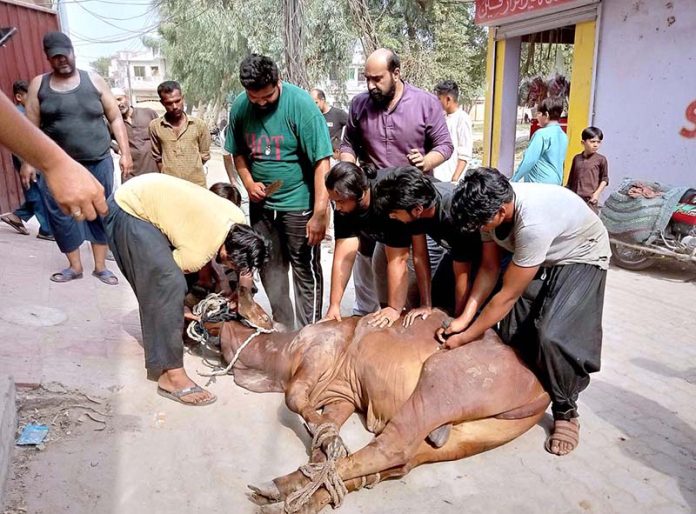

Butchers slaughtering sacrificial animal on the 2nd day of Eid ul Azha


President strongly condemns desecration of Holy Quran in Sweden; urges measures for prevention of Islamophobic acts
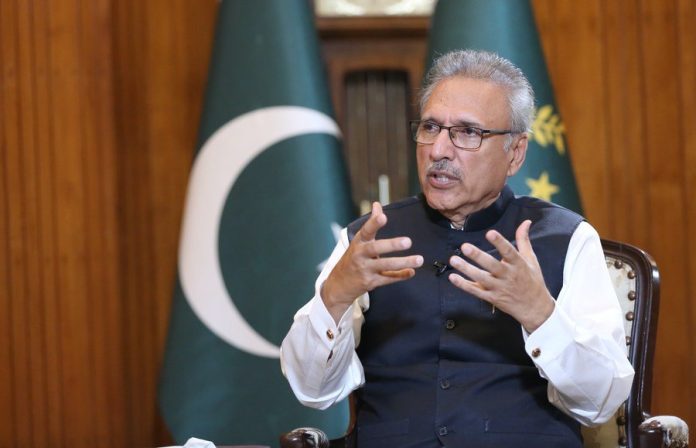
ISLAMABAD, June 30 (APP): President Dr Arif Alvi on Friday strongly condemned the desecration of the Holy Quran in Sweden and said the painful incident had deeply hurt the sentiments of billions of Muslims.
On his Twitter handle, the president said that every state must take measures for the prevention of such Islamophobic acts.
“I urge the international community to work for promoting inter-faith harmony and dialogue to create tolerance for each other’s religious beliefs and values,” he added in a related tweet.
The president stressed that humanity must move away from acts of senseless hatred towards uniting the world in peace.
Xi to deliver important speech at SCO Council of Heads of State meeting: Mao Ning
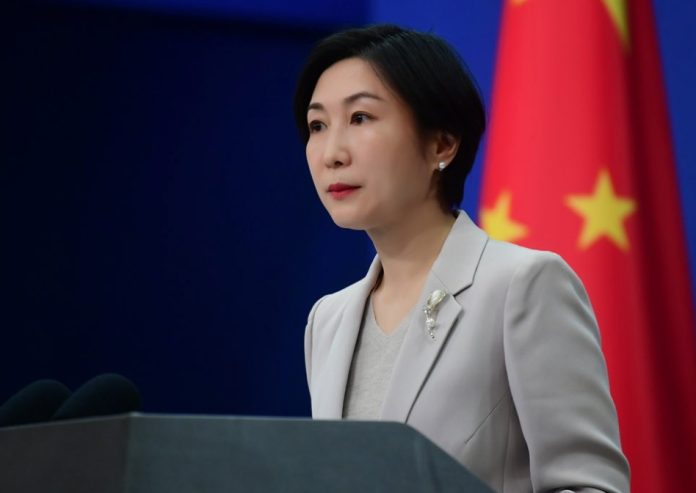
BEIJING, June 30 (APP): China’s Foreign Ministry on Friday announced that Chinese President Xi Jinping’s attendance at the 23rd Meeting of the Council of Heads of State of the Shanghai Cooperation Organization (SCO) via video link would further strengthen cooperation to counter heightened geopolitical confrontations.
President Xi will deliver important remarks at the meeting and, together with other participating leaders, chart the course for the future growth of the organization. With the concerted efforts of all sides, the SCO will achieve greater progress and boost development and prosperity in regional countries, Chinese Foreign Ministry spokesperson Mao Ning said.
The spokesperson also outlined China’s expectations for the upcoming summit, saying that in a world marked by change and disorder and fraught with increasing instability, uncertainties and unpredictable factors, regional countries as well as other members of the international community are looking to the SCO to play a bigger role in safeguarding regional security and promoting common development.
As a founding member, China views the SCO as a priority in its foreign affairs. We stand ready to work with other members to act on the Global Development Initiative, the Global Security Initiative and the Global Civilization Initiative, build an even closer SCO community with a shared future, and usher in a brighter future for the Eurasian continent, said Mao.
India is the chair nation of this year’s summit of the SCO Council of Heads of State, and its external affairs ministry said on Tuesday that heads of state of all members were invited. Defense and foreign ministers from member states attended in-person meetings in India earlier this year.
The upcoming SCO summit is to be held as Iran becomes the newest member of the SCO, which marks the SCO coordination mechanism ushering in a new development phase, Zhao Huirong, an Eastern European studies expert from the Chinese Academy of Social Sciences, told the Global Times.
Iran’s ambassador to India Iraj Elahi said in March that the process of Iran acquiring membership in the SCO will be completed at the upcoming summit in India, according to Indian media reports.
In September 2021, the 21st summit of the SCO leaders held in Tajikistan’s capital Dushanbe announced the decision to start admitting Iran as a full member of the organization. Belarus, another observer country, is reportedly set to start the process of becoming a member of the SCO during the meeting.
The SCO, guided by the Shanghai Spirit, has continuously consolidated good neighbourliness and political mutual trust between member states and played an important and constructive role in international and regional affairs, analysts said, expressing expectations that the upcoming SCO meeting will inject impetus into regional development amid increasing threats.
The Eurasian region has recently faced a severe security deficit after the Russia-Ukraine conflict began in 2022 with increasing threats to traditional and non-traditional security fields. For example, the heightened confrontation between Russia and the US has intensified geopolitical competition, terrorism remains active in the region, and climate change and food issues concern regional countries.
All these topics will be discussed during the summit, Cui Heng, a lecturer at the China-Shanghai Cooperation Organization training base for international judicial exchanges and cooperation, told the Global Times on Friday.
How to ensure efficiency within the SCO as its membership grows will also be a topic that may be discussed by the member states, Cui said.
Zhao noted that SCO member countries will push forward cooperation in four major fields – security, economic development, people-to-people exchanges, and political cooperation. Member states have reached a consensus on fighting terrorism, extremism and separatism and will further promote pragmatic cooperation in the field.
They will also pay attention to food, energy security, the stability of supply chains and facilitation of trade, said Zhao, noting that some new documents in the above fields are expected to be made during the meeting.
The Shanghai Spirit, which undergirds values and guidelines for the SCO, featuring mutual trust, mutual benefit, equality, consultation, respect for diversity of civilizations, and pursuit of common development, is consistent with the pursuits of new developing countries and has been well-accepted by them.
The SCO coordination mechanism has brought concrete benefits to member states and observer states and through cooperation on security and other fields, countries can find consensus and shared interests to avoid misunderstanding or escalation of conflicts, which is conducive to regional peace and stability, said Zhao.
Pakistani youth leader calls for int’l efforts to address climate change
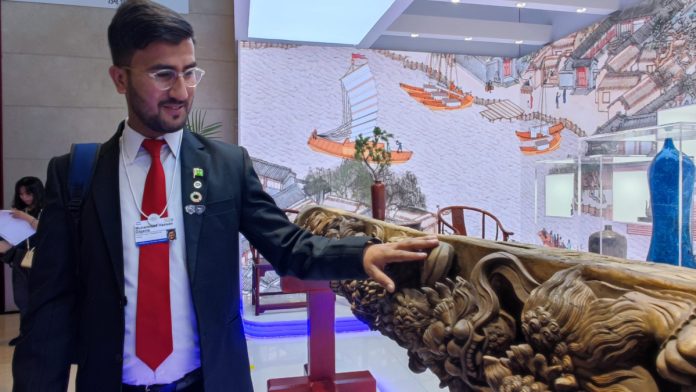
BEIJING, , Jun 30 (APP):A Pakistani youth, who attended the just concluded 14th Annual Meeting of the New Champions (AMNC) – also known as the Summer Davos Forum, has called for international efforts to address the issue of climate change.
“It’s my first visit to China. I hope to leverage this opportunity to do something for my country Pakistan and its lovely people,” Muhammad Hassan Dajana, a Climate Action and Advocacy Professional from Pakistan, told China Economic Net (CEN).
This year’s Summer Davos Forum – scheduled from June 27 to 29 – gathered over 1,500 global leaders from business, government, civil society and international organizations as well as from among innovators and academics, at a crucial time for global economic recovery. Energy transition and materials supply, conservation of nature and climate were among the six major topics of the event.
“I am extremely happy to be selected by the Global Shapers Community – an initiative of the World Economic Forum – to participate in the AMNC as a delegate representing the Rawalpindi Hub from Pakistan,” Dajana noted.
The AMNC 2023 facilitated dialogue and cooperation among policy-makers, business, technology pioneers, entrepreneurs and innovators to address the world’s most pressing challenges, including the climate, cost of living, energy and food crises.
As the co-Founder of Urban Sustainability Startup Green Squad and also the Programme Manager of Amal Academy, Dajana told CEN that the theme “Safeguarding Nature and Climate” was of particular relevance to his work.
“Pakistan is responsible for less than 1% of the world’s planet-warming gases, yet it is one of the top ten most vulnerable nations to the climate crisis,” he highlighted and proposed joint efforts to address the climate issue.
“The first thing is accountability. The world should join hands to increase green climate finance for relevant equipment; secondly, our adaptation and resilience. I think we have wonderful support from China as a wonderful leader; the third is that we need to plan better. We need collaborative networking with the rest of the world, using COP 15 and other mechanisms to do something about it.”
Dajana said with prior experiences in the United States and Europe, he looked forward to seeing what the East could offer.
He said the world was standing at a very crucial stage that multilateral globalism was being converted into unilateral polarization. However, “this forum brings together the world to China. I look forward to connecting with colleagues working on Climate Action, especially business and industry leaders and in particular Chinese colleagues.”
China’s leading solar provider commits to optimizing PV market in Pakistan
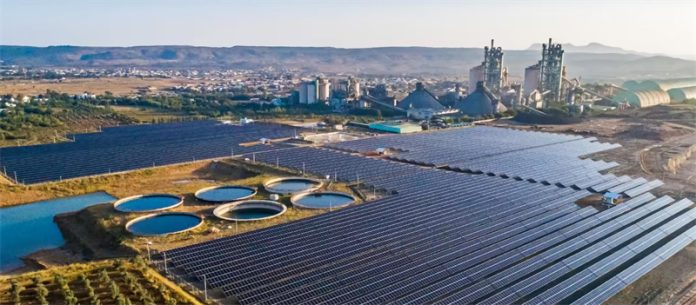
BEIJING, June. 30 (APP): Recently, China’s leading solar solutions provider LONGi and three certification and testing institutions, including SGS (Shanghai), SGS (Qingdao), and Intertek, held a strategic cooperation signing ceremony in Shanghai, by which the four parties will strengthen cooperation in the fields of PSI+COC certification and testing necessary for photovoltaic modules to enter the Pakistani market.
Ali Majid, General Manager, Pakistan, LONGi Solar, attended the ceremony to sign the agreement, China Economic Net (CEN) reported on Friday.
According to the agreement, the institutions will carry out standardized management of module certification and testing with LONGi. The three certification and testing institutions are consistent with the LONGi agreement, and when certifying LONGi modules whose destination country is Pakistan, the three certification and testing institutions need to obtain written testing authorization from LONGi before they can carry out product testing and certification.
The four parties will crack down on counterfeit LONGi products from the source, protecting the rights and interests of customers and ensuring the sustainable development of LONGi’s panels business, and working together to build a healthy business environment for Pakistan’s PV market.
Photovoltaic power generation, as the best choice to solve Pakistan’s power shortage and optimize its energy structure to a great extent based on fossil fuels, while saving foreign exchange required for energy imports, has vast potential for future development.
From 2012 to 2022, LONGi produced a total of 290GW of photovoltaic products, with the cumulative output of clean electricity exceeding 1,148,287 GWh. According to the International Energy Agency’s global power grid average emission factor, it is equivalent to avoiding 536 million tons of carbon dioxide emissions.
As for the Pakistani market, both distributed and centralized PV products have market segment demand, distributed PV systems, such as rooftop solar installations on residential, commercial, and industrial buildings, have been gaining popularity in Pakistan.
Majid mentioned that net metering policies and incentives had been introduced to promote distributed generation and allow consumers to offset their electricity bills by exporting excess power back to the grid.
“In recent years, the Pakistani government has successively formulated a number of related policies, thus the country’s photovoltaic industry has shown good development potential. According to Pakistan’s long-term power plan – the Indicative Generation Capacity Expansion Plan (IGCEP), the cumulative installed capacity of photovoltaics will reach 12%, or 13.2GW, by 2030, and the government will continue to provide maximum support for renewable energy projects.
“The global photovoltaic industry is developing in full swing. China-Pakistan cooperation in related industries can make due contributions to the global response to climate change,” Majid said.
Huawei unveils 5GigaGreen innovations to enhance wireless communications performance
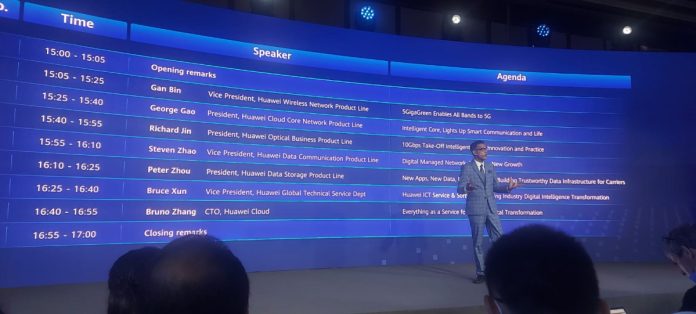
SHANGHAI, Jun 30 (APP): Huawei, a global leader in telecommunications technology, has introduced 5GigaGreen – a groundbreaking initiative to revolutionize wireless communications and advance network performance while prioritizing energy efficiency.
Gan Bin, Vice President and Chief Marketing Officer of Huawei Wireless Network Product, announced the launch of the cutting-edge innovations, which aim to promote the ultimate network experience while minimizing energy consumption.
“Ultimate performance and energy saving are the driven forces for Huawei wireless innovation. Adhering to the philosophy of 5GigaGreen, Huawei keeps innovating in ultra-wideband, multi-antenna, maximized passive capability, and “0 bit 0 watt” equipment and network to make 5G from good to great” he said while addressing the MWC Shanghai 2023.
Huawei’s ultra-wideband solution combines multiple bands into one for lower energy consumption and is applicable to all bands and scenarios.
With the innovations in ultra-wideband RF and power amplifier algorithm, Huawei is able to introduce the triple-band FDD 4T4R RRU, boasting the lowest power consumption in the industry, which supports the simplified deployment of all RATs on all frequency bands and offers a more than 20% energy consumption gain compared with the industry average.
In Europe, after a site is upgraded from four to six bands, its energy consumption can be reduced by 30%. The ultra-wideband 4T4R RRUs have already entered large-scale commercial use around the world, with over 100,000 shipments.
Huawei has also expanded ultra-wideband technology from FDD to TDD. The 800 MHz MetaAAU, the industry’s largest bandwidth, covers the full C-band and reduces power consumption by 20% than two separate 400 MHz modules.
Ultra-wideband has also been expanded from macro base stations to microwave and DIS. In microwave, the new 2T ODU enables the aggregation of more carriers to deliver 800 MHz bandwidth, reducing power consumption by 50% compared with the industry average. Furthermore, ultra-wideband LampSite enables 2 GHz bandwidth, slashing the power consumption of the entire site by 40%.
Supported by multi-antenna and large-bandwidth technologies, Huawei TDD Massive MIMO improves bit energy efficiency by 20 times compared with 4T4R.
In high-traffic areas of commercial networks in the Middle East, TDD 64T64R Massive MIMO has achieved a bit energy efficiency gain of more than 10 times by employing multi-layer pairing technology. In the future, traffic volume will keep increasing, and more layers will be configured to improve the bit energy efficiency by up to 20 times.
Huawei is also the industry leader in FDD multi-antenna technology. In Europe, the FDD 8T8R solution, with its intelligent beam forming algorithm, has achieved a gain in bit energy efficiency of 1.5 times compared with traditional 4T4R. FDD M-MIMO, which is the only solution in the industry that is in large-scale commercial use, has improved energy efficiency by 3 times.
With the enhancement in 3GPP Release 18 and beyond, it will be possible to achieve a 4 to 6 times increase in energy efficiency. Signal direct injection feeding (SDIF) is Huawei’s unique advanced antenna technology. It achieves zero cable and reduces loss by 1.5 dB.
It works with Meta Lens to concentrate beam energy for greater RF efficiency of antennas, improving energy efficiency by 25%. Huawei has delivered more than 250,000 green antennas for global commercial networks. In addition, Huawei continues to innovate in TDD Massive MIMO.
The industry’s unique MetaAAU introduces extremely large antenna array (ELAA) technology. In Europe, compared with traditional AAUs, MetaAAU has reduced energy consumption by 33%, while providing the same coverage, thanks to innovations in algorithms, architectures, software, and hardware.
MetaAAUs have already entered large-scale commercial use around the world, with over 100,000 pieces shipped. Based on advanced hardware and software design, Huawei has achieved the industry’s first super deep dormancy with a 99% shutdown ratio, cutting equipment operating power to less than 5 W. With the innovative on-demand wakeup algorithm, equipment can wake up at any time to guarantee user experience.
Huawei is also the first company in the industry to achieve millisecond-level carrier and channel shutdown through joint innovations with digital and RF modules.
This capability means an additional 10% energy saving compared with the minute-level shutdown commonly seen in the industry. On a single network, traffic volume, energy-saving features, band and equipment energy efficiency, and the coverage of each band vary across sites.
Huawei iPowerStar implements intelligent energy saving strategy orchestration that is based on the traffic characteristics, energy saving characteristics, energy efficiency grids, and experience grids on live networks.
This maximizes the energy efficiency of multi-band networks by applying an optimal strategy for each site at each time. During the May Day holiday in Hebei, China, iPowerStar reduced energy consumption by 19%, while traffic volume increased by 19%.
Overall, the energy efficiency of the network increased by 45%. At the end of his speech, Gan Bin said that Huawei will never stop 5GigaGreen innovation and will continue working with industry partners to make 5G from good to great.