PM reiterates call for Charter of Economy to ensure consistent economic policies
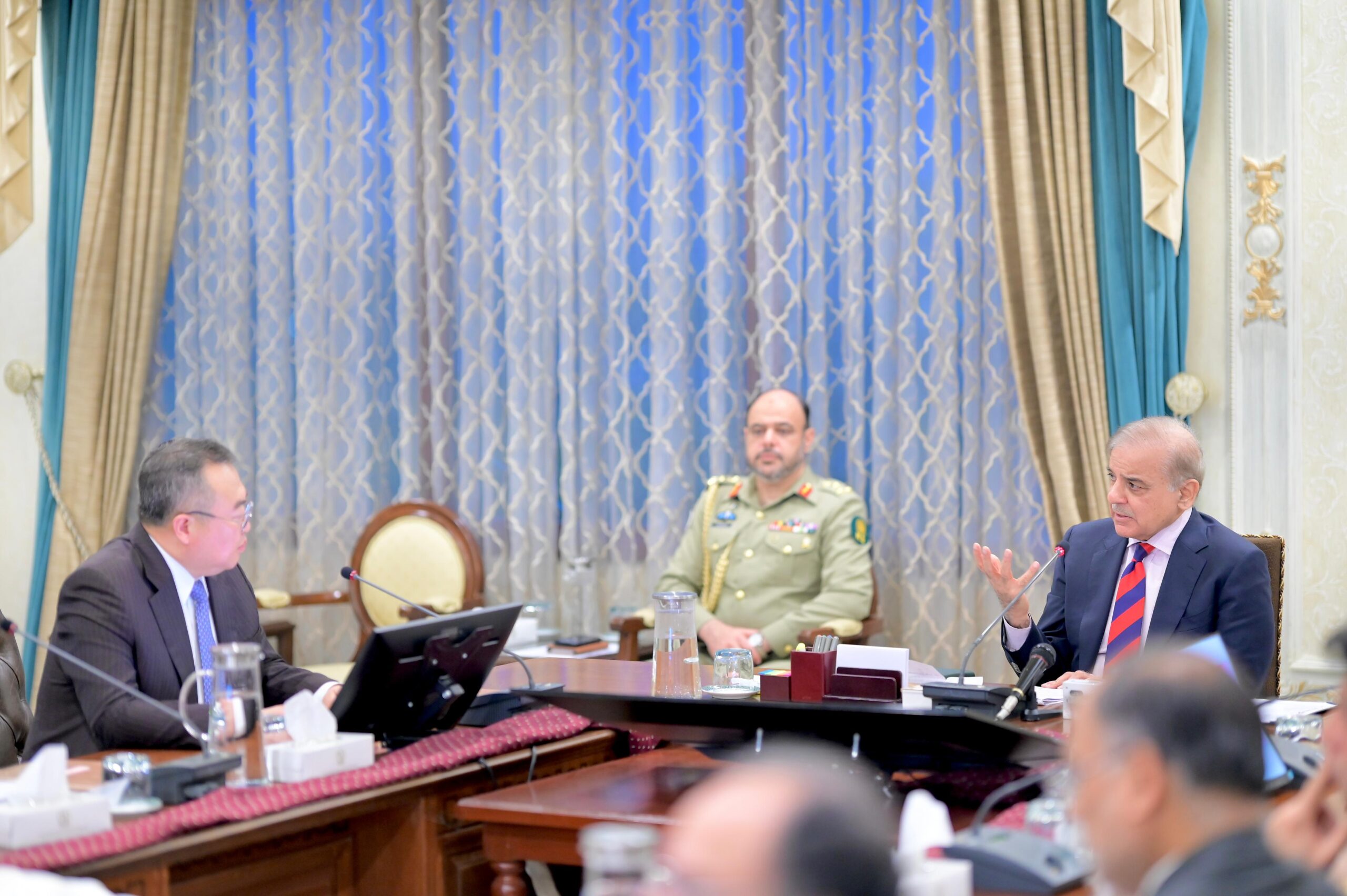
ISLAMABAD, July 18 (APP): Prime Minister Shehbaz Sharif on Tuesday reiterated his call for the nation to unite on Charter of Economy to ensure the consistency of economic policies and put country on the course towards progress and prosperity.
The prime minister, addressing the groundbreaking ceremony of Islamabad Model Special Economic Zone, said with the signing of IMF agreement, the risks for default had ebbed away and the country would have to focus on boosting exports to compete with the neighboring states particularly the eastern neighbor.
He said the Islamabad Model Special Economic Zone was launched with a delay of five years as nine SEZs were planned to be built under China Pakistan Economic Corridor (CPEC).
He said despite the land and designs finalised for the SEZs in Punjab, the previous government not only impeded the projects but also made conscious effort to undermine the Pak-China ties.

The prime minister, who earlier broke ground for the project and penned a testimonial, said that during Nawaz Sharif’s tenure, $30 billion Chinese investment came to the country in form of CPEC featuring power and road projects.
He told the gathering that after the Chinese industry gone hitech, Pakistan had the golden opportunity to learn from the Chinese textile expertise, go for joint ventures and bring Chinese second hand machinery to Pakistan to boost its exports.
He said during last 14 months, the incumbent government remained in the “fire-fighting” as it had to cope with the unprecedented floods and record inflation begotten by the Ukraine war.
The prime minister said after the IMF agreement, the government would mainly focus on boosting industrial and agriculture sectors.
He told the gathering that a Special Investment Facilitation Council had been established with a mandate to attract investment to the agriculture, mining, information technology and exports sectors.
He said the government would abide by the IMF agreement which had laid a basis for the economic reforms.

Citing the Bangladesh’s $40 billion export of imported cotton, the prime minister said the successful nations always learned lessons from the past mistakes strived to cope with the challenge.
“Now we will have to get out of the loans and attract investment. This is what the Model Special Economic Zone is for to attract investment from China, UAE, Qatar and others to take Pakistan at par with the neighboring nations,” he added.
Prime Minister Shehbaz said in the past, the SEZ turned into the development estate and the people have been minting money.
Emphasising the provision of land to the investors in SEZs on easy terms, he said the land in the Bahawalpur Solar Park was leased out at just $1 to the investors which was inevitable for the investors to save its capital to set up the industry.
He also called for establishing a mechanism to cancel the lease agreement if the investor failed to develop the industry within the specified timeframe.
In his address, Planning Minister Ahsan Iqbal said after 2020, the establishment of nine industrial zones was agreed under CPEC but the previous government put all the projects to the backburner. The officers were implicated in the false cases which begot a crisis of decision making, he added.
He said the incumbent govt took up the SEZs on priority basis and started reviving the stalled projects as Rashakai SEZ was about to be inaugurated.
Emphasising the execution of 5E framework, the minister said the country had no other option but to take its exports to $100 billion. These SEZ will act as a powerhouse to boost exports, he remarked and suggested that the land should be provided on easy terms to the investors.
Federal Minister for Industries and Production Makhdoom Syed Murtaza said with the establishment of Islamabad Model Special Economic Zone, a longstanding demand of Islamabad’s industrial community would be addressed.
Highlighting his ministry’s performance, he said they addressed the anomalies in the processes like the import of solar panels and that the petrochemical and coal gas policies would be finalised by July 30.
He called for taking advantage of Pakistan’s cheap labour and creating an ease of doing business environment in the country.
Secretary Board of Investment Asad Rehman Gillani said that PM’s vision of “investors are my masters” gave the government machinery a strength to execute the projects.
He told the gathering that SEZs would help develop the people-to-people and business-to-business contacts.
He said the Islamabad SEZ would be established over 1000 acres of land on the junction of N-5 and Islamabad Expressway and would create around 1000 jobs. Another industrial zone is already functional in the nearby area, he added.
The BOI Secretary said the industry with low-carbon footprints would be established in the Zone which would bring in an investment of around $2.5 billion.
PTA between Pak-Azerbaijan to be finalized in August
ISLAMABAD, Jul 18 (APP): A preferential Trade Agreement (PTA) between Pakistan and Azerbaijan is expected to be finalized in the first week of the coming month of August 2023, for evolving the trade liberalization and enhancing the bilateral trade between both countries.
Pakistan and Azerbaijan also agreed to initiate direct flight operations in major cities of both countries including Islamabad and Baku.
Azerbaijan Minister of Digital Development and Transport, Rashid Nabiyev, visited Pakistan on Tuesday to meet with Federal Minister for Commerce, Syed Naveed Qamar, to discuss the finalization of the Preferential Trade Agreement (PTA) and Transit Trade Agreement (TTA) between the two sides, said a press release issued here.
During the meeting, Minister Nabiyev informed Minister Qamar that the PTA is expected to be finalized in the first week of August, while the TTA is planned to be signed by the end of August or in September.
He mentioned that discussions regarding the TTA are currently underway in Azerbaijan’s relevant ministries.
In addition, Minister Nabiyev revealed that Azerbaijan to initiate flights of Azerbaijan Airlines between Islamabad and Baku soon.
Syed Naveed said direct flights would further strengthen the bilateral trade and connectivity between the two nations.
To ensure the timely finalization of the Transit Trade Agreement, Federal Minister Syed Naveed Qamar proposed the establishment of a High-Level Joint Working Group, which would actively work towards achieving the desired goals.
Both countries are presently engaged in negotiations for the Preferential Trade Agreement.
Pakistan has completed consultations to finalize its list of requested items, sharing a request list of 103 items with Azerbaijan on June 14, 2023, seeking market access.
On the other hand, Azerbaijan has shared its request list of 84 items, and the Ministry of Commerce in Pakistan is currently conducting stakeholder consultations on these items.
Regarding the Transit Trade Agreement, the Ministry of Commerce shared the draft agreement with Azerbaijan on September 15, 2022, with the consensus of all stakeholders.
The agreement encompasses all modes of transportation, including road, railways, air, and sea.
During the discussions, tariff reduction modalities and lists were also deliberated upon, with the aim of further facilitating trade between Azerbaijan and Pakistan.
Both sides expressed their commitment to enhancing bilateral trade ties between the “brother countries” and strengthening economic cooperation.
Online course to showcase ‘modern Indonesia’ begins
ISLAMABAD, Jul 18 (APP): An International Online Internship Programme (OIP), featuring prominent experts and scholars from Indonesia to showcase a ‘modern Indonesia’, share views and explore mutual learning opportunities for further development of bilateral ties, got underway here at the Bahria University on Tuesday.
The OIP, being organized in collaboration with the Indonesian Embassy, was inaugurated virtually by Dr Teuku Faizasyah, Indonesian Deputy Foreign Minister for Public Diplomacy.
Speaking on the occasion, Dr Teuku Faizasyah said,” The OIP applies a two-way learning approach, firstly it provides a platform to analyze Indonesia from various aspects and secondly, it allows participants to explore potential for cooperation from the current state of bilateral relations.”

Through the programme, he said, “we hope to enrich the participants’ knowledge about Indonesia and at the same time we hope that it will also stimulate exchanges of views on the topics of discussion among scholars, students and people in general”.
Dr Teuku Faizasyah said Indonesia and Pakistan had many similarities being the largest Muslim population and shared history of colonization, and today both strived for economic and social betterment of their citizens respectively.
“Let us not forget that in 1959 Indonesia and Pakistan together with Sri Lanka, Myanmar and India initiated the Asian African Conference to advocate the values of solidarity friendship and cooperation. These values remain relevant in the context of today’s geo-politic and geo-economic landscape where we face global competition among major powers.
“It is, therefore, important for two countries to strengthen our cooperation amidst these challenges and continue to invest in efforts to strengthen mutual understanding and people-to-people between our two countries,” he stressed.
The minister expressed the hope that the OIP would be one of the paths to achieve the goal and offered selected OIP alumni to participate in the public diplomacy programmes such as Indonesia-ASEAN cultural scholarship and friends of Indonesia.
Director General Bahria University, Islamabad, Rear Admiral Zakaur Rehman, in his welcome remarks, expressed his gratitude to chief guest Dr Teuku Faizasyah for his virtual presence at the OIP’s inaugural session.
He commended Ambassador Tugio’s initiative of organizing the OIP which reflected his interest in furthering the fraternal ties between Indonesia and Pakistan through education.
He urged the participants to fully benefit from the Indonesian panelists’ discussion on a diverse range of topics to enhance their understanding of emerging Indonesia’s contemporary dynamics.
Indonesian Ambassador Adam M Tugio, in his remarks, said,” The OIP brings a wealth of Indonesian experiences and similarities to share with the participants.”
He said besides the religious and cultural similarities, the OIP would also highlight Indonesia’s great struggle to overcome the successive and multiple enormous challenges, including political and economic crises.
Ambassador Tugio mentioned that in Pakistan Indonesia was synonymous to its founding father President Sukarno, Palm Oil and Bali. “Indonesia was much more than that because it is also a third largest democracy, a global emerging economy of inclusive growth and a pluralistic society with the largest Muslim population in the world.”
The envoy expressed his pleasure that the Pakistani students were among the highest recipients of scholarships in Indonesia in the last three years and added the OIP would hopefully attract more students from Pakistan to study modern Indonesia and in Indonesia as well.
At the session-I, Dr. Abdul Gaffar Karim from Gajah Mada University, Yogyakarta, on the topic of “Discourse on Islam and Nationalism in Indonesia” gave an insightful view on how discourse about Islam and nationalism has continued to resonate in modern Indonesia.
He discussed the ongoing debate on Islam and nationalism in Indonesia, a country with the world’s largest Muslim population.
“Despite not being an Islamic state, Indonesia’s 1945 constitution and Pancasila ideology ensure freedom of religion for all faith believers”, added Dr. Gaffar Karim.
Underscoring Indonesia’s diversity and pluralism, he further said that balance between Islam and nationalism remained a subject of constant debate.
The Online Internship Programme, which spans over six weeks, will have several dedicated sessions to ensure focused and productive engagement between the participants and the speakers on various aspects of Indonesia who join online from Indonesia.
Session 2 will be held on Thursday (20/08) focusing Indonesia’s journey to democracy.
A lady selecting and purchasing sunglasses from a roadside vendor