Under US prodding, India now seeks information from Canada on Sikh leader’s murder
UN urges support to Pakistan as floodwaters have receded, “needs have not”
UNITED NATIONS, Sep 28 (APP): UN Secretary-General Antonio Guterres, his top officials and representatives of key nations Wednesday reaffirmed support for Pakistan as it pushes ahead with the massive task of rebuilding following last year’s “apocalyptic” flood that submerged a third of the country.
The occasion was an informal meeting of the U.N. General Assembly convened to review the implementation of its last year’s resolution calling on the world community to increase aid and keep up the political will to support the country’s recovery long-term.
That resolution also expressed solidarity with the government and people of Pakistan in dealing with the aftermath of the devastation left behind by the climate-induced deluge.
Record-breaking floods in Pakistan affected over 33 million people and killed 1,700 or more. Nearly 8 million people were displaced, with many still living in tents and makeshift homes.
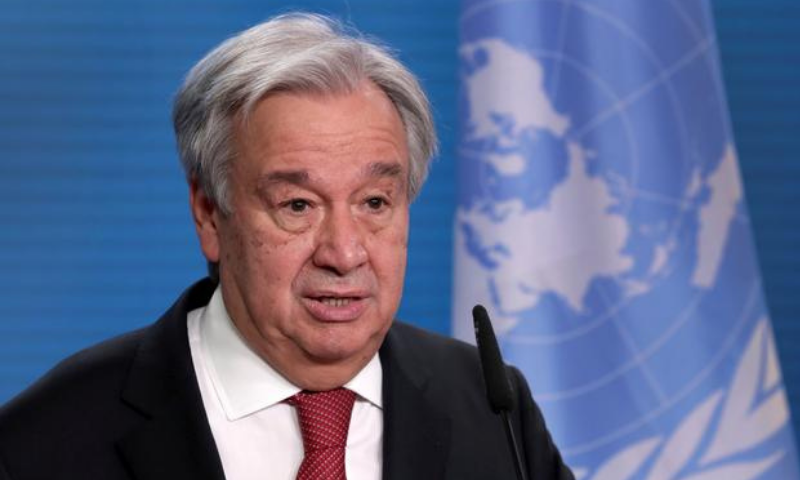
“We are here for the people of Pakistan,” the UN chief, who saw the huge damage for himself during a visit to the flood-hit country in August 2022, said in his keynote speech to the delegates in the UN’s Trusteeship Council chamber.
“I will never forget the climate-related carnage I saw. Lives, homes, livelihoods, schools, hospitals all obliterated,”
Guterres said.
“Billions were pledged” by rich nations in the aftermath of the disaster,he said, “but the vast majority was in loans. And Pakistan is still waiting for much of the funding.”
“Delays are undermining people’s efforts to rebuild their lives,” the UN chief said,
Some $9 billion was pledged to help reconstruct Pakistan in January, though it is still reeling from the effects of the heavy monsoon rains.
“While much of the water has receded, the needs have not,” he said.
“When the floods hit Pakistanis were first to help each other,” Guterres said, adding that the United Nations stood with them.
He said that as of now 69 percent of the $816 million UN appeal for immediate aid and protection has been funded, the amount sought for Pakistan’s Floods Response Plan.
Expressing gratitude to the “esteemed” Secretary-General , Pakistan’s UN Ambassador Munir Akram said he was with the people of Pakistan all the way; visiting those affected, issuing an Emergency appeal, mobilizing relief, and then working with Pakistan and other development partners.
The partners included the World Bank, the Asian Development Bank, the European Union, the UNDP and the Resident Coordinator to develop, first, a Post-Disaster National Assessment, and then the Resilient Recovery, Rehabilitation and Reconstruction Framework (the 4RF Plan).
Pakistan, Ambassador Akram said, is grateful for the solidarity and support displayed by the international community. OCHA (UN Office for the Coordination of Humanitarian Affairs) Emergency Response Fund was critical in the early stages of the disaster.
Noting that OCHA’s Flood Response Plan has received $563 million, or 69 percent, of the $816 million requested, the Pakistani envoy said, “We hope it will be fully funded.”
The mechanisms for the timely implementation and oversight of the Plan have been established — the Policy and Strategy Committee, and Oversight Board, and the Recovery and Reconstruction Project Managemment Unit; and the Investment Partners’ Support Group, he told delegates.
Implementation of the Plan is underway, Ambassador Akram said. Sindh, the worst affected province, with funding from the World Bank and Asian Development Bank, and its own resources, has launched a multifaceted reconstruction strategy, encompassing the reconstruction of 2 million homes, flood assistance and rehabilitation, a Water and Agriculture Transformation Project, and projects for integrated health and women’s empowerment and strengthening of the social protection delivery system.
The projects worth $16.3 billion in the 4RF Plan which received funding pledges at the Geneva Conference were for the reconstruction of the direct damage caused by the epic floods. The 4RF also contained a supplementary component of projects to induct “resilience” into the reconstruction, especially in water and irrigation and road and rail transportation, costing t $13.5 billion.
In his remarks, Guterres, the UN chief, said how the world responds now to Pakistan’s struggles is a “litmus test” for climate justice.
“Pakistan needs and deserves massive support from the international community,” he said.
Despite contributing less than one per cent of global emissions, Pakistan’s people face a staggering 15 times higher risk of dying from climate-related impacts.
“Pakistan is a double victim of climate chaos, and of our outdated and unjust global financial system that prevents middle-income countries from accessing much-needed resources to invest in adaptation and resilience,” he stressed.
Even today, according to UN, the response continues as UN and partners assist people in flood-ravaged areas, after further punishing rains fell this summer and Pakistan’s economy struggles to recover. Agencies such as the UN Development Programme (UNDP) are also helping people rebuild livelihoods.
Dennis Francis, President of the General Assembly, urged Member States and the broader UN system to maintain their steadfast support for recovery and reconstruction endeavours.
“I urge Member States and stakeholders to step forward and fill the funding gaps needed to mobilize resources,” he said, emphasizing the need to address funding shortfalls for both climate change adaptation and disaster risk reduction.
According to UN Children’s Fund (UNICEF), around eight million people (half of them children) in flood-affected areas, remain without access to safe water, 3.5 million children remain out of school, and about 1.5 million require lifesaving nutrition assistance.
“The situation facing many people in flood-affected areas is dire, and it comes on top of other pre-existing problems and inequities,” said Catherine Russell, UNICEF Executive Director.
“But the challenges are not insurmountable … we have a reall opportunity to drive lasting positive change for Pakistan’s children.”
Guterres, the UN chief, also reiterated his warning that climate chaos is knocking on everyone’s door, adding that today, however, it’s beating that door down, from the Horn of Africa to Canada.
“Carbon emissions are heating our planet, killing people, destroying communities and devastating economies,” he said.
Besides heads of UN agencies and funds, representatives of the European Union (EU), Qatar, Denmark, Turkeiye, Japan, UAE, Azerbaijan, Vietnam, Sierra Leone, Canada, U.K., Russia, Egypt, United States and Saudi Arabia
addressed the Assembly.
The international system must support vulnerable countries, the secretary-general said, and called for
operationalizing the Loss and Damage Fund and replenishing the Green Climate Fund.
The UN chief also called for delivering the $100 billion US dollars, and double [climate] finance for adaptation and resilience.
SIFC reviews progress of ministries regarding improving business environment, macro-economic
ISLAMABAD, Sep 27 (APP): Special Investment Facilitation Council (SIFC) here on Wednesday in a 2nd session reviewed the progress of remaining ministries regarding improving the business environment in the country and macro-economic stability.
The meeting was chaired by the Minister for Planning, Development and Special Initiatives and attended by the National Coordinator for SIFC, Dr Jehanzeb Khan SAPM (Governance Effectiveness), concerned Federal and Provincial Ministers and high-level government officials, said a news release.
The ministries presented elaborate plans to remove barriers impacting businesses and improve the ecosystem for attracting investment in the country.
The Committee also reviewed various enforcement mechanisms put in place to deal with the menace of smuggling, hoarding and grey/black market; various lines of action were deliberated upon to hammer out a consensus-based way forward.
In the end, the Committee recommended concrete measures and policy-level interventions in the short, medium and long term for a sustainable economic revival of the country.
The recommendations made by the Executive Committee will be presented in the next meeting of the Apex Committee for approval and implementation.
Under US prodding, India now seeks information from Canada on Sikh leader’s murder
NEW YORK, Sep 27 (APP): Following U.S. pressure on India to cooperate with Canada in investigating the murder of a Sikh leader, its External Affairs Minister S. Jaishankar has said that New Delhi is now open to looking into any “specific” information the Canadians provide on the incident.
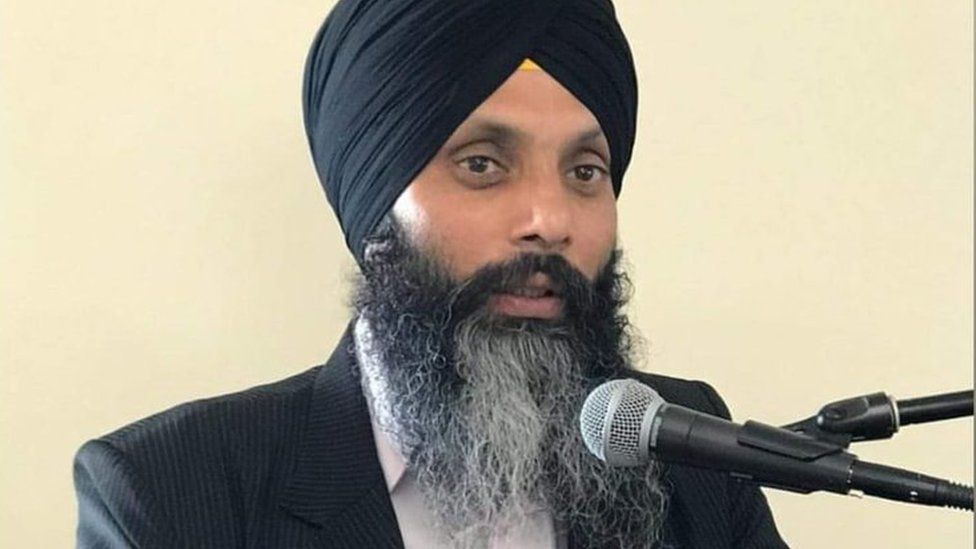
The Sikh leader, Hardep Singh Nijjar, was shot dead outside a Sikh temple on June 18 in Surrey, a Vancouver suburb with a large Sikh population. Nijjar supported a Sikh homeland in the form of an independent Khalistani state and was designated by India as a “terrorist” in July 2020.
Tensions flared up after Canada recently said it was investigating “credible allegations” linking the Indian state with the
murder. India dismissed the allegations as “absurd”.
Asked about the allegations at a Council on Foreign Relations event in New York Tuesday afternoon, Jaishankar detailed India’s response in diplomatic engagements.
“One, we told the Canadians that this [trans-border killings] is not the government of India’s policy,” he said. “Two, we told the Canadians saying that look, if you have something specific, if you have something relevant, you know, let us know – we are open to looking at it.”
The Indian government has often reacted sharply to demands by Sikh separatists in Western countries for Khalistan, or a separate Sikh homeland.
The minister added that India had given Canada “a lot of information about organized crime and leadership” relating to secessionist forces operating out of the country.
“The picture is not complete without the context,” he said. “You also have to appreciate that in the last few years, Canada actually has seen a lot of organized crime relating to the secessionist forces, organized-crime, violence, extremism, they’re all very deeply mixed up.”
“There are a large number of extradition requests. There are terrorist leaders, who have been identified,” Jaishankar said.
The row burst into the open earlier this month after Prime Minister Justin Trudeau said Canada’s intelligence agencies were investigating whether “agents of the government of India” were involved in Nijjar’s murder.
Following Canada’s allegation, India had issued a sharp statement saying that it had “strong concerns about continuing anti-India activities of extremist elements in Canada” who it accused of “promoting secessionism and inciting violence against Indian diplomats”.
Both countries have since expelled a diplomat each of the other nation. Last Thursday, India also suspended visa services for Canadians citing security concerns at its diplomatic missions in the country.
On Tuesday, Jaishankar was also asked about the “intelligence” shared among the Five Eyes, an intelligence-sharing network that includes the US, Britain, Canada, Australia and New Zealand – relating to Nijjar’s murder.
A US diplomat in Canada had last week confirmed that “there was shared intelligence among Five Eyes partners that helped lead Canada to making the statements that the prime minister made”.
Jaishankar said, “I’m not part of The Five Eyes, I’m certainly not part of the FBI. So I think you’re asking the wrong person.”
In Washington, the US, meanwhile, said it backed “a full and fair investigation” into Canada’s allegations.
“Canada has said it is committed to doing that, and we believe the Indian government should cooperate with it,” US State Department Spokesperson Matthew Miller said during a press conference on Tuesday.
“We are obviously quite concerned about the situation in Canada. We’ve cooperated closely with our Canadian counterparts, and we have urged India to cooperate in that investigation and we’ll continue to do so,” he said in response to a question.
“And India remains an important partner of the United States. We work with them on a number of issues. But of course we – on this matter, we urge them to cooperate with the Canadian investigation.”
Annual Urs of Hazrat Khawaja Allauddin Ali (RA) held at Kaliyar Sharif, India
ISLAMABAD, Sep 27 (APP):The 755th annual Urs Mubarak of Hazrat Khawaja Allauddin Ali Ahmed Sabir (RA) was held at Kaliyar Sharif on Wednesday, in which a group of 107 Pakistani Zaireen also participated.
Charge d’ Affaires, Pakistan High Commission, New Delhi Aizaz Khan also paid obeisance at the Dargah of 13th century Sufi saint, which is known as one of the most revered shrines in India, a press release received said.
After placing the traditional chaddar on behalf of the people and Government of Pakistan, Charge d’ Affaires and the visiting Zaireen offered special prayers for Pakistan.
On arrival at the Dargah, the Charge d’ Affaires and Pakistani Zaireen were greeted by Sajjada Nasheen Hazrat Shah Ali Manzar Aijaz Quddusi Sabri. Aizaz Khan thanked all those present at the shrine, especially the administration for facilitating the visit on the auspicious occasion.
The annual Urs is being held from September 25 to October 02, 2023 in Kaliyar Sharif. Pakistani Zaireen attend the annual Urs Mubarak of Hazrat Khawaja Allauddin Ali Ahmed Sabir (RA) under the framework of 1974 India-Pakistan protocol on visits to religious shrines.
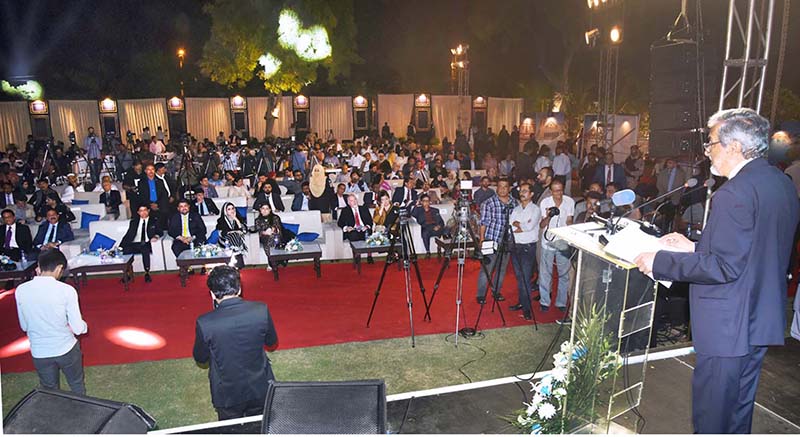
Sindh Chief Minsiter Justice (Retd) Maqbool Baqir speaks at World Tourism Day organized by Culture Department at Mohatta Palace


KARACHI: September 27