Home Blog Page 12164

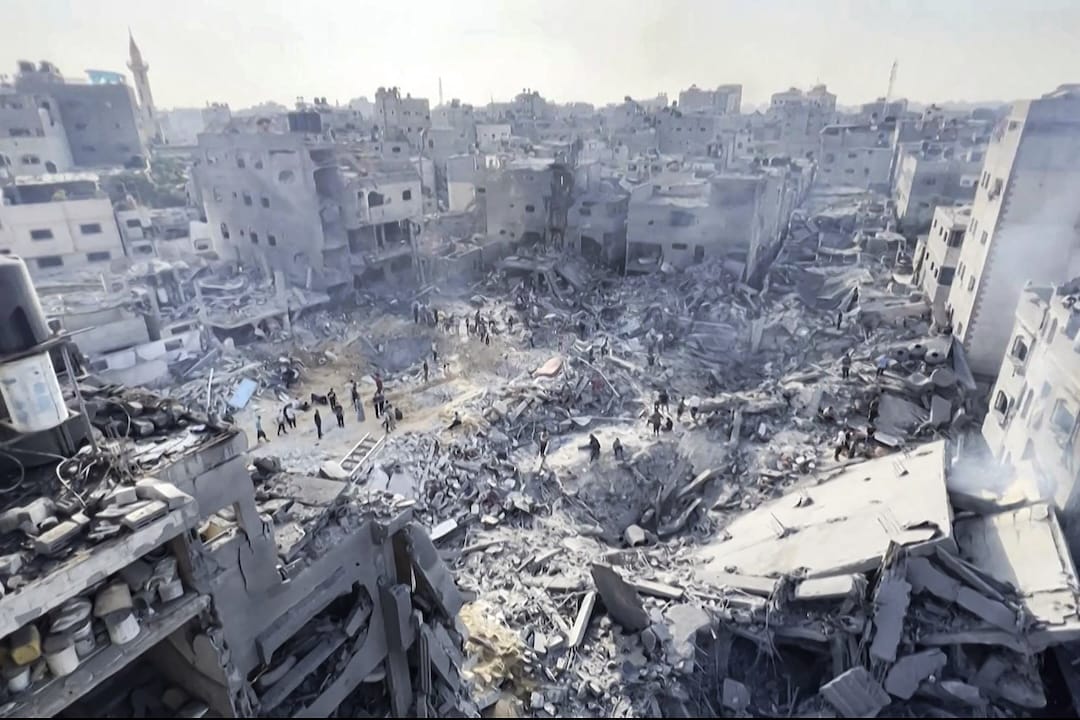
Killings of civilians in Gaza ‘unparalleled, unprecedented’; UN protectorate not a solution: Guterres

0
Antonio Guterres

UNITED NATIONS, Nov 21 (APP): UN Secretary-General Antonio Guterres on Monday decried events in bombed-out Gaza since Oct. 7, calling them a “killing of civilians that is unparalleled and unprecedented” since he took office.

“What is clear is that we have had in a few weeks thousands of children killed, so this is what matters,” the UN chief said in New York while presenting a new UN environmental report.

“We are witnessing a killing of civilians that is unparalleled and unprecedented in any conflict since I am secretary general.”

It is important to be able to transform the tragedy into an opportunity, Guterres said, adding: “It is essential that after the war we move in a determined, and the reversible way to a two-state solution.”

In reply to a question, the secretary-general said that in all the reports issued during his tenure, on children in conflict, it was clear that the current war in Gaza has seen thousands of child deaths – compared with hundreds, in conflicts in Yemen and Syria.

Without entering into discussing the accuracy of the figures released by the Palestinian health ministry in Gaza, which are regarded by UN agencies as reliable, he said that “what is clear is that we have had in a few weeks thousands of children killed.”

Latest reports from health authorities indicate that more than 13,000 civilians in total have died in the enclave since the 7 October attacks by Hamas, and subsequent Israeli offensive.

“This is what matters. We are witnessing a killing of civilians that is unparalleled and unprecedented in any conflict since I have been Secretary-General.”

Also addressing how the region can move forward once the fighting stops, the UN chief said that it was “important to be able to transform this tragedy into an opportunity.”

“For that to be possible, it is essential that after the war we move in a determined, irreversible way to a two-state solution”, he told correspondents.

“It means also that after the war – and this is my opinion – I believe it to be important after the war to have a strengthened Palestinian authority to assume responsibilities in Gaza.”

He said a humanitarian ceasefire was a crucial first step, along with unrestricted access to humanitarian aid, “the liberation of hostages” and an end to violations of international humanitarian law and protection of civilians.

He said the Palestinian Authority which administers the West Bank, and which was forced out of Gaza in 2006 by Hamas, could clearly not assume control while Israeli tanks remain, meaning there must be a “transition period”.

“I do not think that a UN protectorate in Gaza is a solution. I think we need a multi-stakeholder approach in which different countries, different entities, will cooperate. For Israel, of course, the US is the main guarantor of its security. For Palestinians, the neighbouring and Arab countries of the region are essential”, Guterres said.

“So everybody needs to come together to make the conditions for a transition, allowing for a strengthened Palestinian Authority, to assume responsibility in Gaza and then, based on that, to finally move…in a determined and irreversible way to a two-State solution based on the principles that have been largely established by the international community and which I have time and time again outlined.”

Meanwhile, in Gaza, a tweet by the UN agency for Palestinian refugees, UNRWA on Monday, described the situation in shelters as “unliveable”. It said that Gazans had “no options”, echoing repeated warnings from UN humanitarians that nowhere is safe for civilians in Gaza.

Since Oct 7, hundreds of thousands of Gazans have fled south, following an evacuation directive from the Israeli military.

Satellite images of the exodus showed a mass of people moving across a landscape of shattered buildings, while photographs taken at ground level showed families carrying their belonging on foot and a woman dragging two babies in car seats behind her.

In an update on Sunday, Tom White, Director of UNRWA Affairs, told US network ABC that 13 UNRWA sites where people had been “sheltering under the UN flag” had been “directly hit” since 7 October, while “countless other shelters” had suffered “collateral damage” – many of them in the south of Gaza, where civilians had been told to flee.

White said that 73 people had been killed in UNRWA shelters to date, “a large proportion of them in the south”.

“The reality is the Gazans have got nowhere to go for safety and they are all exposed to the threat of fighting and particularly airstrikes,” the UNRWA official said.

According to the UN agency, more than 880,000 internally displaced have sought shelter in 154 UNRWA installations across all five of Gaza’s governorates. Out of Gaza’s 2.3 million people, 1.7 million are now displaced.

To date, 104 UNRWA staff have been killed along with at least 11,000 people in Gaza according to health authorities.

“Houses have been hit all across the Gaza Strip,” said UNWRA’s White, who said that people’s main concern was, “If they’re in the north or in the south, are they safe?”

Senator Sherry Rehman flags challenges for Pakistan ahead of COP 28

0

ISLAMABAD, Nov 20 (APP): Senator Sherry Rehman on Monday shed light on pressing issues and viable pathways for nations like Pakistan at the upcoming COP 28, stressing that while the global event might engender positive outcomes on many opportunities, it will likely not be a silver bullet in addressing the systemic disparities faced by developing countries in accessing public financing and drawing private investment for sustainable initiatives.

Addressing the “Accelerating Green & Climate Resilient Financing in Pakistan” event organized by the Foreign, Commonwealth, and Development Office (FCDO) in Islamabad, Senator Rehman talked about the challenges encountered by developing economies in navigating green financing and climate action.

Speaking about Pakistan’s specific circumstances, she voiced concerns regarding the state of international public financing and the nation’s preparedness to access such financing and effectively compete in a tough environment for green private investment, particularly for adaptation needs.

“The private sector is looking for returns, but even the public sector is making [the developing countries] compete with already resilient economies,” she said.

“There is no level playing field because you are competing with developed countries, and many other economies that are completely differently equipped and we are differently-abled in catching those projects.”

Senator Rehman highlighted the substantial impact of inaction, explaining how unchecked climate change could potentially cost the global economy a staggering US$178 trillion in net present value terms between 2021 and 2070. This would be the cost of inaction, she said.

Expressing realism tempered with optimism, she acknowledged the probable outcomes of COP 28, expecting advancements in commitments to renewables and emission reduction. However, she cautioned against expecting a seismic shift in public financing reaching countries like Pakistan. Instead, she envisaged a pathway opening for crucial dialogue and continued engagement, advocating for sustained efforts in addressing these challenges beyond COP 28.

Students giving final touch to their artwork during literature festival in connection with world Children’s day at Basant hall

0
Students giving final touch to their artwork during literature festival in connection with world Children’s day at Basant hall
APP55-201123 HYDERABAD: November 20 – Students giving final touch to their artwork during literature festival in connection with world Children’s day at Basant hall. APP/FHN/FHA
Students giving final touch to their artwork during literature festival in connection with world Children’s day at Basant hall
APP55-201123
HYDERABAD
Students giving final touch to their artwork during literature festival in connection with world Children’s day at Basant hall
APP56-201123
HYDERABAD

PM meets his school teacher; expresses gratitude for role in shaping his personality

0

ISLAMABAD, Nov 20 (APP): Caretaker Prime Minister Anwaar-ul-Haq Kakar on Monday warmly received his school teacher Azra Naheed at his office and expressed gratitude for her role in shaping his personality.

In a social media post on X, the prime minister mentioned his reunion with his teacher after a span of three decades.

“After three decades, I met with Ms Azra Naheed, the school teacher of my student life in Quetta. Her kindness and sometimes strictness played an important role in shaping my personality,” the prime minister remarked.

In a video shared by him on X, the prime minister is seen warmly welcoming his teacher who also patted him affectionately.

Pakistan Pavilion at Singapore Fintech Festival showcases innovation, collaboration

0

SINGAPORE, Nov 20 (APP): The annual Singapore Fintech Festival (SFF), a global congregation of fintech firms, witnessed a significant representation from Pakistan with a 62-member delegation of fintech companies attending the event.

Hosted by Invent Global, an exhibition experience provider, the Pakistan Pavilion was inaugurated by
High Commissioner and Deputy Governor of the State Bank of Pakistan (SBP) Saleem Ullah.

The pavilion showcased seven fintech companies including Red Buffer, Vizz Web Solutions, Dimensional Sys, EastRiver, Botwa Fintech, E.ocean and Emblem.

The Bank of Punjab-sponsored Sprint Pakistan Hackathon’s three finalists, Investors Lounge, Digi Khata and Dukan.pk were provided complimentary booths by SFF at the Talent Zone.

The festival, attended by more than 62,000 participants and 10,000 organizations from 134 countries, featured key addresses by global financial leaders. Kristalina Georgieva, Managing Director of the International Monetary Fund (IMF), delivered a keynote speech focusing on advancements in the international digital finance sector. Tharman Shanmugaratnam, the President of Singapore, engaged in a fireside chat discussing the rise and challenges of AI trends in Singapore, while the President of the World Bank, Ajay Banga, concluded the event with his closing speech.

The festival also provided unique opportunities for Pakistan to engage with global leaders in the fintech space.

The high commissioner hosted a networking dinner at Pakistan House, attended by top leaders from the Monetary Authority of Singapore, Singapore Fintech Association, Apix Singapore, Global Fintech Institute, and major banks including HSBC, Standard Chartered, and OCBC.

This dinner facilitated networking between Pakistani entrepreneurs and their Singaporean counterparts, as well as high-ranking tech executives.

Additionally, notable events included Dr. Sara Saeed, CEO of Sehat Kahani, sharing her success story at the prestigious “Founders Peak” and the Deputy Governor of SBP participating in a discussion at the Regulators Stage, sharing Pakistan’s experience in financial crimes prevention.

Pakistan fintech delegation visited and networked at Google, Meta and Stripe offices, arranged by the High Commission for exclusive networking and knowledge-sharing sessions. Deputy Governor SBP also visited and met with the Vice President of Meta, Singapore.

The UK-based Centre for Finance, Technology and Entrepreneurship hosted a lunch for Deputy Governor SBP, HBL team and the High Commissioner to explore courses on financial technologies and entrepreneurship for Pakistani bankers/finance professionals.

Participation of the Pakistani fintech delegation in the Singapore Fintech Festival 2023 and events on the sidelines was a significant milestone for the promotion of innovation and collaboration between Pakistan and the global fintech industry.

It showcased the growing strength and potential of the Pakistani fintech sector on a global stage.

Science can serve as gateway to diplomacy: Dr Kane

0
COMSTECH

ISLAMABAD, Nov 20 (APP): COMSTECH Goodwill Ambassador for French-speaking OIC Member Countries in West and Central Africa Dr Ousmane Kane on Tuesday said that Science can serve as a gateway to diplomacy.

Delivering a lecture at the Institute of Regional Studies (IRS), Dr Kane said that it is essential for scientists and diplomats to support each other’s endeavours for creating synergy against common threats and addressing the common needs of humanity.

Dr Ousmane Kane, a leading plant scientist from Senegal was speaking at an event on scientific diplomacy organized by IRS. Dr Kane was of the view that scientific cooperation can transcend boundaries leading to benefits for mankind.

He added that the scientific community could also assist the diplomats in negotiations about issues related to their scientific specializations.

He maintained that, conversely, diplomacy could also be leveraged to promote scientific cooperation among nations.

Elaborating on his personal experiences of working with different organizations, he encouraged all Muslim countries to increase scientific collaboration and promote greater interaction between their scientists through scientific events and collaborations.

He stated that embassies of all Muslim countries can play an active role in promoting such collaboration between the scientific communities across borders.

President IRS, Ambassador Nadeem Riyaz stated that contemporary diplomacy was challenging as it has to deal with a wide variety of subjects including the common threats of climate change and the need for scientific collaboration in fields like energy, science and technology, human rights, tolerance, water scarcity, etc.

it was essential for scientists and diplomats to support each other’s endeavours for creating synergy against common threats and addressing the common needs of humanity.

NAB Balochistan holds anti-corruption seminar at Mir Chakar Khan Rind University

0
NAB Balochistan

ISLAMABAD, Nov 20 (APP): The Mir Chakar Khan Rind University on Monday collaborated with the National Accountability Bureau (Balochistan) to host a seminar focusing on the involvement of students in the eradication of corruption.

At the seminar, University Controller Professor Abdul Naeem welcomed the chief guest NAB Director General Zafar Iqbal Khan and other participants, sharing perspectives on the topic.

During his speech against corruption, Senior Superintendent of Police Inayatullah Bengalzai urged students to lead their lives in accordance with Islamic teachings.

Expressing that meeting the obligations to Allah while overlooking the rights of people leads to the decay of the societal well-being, he stressed on educating children about corruption’s consequences for better control. “Lying, which is termed as the origin of all evils, stands out as a significant contributor to corruption,” he added.

Deputy Commissioner Khuda-e-Rahim, in his remarks, emphasized that “corruption undeniably prevails as the most pervasive evil, steadily eroding the foundations of our society”.

He stressed the importance of students being knowledgeable about corruption and understanding its implications.

He further mentioned that students consistently contributed significantly to the progress of any society, molding the destinies of their nations with their capable hands.

NAB Director General Zafar Iqbal Khan, in his address, cited the example of developed countries, where corruption was rigorously addressed with an iron hand.

In those countries, individuals who engage in corruption face a social boycott, leading to its reduction and subsequent growth in development. He pointed out that instead of consistently focusing on the corruption of others, “we need to embrace self-accountability”.

The DG NAB emphasized that the elimination of corruption could only be achieved through education and anti-corruption awareness campaigns.

He encouraged students to participate in NAB’s anti-corruption awareness campaign, urging them to vocalize their opposition to corruption. The seminar’s primary objective was to transform the general public into advocates for NAB in its battle against corruption.

Citing a historical example, he mentioned that in the past, corruption was strongly condemned, and individuals involved in corrupt practices faced societal boycott. Nowadays, corruption had sadly become a societal norm, he regretted.

Exhorting the seminar participants, former Chief Minister Ghous Bakhsh Barozai urged them to actively contribute to the eradication of corruption.
He emphasised the importance of comprehending the impact of corruption on society, describing it as a deeply rooted issue. He urged the students to prioritize education as their mission, enabling them to contribute to a society free from corruption and fulfill their roles effectively.

Giving an example from the past, he said that in the 1960s, people used to come to Pakistan from China in search of employment, but by taking measures against corruption, they made their country developed.

Concluding the event, Vice Chancellor Jan Wash Karim expressed gratitude to DG NAB (Balochistan) and other organizers for conducting the seminar at the university.

The Vice Chancellor emphasized that students are the last hope for Pakistan’s development, urging them to learn from mistakes and speak out against corruption.

The speakers expressed gratitude to all participants for dedicating their valuable time to the seminar. Following the event, a public walk against corruption was organized, with the chief guest and other participants actively involved.

World order based on people’s participation, morality to bring peace, sustainable development: President

0

ISLAMABAD, Nov 20 (APP): President Dr Arif Alvi on Monday reiterated his call for a world order characterized by the participation of the populace and steadfast adherence to moral principles to serve as the cornerstones for ensuring enduring peace and sustainable development.

The president, addressing the inaugural plenary titled “Navigating the Road to Recovery, Resilience and Optimism” under the 26th Sustainable Development Conference held by the Sustainable Development Policy Institute (SDPI), highlighted the shortcomings of the Westphalian model in the establishment of peace and also questioned the world’s double standards to deal with the conflicts.

The theme of the three-day conference is “Light at the End of the Tunnel: Hope in Times of Despair”.

The president told the gathering of diplomats, think tanks, researchers and academia that the world had spent around $10 trillion of the taxpayers’ money on the “weapons of mutual destruction” which reflected the priorities of the people.

He said instead just $1 trillion of the said money was enough to address the challenges of poverty and illiteracy while highlighting that around 27 million children in Pakistan were yet out of school.

Rejecting the justifications for the ongoing war in Gaza, he said the war had never been the solution to the conflicts and that peace was inevitable for sustainable development. He also questioned whether the killings in Gaza would make the suffering people think for peace or have a reaction.

He said unfortunately the vested interests had overridden the rules.

Coming to the modern-day challenges, President Alvi said unlike the nuclear bombs, dealt by the states, modern era tools like artificial intelligence had individual control that could have far-reaching impacts. He said human intellectual development was going faster than its ability to use the available technological tools.

President Alvi said that considering its exponential change, he had pinned hopes on the human intellect as currently, humans with even simple and basic knowledge were making a difference.

Earlier in her address, Special Assistant to PM on Human Rights and Women Empowerment Mushaal Mullick said sustainable development and women were intertwined as women played the role of catalyst for change.

Emphasizing women’s political and financial inclusion, she urged the government and non-government organisations to address the hindrances in the progress.

She said as women were instrumental in sustainable development, their education and empowerment were a must to achieve the desired results.

In his address, SDPI Executive Director Abid Qayyum Sulehri said the three-day moot was being attended by over 200 speakers from 19 countries including Australia, Bangladesh, Canada, China, Germany, Italy, India, Kenya, Nepal, Norway, Qatar, Thailand, Pakistan, Philippines, Singapore, Sri Lanka, Switzerland, the UK and the USA.

He said over the next three days, delegates of the Conference would be discussing the way forward in these tumultuous times of political and economic turmoil, marked by uncertainty and despair due to multiple crises, climate change, and the ongoing conflicts in different regions of the world.

Director General, Islamic Organization for Food Security; and Director, Food Security Department, Ministry of Municipality and Environment, State of Qatar Dr Masoud Jarallah Al-Marri also addressed the conference and highlighted the Organization’s role and commitment for food security and sustainable development.

20 % construction work of HFH completed: Dr Jamal

0
Dr Jamal

RAWALPINDI, Nov 20 (APP): Provincial Minister for Primary and Secondary Health Care and Population Welfare Dr Jamal Nasir on Monday said that around 20 per cent of the reconstruction and renovation work of Holy Family Hospital (HFH) had been completed while the remaining work would be completed by February 20.

During a visit to the HFH and Benazir Bhutto Hospital along with Deputy Commissioner Rawalpindi Hasan Waqar Cheema and CEO Health Dr Ijaz Ahmed, he said that Caretaker Chief Minister Punjab Mohsin Naqvi was personally monitoring the ongoing work of the HFH and the project hopefully will be completed by the deadline set for its completion.

The minister informed that the work of the upgradation of 100 government hospitals across Punjab was underway and all necessary resources were being utilized to provide the best healthcare facilities to the residents of the province.

He said that Holy Family Hospital was being converted into a modern hospital and for the first time in history a hospital was being closed for three months to complete reconstruction and renovation work.

Dr. Jamal Nasir further said that Rs 100 million would be provided for the reconstruction and repair of Benazir Bhutto’s physiotherapy and psychiatric ward.

He said that the work on revamping of OPD of BBH was going on for Rs106 million while Rs 110 million would be provided to District Headquarters Hospital Rawalpindi to complete the repair work of the building.

Dr. Jamal Nasir said that the process of handing over the custody of Maternal and Child Hospital Rawalpindi to Punjab was in progress and the Punjab government was interested in converting the hospital into a general hospital.

He said that plans were being made to establish a burn centre in the Red Crescent Hospital.

Govt wants to solve Chaman sit-in issue through negotiations: Minister

0
sarfraz Bugti

ISLAMABAD, Nov 20 (APP): Caretaker Minister for Interior Sarfaraz Ahmed Bugti on Monday said that the government wanted to solve the Chaman sit-in issue through negotiations.

Responding to concerns raised by senators regarding the sit-in staged by local residents and businessmen against the recently implemented border regulations, the minister said, “We held a detailed discussion with the representatives of the sit-in, and our preference is to resolve the issue through negotiations.”

The minister said that it was not possible to allow around 40,000 people to the cross border daily without proper travel documents.

The government wanted to implement a unified document regime in line with previous practices, he added.

Bugti said the Afghan nationals would only be permitted to enter Pakistan through legal documents.

The minister outlined plans to regularize borders with Afghanistan, similar to the Torkham and Wagah borders, emphasizing the government’s commitment to treating all borders equally.

He said that it was not possible for the government to allow foreigners to travel and establish businesses anywhere in Pakistan without following proper procedures.

Earlier, senators had drawn attention to the sit-in issue at Chaman by local residents and businessmen, expressing concerns about its potential adverse impact on the livelihoods of nearly 40,000 people who rely on daily border crossings.

The senators called for an urgent solution that effectively balances security concerns with the economic well-being of the affected population.