MULTAN


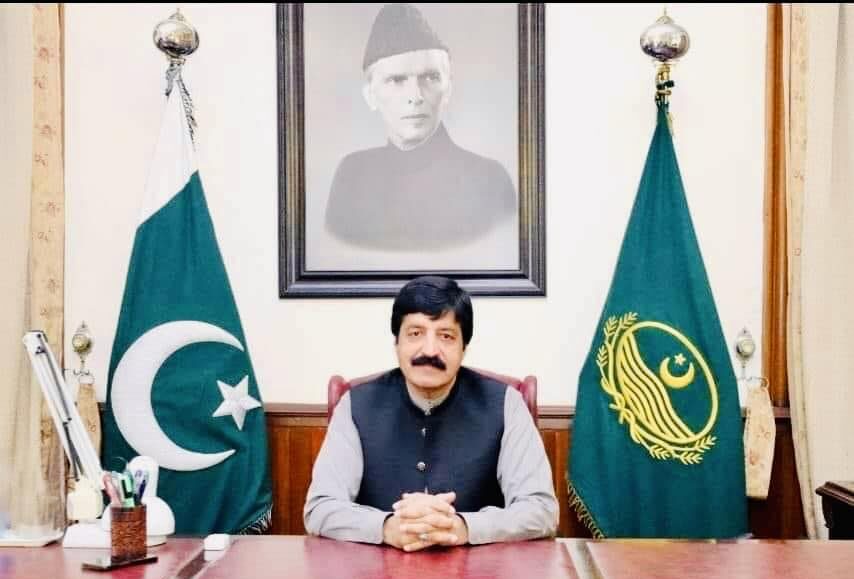
PESHAWAR, Dec 04 (APP): Governor Khyber Pakhtunkhwa Haji Ghulam Ali on Monday emphasized that Islam has bestowed upon women dignity, protection, and all rights and the status given to them by Islam is unparalleled.
He said this in a two-day international conference organized by Shaheed Benazir Women University Peshawar under the supervision of the Border Rural Support Program aimed at empowering women.
In the inaugural session of the conference, held on the first day, Governor Haji Ghulam Ali distributed electronic tablets among Afghan female students and highlighted the importance of technology in women’s education.
He also inspected the products crafted by Pakistani and Afghan women and lauded their creative abilities and business interests.
Speaking on this occasion, Governor Ghulam Ali urged the participants not to view degrees solely as a means to employment, emphasizing the need to create opportunities for both men and women in business and trade.
He advocated for providing economic and social autonomy to women, stating that the progress of society is contingent upon empowering women.
The governor underscored the importance of changing societal perspectives towards women, urging for respectful treatment in all aspects of life.
He encouraged women to actively participate in businesses alongside their husbands, parents, and brothers, stressing the need for collaboration and support.
Governor Ali expressed the need for training women in the jewellery industry, focusing on gemstone polishing and cutting skills.
Highlighting the potential of the gemstone market, especially in the jewellery sector, he suggested that skilled women can contribute significantly to the business.
Governor Ali called upon financial aid institutions to provide special scholarships for female students in educational fields.
He announced plans for a joint Pakistan-Afghan Expo, aiming to provide business opportunities and facilities for Pakistani and Afghan women.
In conclusion, Governor Haji Ghulam Ali reaffirmed his commitment to women’s empowerment, stating that it is essential for the economic and social progress of society.


ISLAMABAD, Dec 4 (APP): The Senate Standing Committee on Commerce Monday discussed a strategy devised to resolve the issues of debt payment by the Trading Corporation of Pakistan (TCP) to various government entities, including the payment of commercial bank loans and their markup.
The committee was informed of the current status of debts and liabilities, with a principal amounts of Rs 105,512.73 million and Rs 153,744.06 million in markup, totaling Rs 259,256.78 million in debt.
The meeting of the committee was held at Parliament House with Senator Zeeshan Khanzada in the chair.
The TCP Chairman briefed the committee on the efforts for recovery, stating that third-party audits on subsidy payments had been conducted, and regular reminders to recipient agencies were being issued.
It was explained that directives had been sent to the concerned ministries, urging them to submit summaries to the Finance Division reflecting the payables to TCP in their financial demands for FY 2013-2024.
The committee was apprised that ongoing efforts include holding repetitive meetings with the Finance Divisions and the concerned federal and provincial recipients.
The matter was deferred for further reporting and the speedy resolution of the dilemma.
The committee decided that matter would be discussed until its resolved.
The Senate Committee discussed a Private Member’s Bill titled the “Imports and Exports (Control) Amendment Bill, 2023. [Amendment of section 3 of Import and Export (Control) Act, 1950 (XXXIX of 1950)] introduced by Senators Zeeshan Khanzada, Faisal Saleem Rehman, and Muhammad Abdul Qadir.
The movers presented that amendment in the act imposes a bar on the export of raw salt and directs the government to impose conditions upon its export.
The ministry argued that Imports and Exports (Control) Act, 1950, was primary legal instrument providing basis for regulating international trade in Pakistan.
Moreover, the imports and exports of all goods are regulated through export orders (EPO) and import policy orders (IPO), respectively, issued under these act after seeking approval of the Federal Government.
It was also debated that the EPO/IPO contains restrictions for export and import of food to and from Pakistan.
The Ministry of Commerce is of view that inclusion-wise prohibitions and restrictions in the act would not be appropriate, as the act provided powers to the federal government to regulate trade.
Deputy Chairman Senator Mirza Muhammad Afridi said that Pakistan possessed world’s largest and most pure rock salt reserves.
He mentioned that this commodity had an estimated annual market in billions of dollars, which was further growing on an annual basis.
Afridi stressed that this commodity had been exported internationally in raw form without a policy that allowed maximum revenue to be regained in Pakistan, and issue must be addressed.
The committee decided to defer the matter and sought the amended draft of the EPO 22 for future deliberation.
The committee also decided to hold meetings with all relevant stakeholders on the legality of the amendment.
The committee directed the ministry to furnish a progress report on the matter within one month and deferred the deliberation for the same period.
Furthermore, the duty-free import of cars up to 1350cc for disabled persons were discussed in the meeting.
Senator Mohammad Abdul Qadir, the mover of the matter, stated that disabled persons should be allowed to import used cars as it became difficult for majority to afford new ones.
The officials apprised the committee that the Ministry of Industries and Production and FBR had imposed restrictions on the import of used cars for disabled persons.
However, they clarified that disabled individuals could import new cars up to 1350cc without paying customs duty once in ten years.
The committee recommended that disabled persons to import used cars up to 1500cc once in 5 years.
Additionally, the committee referred the matter to the Senate Finance Committee for sales tax exemption.
The committee was briefed on the measures taken to enhance kinnow exports.
The officials reported that Pakistan primarily exports of kinnow to Afghanistan, UAE, Russia, Philippines, Kazakhstan, and Indonesia.
However, the fruit exports experienced a decline last season due to floods and the ministry was snow aiming for a substantial increase in its exports, setting an export target of 150 million dollars for the current season.
The deputy chairman suggested that the ministry should include South Korea in the export destinations, as it held potential demand for Pakistan’s kinnow .
He urged the ministry to hold exhibition domestically so that the locals could be aware about the demands of the products.
The chairman committee recommended the ministry to devise an export strategy for the Oranges largely produce in the Mardan, Khyber Pakhtunkhwa.
In attendance were Deputy Chairman Senate Mirza Muhammad Afridi,Senator Fida Muhammad,Senator Saleem Mandviwalla,Senator Danesh Kumar,Senator Palwasha Muhammad Zai Khan,Senator Mohammad Abdul Qadir,Special Secretary Commerce Sarah Saeed,Chairman TCP Syed Rafeo Bashir Shah and other senior officials of relevant departments.
BEIJING, Dec 4 (APP): It is the seventh year that 27-year-old Fahad Kabeer has been studying traditional Chinese medicine (TCM) in Jiangxi University of Chinese Medicine, the only university in east China’s Jiangxi Province that provides TCM education for international students.
He was very excited to experience how modern technology helps traditional medicine become more ‘intelligent’ during an exhibition in 2023 Shanghai Cooperation Organization Forum on Traditional Medicine which opened in Jiangxi, and that has greatly changed his former impression of TCM, according to Xinhua.
Putting his face into the device and showing his tongue, an ‘artificial intelligence (AI) doctor’ shaped like a capsule can proceed data analysis through his face and tongue images. “This is just like to ‘observe’ in the traditional Chinese medicine,” Kabeer said. “My pulse statistics can also be automatically collected through the pulse detector, with the support of massive big data uploaded, the ‘AI doctor’ can help for better diagnosis and treatment.”
After the prescription is issued, it only takes 20 seconds for the smart devices to dispense medicines, and the auto-decoction machine would help the patients in preparing herbal medicines in an efficient and scientific manner, ensuring a better curative effect.
As the saying goes, good medicine depends on good materials. But how can such an ‘unmanned’ system ensure the quality of medicinal materials? Zeng Ji from the Digital TCM Industry Innovation Exhibition Center at TCM Sci-Tech Innovation City in Ganjiang New Area, explained that the source of authentic medicinal materials can be traced through the digital management platform.
“The medicinal materials prescribed by doctors can be seen in real-time through the screen, and the monitored statistics of the soil, water source, and atmospheric environment where the herbs growing clearly be indicated, so that the quality and security of medicinal materials can be strictly controlled,” Zeng said.
“With the help of modern technology, traditional medicine will become more ‘intelligent.’ While experiencing an efficient and convenient medical treatment, the tracing system will guarantee the security of medicinal materials,” said Kabeer.
Over the years, the Shanghai Cooperation Organization has provided an important platform, which continuously promotes TCM to the world.
A official in the Ministry of National Health Services Regulations and Coordination, noted that China and Pakistan had broad prospects for cooperation in the field of traditional medicine.
The official believes that China is heading in the field of traditional medicine education, and more and more Pakistani students will come to China to learn TCM in the future.