KP CM condemns killing of five laborers in SW
Kh Asif submits nomination papers for NA-71, PP-46, PP-47
8th CPEC Media Forum calls for objective narrative of CPEC amid fruitful outcomes
BEIJING, Dec. 22 (APP): The 8th China-Pakistan Economic Corridor (CPEC) Media Forum was held in Beijing, Islamabad and Gwadar, both online and offline.
The Forum saw the unfolding of several key events, including the CPEC Golden Anchor Awarding Ceremony, the launch of the CPEC Media Forum Balochistan Initiative, and the Perceptions on CPEC in Pakistan research paper, and the unveiling of its Joint Statement.
The Forum commenced with Cui Jun, President of China Economic Net, reading out a congratulatory letter from Sun Weidong, Vice Minister of Foreign Affairs of China.
The letter stated,”Under the strategic guidance of the leaders of the two countries and the care and support of people from all sectors, China-Pakistan relations have grown in depth in recent years and bilateral cooperation in various fields has yielded fruitful results.
To further strengthen friendship and collaboration, it added, media professionals of both countries were expected to undertake significant responsibilities and tasks.
The positive role of CPEC in Pakistan was echoed by Murtaza Solangi, Caretaker Federal Minister for Information & Broadcasting, who stated that the economic corridor “has transformed Pakistan’s socioeconomic landscape, addressing a dire energy crisis and crumbling infrastructure, has generated 236,000 jobs since 2013, and is set to create 1.2 million direct jobs, contributing to local workforce development and reducing regional disparities”.
In response to the use of selective facts, emotions, and sometimes misleading stories by the Western media against CPEC, Solangi urged the media personnel of both countries to engage in the objective reporting of CPEC and disseminate accurate and unbiased narratives responsibly.
Zheng Qingdong, President and Editor-in-Chief of Economic Daily, highlighted the constructive role of Chinese and Pakistani media in creating an enabling public atmosphere for CPEC.
He suggested that both sides should jointly navigate through challenges for more development opportunities, enhance exchanges for people-to-people bonds and connectivity, and conduct impartial, evidence-based news reporting.
Senator Mushahid Hussain Sayed, Chairman of the Senate’s Defence Committee and Pakistan-China Institute, noted that CPEC, featuring openness, inclusivity, and connectivity, had advanced notably and “the best of CPEC is yet to come”.
He added that challenges such as the issue of fake news from the West around China-Pakistan cooperation should be tackled.
Wu Xu, Executive Secretary of China Journalists Association, advocated for objective reporting to counter misinformation against CPEC, and stressed the importance of social media for positive narrative of bilateral cooperation.
She also called for enhanced Chinese-Pakistani media cooperation through news cooperation and training sessions.
Chinese Ambassador to Pakistan Jiang Zaidong highlighted the major cooperation features between China and Pakistan during the current year.
“This encompasses high-level government exchange and cooperation, deepening CPEC cooperation, as well as fruitful outcomes in livelihood projects,” he said.
Jiang further noted that to counter fake news against China-Pakistan cooperation, media in both countries were encouraged to enhance cooperation, diversify content, innovate communication methods, extend media platforms, and widen audience reach.
Pakistan’s Ambassador to China Khalil Hashmi underscored that “as CPEC enters its second phase, bilateral cooperation is expected to further boost bilateral socio-economic development, industrial cooperation media collaboration, enhance the seamless connectivity between Xinjiang and Gilgit Baltistan, and join hands to combat climate change”.
Following the welcoming remarks and speeches, three panel discussions were held. The topics ranged from exploring green development opportunities under the Belt and Road Initiative (BRI), and concerted efforts to counter propaganda and disinformation against CPEC, to reviewing achievements and future plans for CPEC.
On the occasion, eight Pakistani media persons, including Imran Khalid, Nasir Jamal, Yasir Habib Khan, Usman Mujib Shami, Zia ul Amin, Tanveer Hashmi, Muhammad Zamir Assadi, and Fawad Yousafzai were awarded the CPEC Golden Anchor for their contributions to strengthening CPEC and China-Pakistan friendship.
The Forum released “The Perceptions on CPEC in Pakistan”, a research paper which, through a questionnaire interview of 350 Pakistani people across different age groups and various sectors of stakeholders, accessed how Pakistani people view CPEC and explored the reasons for their responses.
It also launched the CPEC Media Forum Balochistan Initiative, which includes workshops for lawmakers in Balochistan, collaboration for chambers of Balochistan, and internship opportunities for Baloch youth.
The Joint Statement of 8th China Pakistan Economic Corridor (CPEC) Media Forum was also inaugurated, in which 11 points were made to celebrate a decade of China-Pakistan cooperation in infrastructure and energy, emphasising sustainable development, countering misinformation, and fostering inclusivity, with a focus on technological innovation, cultural exchanges, and regional diplomatic dialogue for future success.
Themed “Next decade of CPEC: opportunities & learning from past decad”, the CPEC Media Forum was jointly organised by China Economic Net (CEN) and Pakistan-China Institute (PCI) in collaboration with the Chinese Embassy in Pakistan.
After eight years of development, the CPEC Media Forum has now grown into an indispensable exchange platform for the Chinese and Pakistani media with the biggest influence and most remarkable achievements.
The Chinese side was represented by Sun Weidong, Vice Minister of Foreign Affairs of China, Jiang Zaidong, Ambassador of China to Pakistan Zheng Qingdong, President and Editor-in-Chief of Economic Daily, Wu Xu, Executive Secretary of China Journalists Association, Cui Jun, President of China Economic Net, Li Yue, Vice President and Board Member of China Economic Information Service of Xinhua News Agency, Mu Zongcong, Chief Editor of International Department of People’s Daily, Du Jianing, Director of China Media Group Islamabad Studio, Yu Xiaokui, Deputy Director of International Department of Guangming Daily.
The Pakistani side was represented by Murtaza Solangi, Caretaker Federal Minister for Information & Broadcasting, Senator Mushahid Hussain Sayed, Chairman of the Senate’s Defence Committee and Pakistan-China Institute, Hassan Daud Butt, former CEO of Khyber Pakhtunkhwa Board of Investment & Trade (KP-BOIT), Naghmana Hashmi, former Pakistan’s Ambassador to China Mustafa Hyder Sayed, Executive Director of Pakistan China Institute, Khalid Waleed, Research Fellow of SDPI, Muhammad Umar Farooq, Research Associate of Pakistan-China Institute, Hamid Mir, Senior Journalist and Anchor at Geo TV, Shiffa Yousafzai, Journalist and Anchor at 92 News HD, Bahram Baloch, Correspondent of Dawn, Prof Dr Manzoor Ahmed, Vice President of Gwadar University, and Saboor from the University.
FIA team arrest two human smugglers
Two-day Regional Heads conference concludes at AIOU
ISLAMABAD, Dec 22 (APP): Vice Chancellor of AIOU, Prof. Dr. Nasir Mahmood on Friday urged the Regional Heads of Allama Iqbal Open University (AIOU) should create a “Reference Document Chart” in order to increase enrollment, strengthen student support system, improve examinations system and overall development of the university.
Addressing the closing session of a two-day Regional Heads Conference, he emphasized the need for transparency in all matters, including exams, and requested a report on the regional heads’ success in meeting admission targets.
VC AIOU, Prof. Dr. Nasir Mahmood, said that any kind of irregularities or corruption would not be tolerated.
He emphasized the importance of providing excellent services to students, not only to retain them until they completed their program but also to encourage them to join future programs for themselves and their families.
He also announced that the “Performance Award” ceremony would be held in December every year.
Dr. Nasir urged regional heads to modernize the admission and examination system and assured to support them in implementing their suggestions.
Director General Regional Services, Dr. Malik Tauqir Ahmad Khan, assured the Vice Chancellor that they would improve student services and ensure transparency in the admissions and examination system.
In the closing session, the regional heads presented their recommendations to the Vice Chancellor.
WASA sub-engineer suspended
Prize winners of Quaid Day Declamation Contest organized by Federal Directorate of Education at Model College for Girls F-7/2 pose for group photo with Director General (FDE) Tanveer Ahmad and Principal Prof. Fouzia Sheikh


ISLAMABAD: December 22 –

ISLAMABAD: December 22 – Director General (FDE) Tanveer Ahmad and Principal Prof. Fouzia Sheikh giving away 1st prize award to the winner of Quaid Day Declamation Contest organized by Federal Directorate of Education at Model College for Girls F-7/2. APP/SMR/ABB
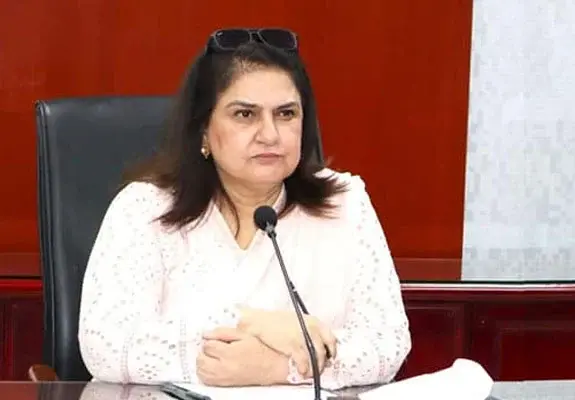
Senator Khalida Ateeb, Chairperson Senate Standing Committee on Industries and Production presiding over a meeting of the committee at Parliament Lodges Islamabad


ISLAMABAD: December 22 – .
PMDC successfully conducts NRE exams
ISLAMABAD, Dec 22 (APP): Pakistan Medical and Dental Council (PMDC) has successfully conducted the National Registration Examination (NRE) step 2.
According to spokesperson PMDC, more than 50% of candidates passed the examination as
367 candidates appeared for the test.
These candidates were given the best possible facilities so that they were able to take the exam in a good environment, he added.
The exam was conducted by the National University of Medical Sciences, as per the schedule announced by the council.
The exam was held at Combined Military Hospital (CMH) on the 10th of December 2023.
The whole purpose of the NRE was to test the competency, knowledge, and skills of a graduate to ensure they are a ‘safe doctor’ as they would be granted a license to treat patients independently.
The NRE skills and clinical exam represent the basic skills that are mandatory for patient handling and management in the absence of which patients would be at severe risk.
NRE step one exam was a theoretical MCQ based basic and clinical sciences evaluation exam for foreign medical graduates to qualify.
Candidates who successfully cleared the NRE step one became eligible for NRE step two which is clinical evaluation for the permanent license.
The NRE refers to a standardized test administered by the Pakistan Medical and Dental Council.
The PMDC conducts this examination for medical graduates who have acquired their degrees from foreign institutions and wish to practice medicines in Pakistan.
President PMDC stated that the National Registration Examination was likely to protect right of the patients and to encourage all able and learned students to assume practice in the mainstream field.
He added that PMDC has not compromised on the standards of public safety and is working with clear vision and dedication to facilitate and improve the healthcare system in Pakistan.