The unique tugai forests lining the major rivers of Central Asia, particularly in Uzbekistan, are facing growing threats from global climate change, rising temperatures, water scarcity and human activities, putting their biodiversity and ecological balance at increasing risk.
Tugai forests of Uzbekistan face growing threat from climate change, water scarcity
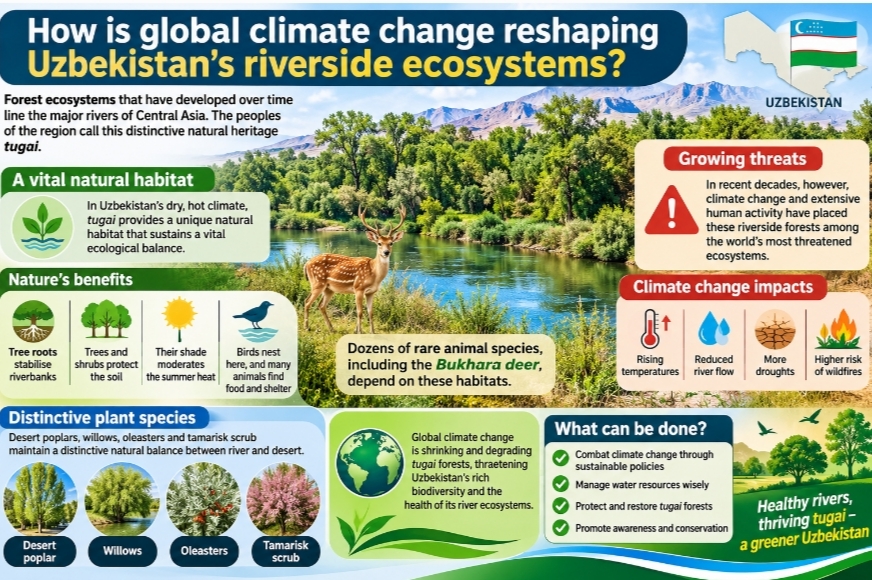
ISLAMABAD, Nov 10 (APP): The unique tugai forests lining the major rivers of Central Asia, particularly in Uzbekistan, are facing growing threats from global climate change, rising temperatures, water scarcity and human activities, putting their biodiversity and ecological balance at increasing risk.
Tugai, a distinctive type of riverside forest ecosystem, plays a vital role in maintaining environmental stability in the region’s predominantly dry and hot climate.
These forests stabilise riverbanks, protect soil from erosion, regulate local temperatures and provide essential habitats for numerous plant and animal species, including the rare Bukhara deer.
In a research paper, B. Khabibullaev, Head of Laboratory at the Institute of Botany, Academy of Sciences of the Republic of Uzbekistan, said that the ecological importance of tugai was becoming increasingly evident as these natural habitats continued to shrink, in release issued by embassy of Uzbekistan in Pakistan here on Tuesday.
Historically, tugai forests extended two to three kilometres inland from some Central Asian rivers. However, many of these extensive ecosystems have now been reduced to narrow and disconnected strips of vegetation, affecting their capacity to sustain wildlife and regenerate naturally.
Scientists from the Academy of Sciences of Uzbekistan conducted long-term research on tugai ecosystems along the Amu Darya, Syr Darya and Zarafshan rivers, as well as around the Aydar-Arnasay lake system. Combining field observations, historical records, satellite imagery and tree-ring analysis, the researchers identified 632 plant species supported by these ecosystems.
The study found that climate change was intensifying existing environmental pressures. Rising temperatures, increasing evaporation, prolonged droughts, declining soil moisture and changing river-flow patterns were undermining the natural regeneration of tugai forests.
Mountain snow and glaciers play a crucial role in sustaining these rivers. However, rising temperatures are reducing winter snow accumulation and accelerating snowmelt, while shrinking glaciers threaten long-term summer water supplies across Central Asia, including Uzbekistan, Tajikistan , Pakistan and neighbouring countries.
The researchers noted that the survival of tugai depended not only on the annual volume of river water but also on its seasonal availability. Under natural conditions, seasonal flooding replenishes groundwater, moistens floodplain soils and creates suitable conditions for seeds to germinate and young trees to establish roots.
When flooding becomes shorter, changes in timing or fails to reach particular areas, natural regeneration is disrupted. Young seedlings, whose roots have not yet reached deeper moisture reserves, become particularly vulnerable to hot and dry summers.
The research also highlighted the combined effects of rising temperatures and soil salinity. Excessive evaporation increases salt accumulation, making it difficult for plants to absorb water even when some moisture remains in the soil.
In the lower Amu Darya and its delta, researchers observed declining desert poplar stands and moisture-dependent vegetation, alongside an increasing presence of drought- and salt-tolerant shrubs and herbs. Such changes indicate that the presence of green vegetation does not necessarily mean that the original forest ecosystem remains healthy.
The scale of degradation is also evident in the Syr Darya basin. Research on three tugai forest stands in the Fergana Valley showed that their combined area declined from approximately 754 hectares in 1975 to 377 hectares in 2025, representing a loss of almost half their coverage over five decades.
Tree-ring analysis further demonstrated the impact of environmental stress. In the Amu Darya basin, average tree-ring width declined from 6.96 millimetres in 1949 to 2.46 millimetres in 2022. In the Syr Darya basin, it fell from 11.26 millimetres in 1965 to 1.95 millimetres in 2022.
According to the researchers, these changes reflect deteriorating growing conditions and increasing pressure on ecosystem stability.
Forest fragmentation is also making wildlife movement more difficult, reducing opportunities for plant regeneration and increasing vulnerability to fires. Prolonged heat, dry vegetation and declining soil moisture further complicate the recovery of damaged forest areas.
The study emphasised the need for an integrated conservation strategy, including protection of remaining tugai forests, restoration of natural floodplain connections, controlled grazing and plantation of native tree species suited to local environmental conditions.
It also called for improved water management, reduced water losses and the inclusion of ecological requirements in regional water-allocation policies, stressing that tree planting alone cannot restore forests without adequate water supplies.
The researchers underlined that conserving tugai was a shared responsibility of Central Asian countries, requiring stronger regional cooperation in water management, scientific research, biodiversity protection and ecosystem restoration.
They stressed that protecting these unique riverside forests was essential not only for Uzbekistan’s environmental sustainability but also for preserving the region’s biodiversity and ecological resilience for future generations.