
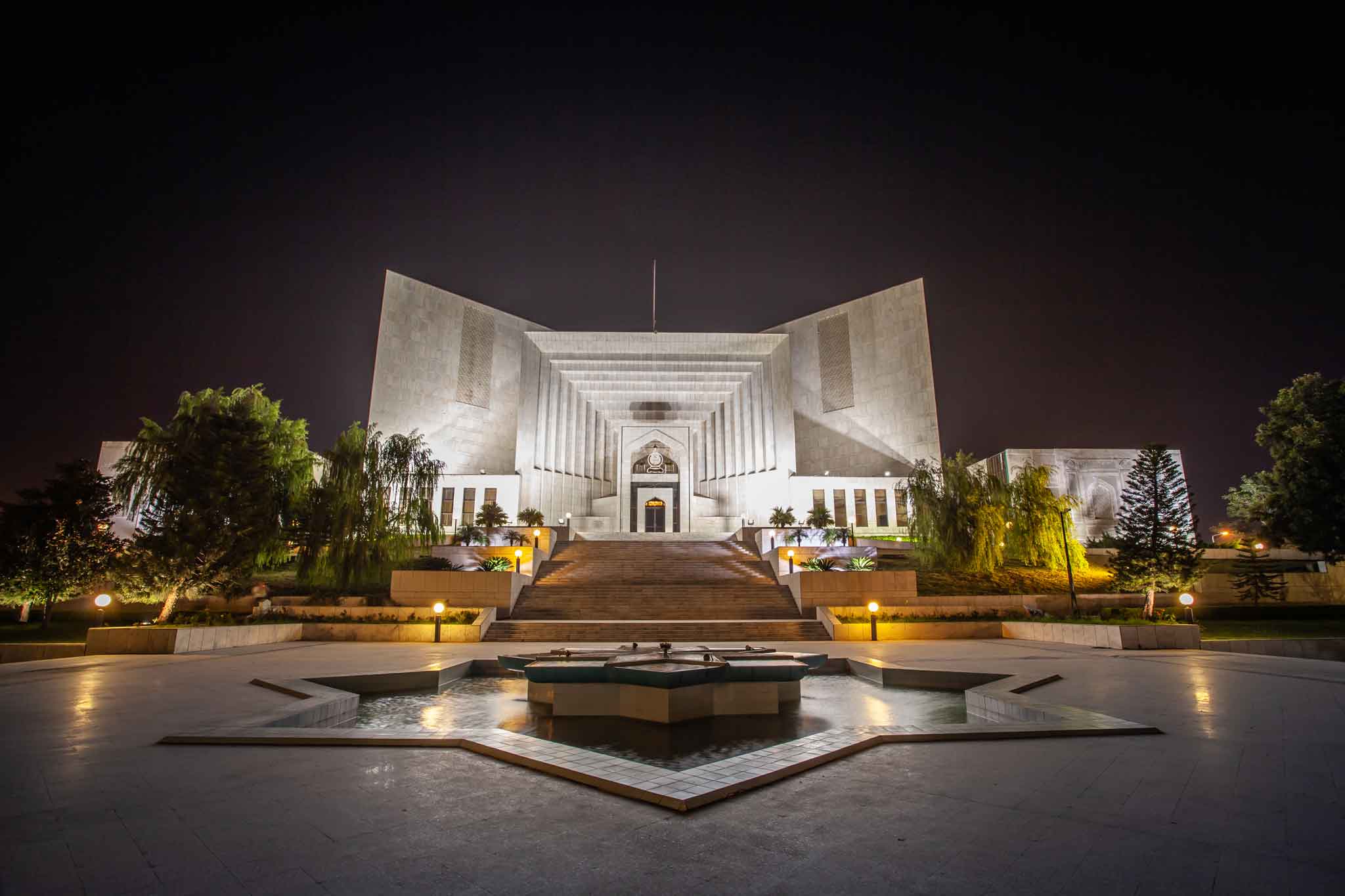

ISLAMABAD, Mar 02 (APP):The Shariat Appellate Bench of the Supreme Court of Pakistan on Monday made significant observations while hearing the federal government’s appeal against a judgment declaring the government’s power to remit sentences as un-Islamic.
A five-member larger bench headed by Justice Jamal Khan Mandokhail heard the case. The bench also comprised Justice Shahid Waheed, Justice Irfan Saadat Khan, Aalim Judge Dr Khalid Masud, and Dr Qibla Ayaz.
During the hearing, Aalim Judge Dr Khalid Masud observed that in Islam punishments are of two kinds: those prescribed in the Holy Quran and those falling under the category of tazir. He said that in cases of tazir, the determination of punishment rests with the Qazi, who decides in light of the facts and circumstances of each case.
Justice Mandokhail remarked how an individual could submit an application to the government seeking termination of a sentence. “If that is so, then the courts themselves should be abolished,” he observed. He added that a party to a case cannot unilaterally terminate a sentence, warning that such a practice would lead to the collapse of society.
Citing an example, Justice Mandokhail said that if a person’s house is robbed, he would approach the state for redress, but if later he finds out that the state has withdrawn the case, where would the aggrieved person go for justice?
Justice Irfan Saadat Khan observed that no government could abolish a sentence while remaining within the bounds of Islam.
He clarified that the court was not examining the special power of mercy petitions in this case but rather the issue of tazir.
He noted that while compromise is permissible in a murder case, it is not permissible in crimes such as robbery.
Justice Shahid Waheed directed the counsel not to take the case lightly and to come fully prepared. Justice Mandokhail noted that the cases date back to 1989 and expressed the intention to conduct daily hearings.
The court clarified that it was not formally seeking an opinion from the Council of Islamic Ideology; however, if the court were to disagree with the Council’s view, it would not be appropriate, as the Council of Islamic Ideology is a constitutional body. The court directed the lawyers to prepare their arguments in light of the Council’s opinion.
The hearing was adjourned until the first week of April, and notices were issued to all provinces and the Advocate General Islamabad.
It may be recalled that Syed Islamuddin had challenged Sections 401 and 402 of the Pakistan Penal Code and the Criminal Law (Amendment) Act, 1958 before the Federal Shariat Court. In 1991, the Federal Shariat Court declared the relevant provisions un-Islamic, against which the federal government filed an appeal before the Supreme Court in the same year.