The Senate Standing Committee on Cabinet Secretariat met on Thursday at Parliament House under the Chairmanship of Senator Rana Mahmood ul Hassan to deliberate on key policy matters concerning the petroleum sector, supply chain digitalization, tax refunds, and the prevention of fuel smuggling and adulteration.
Senate panel expresses serious concern over fuel smuggling, adulteration
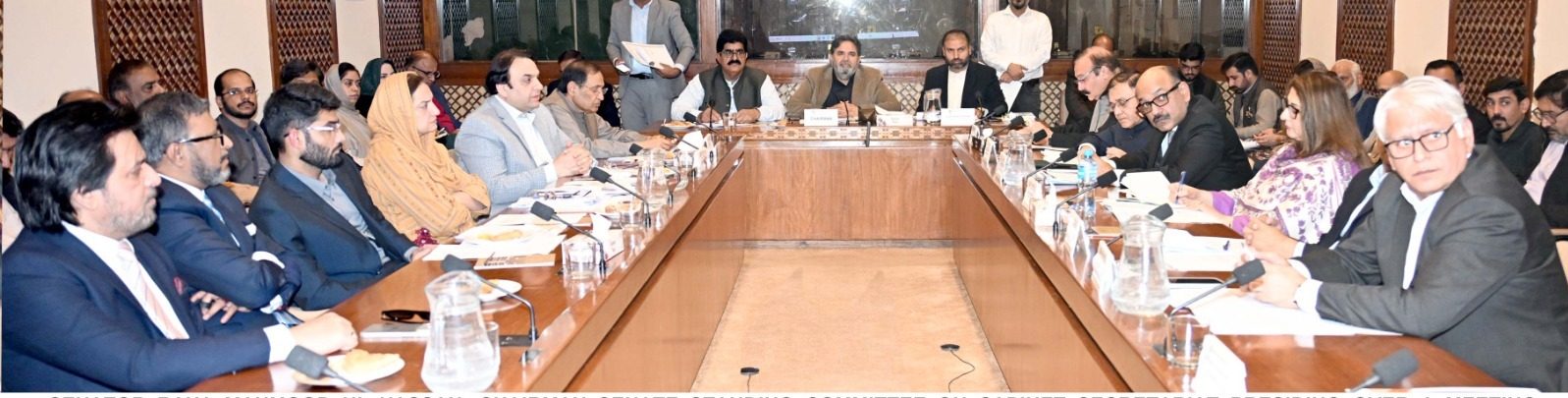
ISLAMABAD, Nov 19 (APP): The Senate Standing Committee on Cabinet Secretariat met on Thursday at Parliament House under the Chairmanship of Senator Rana Mahmood ul Hassan to deliberate on key policy matters concerning the petroleum sector, supply chain digitalization, tax refunds, and the prevention of fuel smuggling and adulteration.
The meeting was attended by Senators Dilawar Khan, and Abdul Qadir, while Senator Aamir Chishti joined via Zoom, Federal Minister Tariq Fazal Chaudhry, Secretary Cabinet, Secretary Establishment,Chairman OGRA, DG Oil, senior officials from the Ministries of Finance, Petroleum, Law & Justice, and Establishment Division, as well as the Chief Executive Officers and senior representatives of Oil Marketing Companies (OMCs), the Oil Companies Advisory Council (OCAC), and the Oil Marketing Association of Pakistan (OMAP).
At the outset, The Chair noted media reports regarding a recent Federal Board of Revenue (FBR) internal proficiency assessment in which a minimal number of officers passed, observing that while the results highlight technical capacity gaps, conducting self-assessments and making the findings public is an appreciable step by FBR leadership toward institutional reform.
The Committee held extensive deliberations on OMC margins, exchange rate adjustments, and the digitalization of the petroleum supply chain.
Representatives of the oil industry highlighted that benchmarking foreign exchange gains and losses against Pakistan State Oil’s (PSO) import schedule places smaller and newer OMCs at a competitive disadvantage, while delays in notifying approved margin revisions have strained operational viability.
Chairman OGRA informed the Committee that while the Federal Cabinet had previously linked the Rs. 1.22 per liter OMC margin increase to 100 percent supply chain digitalization, OGRA and the Petroleum Division are finalizing a pro-rata proposal for Cabinet approval. Under the proposed mechanism, OMCs will receive a proportional share of the approved margin increase corresponding to their verified percentage of digitalization by a stipulated deadline.
Industry representatives noted that companies have already invested approximately Rs. 1.5 billion in tracking tank lorries, storage depots, and retail outlets, with remaining delays largely attributable to import lead times of 12 to 16 weeks for automated tank gauges and nozzles.
The Committee expressed serious concern over fuel smuggling and adulteration, noting that illicit fuel trade costs the national exchequer an estimated Rs. 1 to 1.5 billion daily while damaging vehicle engines and worsening environmental pollution.
Furthermore, industry representatives pointed out that counterfeit lubricants account for nearly 35 percent (150 million liters) of Pakistan’s 450-million/liter lubricant market, resulting in substantial tax evasion.
Chairman OGRA and Ministry officials apprised the Committee that key blending solvents have been placed on the controlled list, proposals to allow the import of used oil have been firmly opposed, and joint enforcement raids with district administrations will be intensified upon receiving actionable intelligence from the industry.
Reviewing pending Sales Tax refund claims of the petroleum sector, OCAC informed the Committee that approximately Rs. 72 billion in input claims accumulated during the 2022–2024 zero-rated/exempt regime remains unadjusted, imposing heavy bank markup costs on companies.
FBR officials stated that out of Rs. 106 billion in total claims, Rs. 37 billion has been sanctioned (with Rs. 28 billion disbursed and Rs. 7 billion under process), while Rs. 66 billion remains deferred due to documentation mismatches.
The Chair directed FBR and the oil industry to hold a joint reconciliation exercise over the next month to verify and clear valid claims without issuing punitive show-cause notices.
During the discussion on fuel pricing mechanisms,the Committee was breifed that daily price adjustments, published transparently on OGRA’s website have successfully eliminated speculative hoarding and panic buying by fuel stations during recent regional supply disruptions, ensuring uninterrupted fuel availability across the country.
The Committee also reviewed the the matter for resolving administrative alignment issues between OGRA and district administrations to expedite No Objection Certificates (NOCs) for authorized fuel stations in Balochistan.
The Chair directed that a joint follow-up meeting will be convened next week with the Ministries of Finance and Petroleum, FBR, OGRA, and the Senate Standing Committees on Finance and Petroleum to finalize solutions for the pending Sales Tax refunds, margin and exchange-rate formulas, and Balochistan NOC clearances.
The Establishment Division breifed the committee that Federal Board of Revenue (FBR) has not yet formulated promotion rules or contacted the Federal Public Service Commission (FPSC) regarding the 20% quota promotional exam (including for Assistant Collector). Once FBR submits a requisition, the Establishment Division and FPSC will finalize the rules, subject to Prime Minister approval where required.
The committee was informed that Officers in grades 17–22, 80 are currently OSD due to disciplinary proceedings, foreign training, or pending postings and the matter regarding Deputation, No violations of prescribed deputation rules or tenure were reported, with extensions beyond five years requiring Prime Minister approval.
The committee also sought details about Dual Nationality and Establishment Division informed the committee that Over 1,700 declarations have been submitted so far with about 100 declaring dual nationality (permitted with 22 agreement countries via NICOP) or foreign residency documents, while an extension has been requested from the Prime Minister for remaining submissions before misconduct proceedings begin.
A proposal with the National Information Technology Board (NITB) to display real-time ministry vacancies publicly will be revisited to reduce its timeline and cost.
The Committee was briefed by the Secretary Cabinet on agenda pertaining to Oil and Gas Regulatory Authority (Amendment) Ordinance / Bill, 2026. He stated that rationale for amending provisions relating to the Chairman OGRA centers on preventing OGRA from becoming dysfunctional or “rudderless” during prolonged selection and appointment cycles, by providing a clear interim mechanism (such as assigning additional charge to an eligible senior civil servant for a limited period until a regular Chairman is appointed).
The Chairman committee deferred the matter until the next meeting.
The committee was also briefed about the Social Media Conduct (2026 Rules) as Under the updated Civil Servants Conduct Rules 2026, personal social media accounts cannot be used for official, over 100 officers will be issued explanation within 7–10 days to ensure compliance before disciplinary action is taken against persistent violators.
The In-camera briefing by STZA was deffered for next meeting.