Climate and Energy experts, policymakers and development practitioners on Thursday called on Pakistan to go to COP31 with credible data, bankable projects and strong coalitions, rather than relying only on its vulnerability narrative.
ISLAMABAD, Oct 01 (APP): Climate and Energy experts, policymakers and development practitioners on Thursday called on Pakistan to go to COP31 with credible data, bankable projects and strong coalitions, rather than relying only on its vulnerability narrative.
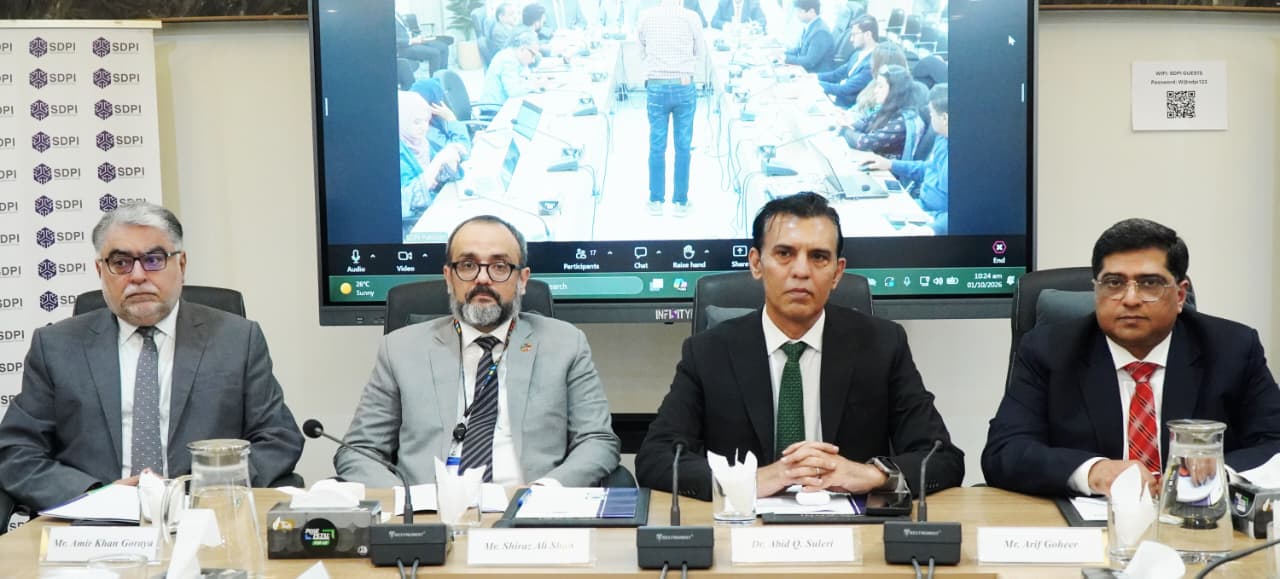
They were speaking at a Pre-COP Dialogue and Consultation on “Pakistan’s Road to COP31”, organised by the Sustainable Development Policy Institute (SDPI) in collaboration with the Pakistan Renewable Energy Coalition (PREC) at SDPI’s Conference Hall.
On the occasion, PREC and SDPI launched three policy papers on themes related to Pakistan’s preparations for COP31, including Climate mitigation, finance, and adaptation.
The dialogue brought together government stakeholders, technical experts and civil society to define Pakistan’s core asks, the negotiating streams it should prioritise, and the coalition and evidence base needed to advance them.
In his welcome note, SDPI Executive Director, Dr Abid Qaiyum Suleri said developing countries should press for a tangible framework to deliver the climate finance goals set at Belém.
He mentioned that Pakistan has shown remarkable progress through its solar revolution that must be advocated and sustained. He also called for joint glacier management and data sharing among Hindu Kush Himalaya (HKH) countries, citing glacier warming, landslides, flash floods and glacial lake outburst floods. He urged Pakistan to extend solidarity with Nepal following the recent devastation there at COP31.
Dr Suleri said the unilateral revocation of the Indus Waters Treaty by India was creating problems for the entire region. He added that civil society works with the government, not against it, in the war of nerves at the COP, which is fought over data.
Executive Director of the Global Climate Change Impact Studies Centre (GCISC) Arif Goheer said the panel agreed that Pakistan should not go to Antalya as a vulnerable nation alone. He identified four priorities: evidence and data (including geospatial mapping and cryosphere studies), investment, coalitions, and federal-provincial implementation of NDCs. Pakistan must check whether it has a say in forums such as the G77 and China, he said, or it will only be supporting others’ agendas.
Chief Executive Officer of the National Disaster Risk Management Fund (NDRMF) Aamir Goraya said climate finance is as much a fiscal challenge as an environmental one. He said Pakistan should showcase its institutional capacity on disaster risk reduction and management, and move its narrative “from vulnerability to action”. He noted that parametric earthquake insurance has been extended to over 100 schools in Islamabad, Khyber Pakhtunkhwa and Balochistan.
SDPI Deputy Executive Director (Policy) Dr Shafqat Munir Ahmed said the history of follow-up action after COPs is not promising. He stressed that Pakistan’s negotiations should be framed around loss and damage, adaptation and mitigation, and said the country must decide whether to attend merely to announce its vulnerability or to engage in the negotiations.
Basit Ghauri, Member of PREC and Manager Special Initiatives and China Program at Renewables First, said the Strait of Hormuz crisis showed that fossil fuel systems are no longer reliable. He said Pakistan should highlight at the negotiations its domestic solar uptake as clean electrification, and use coalitions to tap renewable energy funding.
Sheraz Ali Shah of the United Nations Development Programme (UNDP) Pakistan said Pakistan is not going to COP31 empty-handed, as it has NDC 3.0, and had surpassed its unconditional targets under NDC 2.0. He said Antalya is labelled an implementation COP, about moving “from paper to portfolios”, and that Pakistan needs grant-based adaptation finance.
Chairperson of the Pakistan Climate Change Authority (PCCA) Hamza Farrukh said global adaptation funds fall far short of demand: the Adaptation Fund held only $350 million against applications beyond $2 billion. He said Pakistan needs to look at mitigation options as well and build a capable carbon market office. He announced that PCCA would launch a portal for fresh updates.
Ubaid ur Rehman Zia, Head of the Energy Unit at SDPI, said COP31 would be shaped by geopolitical fragmentation and disruptions to energy supply chains linked to the conflict in the Gulf. He said the UNEP overshoot report suggests the 1.5°C target will be surpassed within a few years despite current measures.
Zainab Naeem, Associate Research Fellow and Head of the Ecological Sustainability and Circular Economy Unit at SDPI, gave a technical presentation on key declarations and thematic priorities for COP31. She said finance is the political centre of the conference, and developing countries should advocate programme-based finance that reaches the last mile.
Rabia Bukhari of the Power Planning and Monitoring Company (PPMC), Ministry of Energy (Power Division), said Pakistan has never taken up debt-for-nature swaps, and that projects such as Delta Blue in Sindh and Recharge Pakistan could be scaled up for this purpose.
Sohail Malik, Climate Finance Expert and Technical Team Lead at the Climate Resourcing Coordination Center, said Pakistan’s climate challenge is less about more money than about how capital is raised, how risk is mitigated and who benefits. “Pakistan needs an investment architecture, not another list of projects,” he said.
Noor Ahmed, former Executive Director of the Asian Development Bank (ADB) and Senior Policy Advisor at SDPI, said climate change is an existential threat to mankind. “It is a battle we are not winning so far,” he said, noting that 70-75 per cent of greenhouse gas emissions take place in the Asia region.