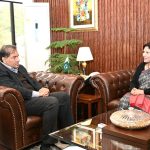
ISLAMABAD, Jan 27 (APP):Chairperson Benazir Income Support Programme (BISP), Senator Rubina Khalid, visited the Pak-Austria Institute of Applied Sciences and Technology (PAF-IAST) in Haripur to explore collaboration opportunities for skill development and training of BISP beneficiaries and their family members under the Benazir Hunarmand Program (BHP). She was received by Prof. Dr. Mohammad Mujahid, Rector PAF-IAST, and senior management, who briefed her on the institute’s academic structure, training facilities, and …
Rubina Khalid explores skill development partnership with Pak-Austria Institute, Haripur
ISLAMABAD, Jan 27 (APP):Chairperson Benazir Income Support Programme (BISP), Senator Rubina Khalid, visited the Pak-Austria Institute of Applied Sciences and Technology (PAF-IAST) in Haripur to explore collaboration opportunities for skill development and training of BISP beneficiaries and their family members under the Benazir Hunarmand Program (BHP).
She was received by Prof. Dr. Mohammad Mujahid, Rector PAF-IAST, and senior management, who briefed her on the institute’s academic structure, training facilities, and industry-linked education model.
Chairperson BISP Senator Rubina Khalid also visited various facilities of the institute, including laboratories and hostels, to assess the institutional capacity for implementing skill development programs.
While appreciating the presentation, the Chairperson emphasized her strong focus on training and diploma programs aligned with BHP. “We need to engage the youth of Pakistan in skill development and turn them into national assets. Skills are the foundation of dignity, self-reliance, and sustainable livelihoods,” she said, stressing that skill development should follow a value-chain approach, integrating work ethics and employability skills for long-term employment.
Ms. Zainab Azmat, Head of the Human Capital Development Office at PAF-IAST, informed the Chairperson that the institute offers 12 training and 4 diploma programs in hospitality, health, and IT, certified by City & Guilds (UK), with integrated language and soft skills components.
Both BISP and PAF-IAST agreed to work together and explore the design of specialized skill courses tailored for BISP beneficiaries under the Benazir Hunarmand Program.
The chairperson reaffirmed BISP’s commitment to skills-led poverty graduation and youth empowerment.
The meeting was also attended by DG BISP KP Mr. Alaf Jan Afridi and members of the Benazir Hunarmand Program team.
The visit marks a significant step toward strengthening partnerships between BISP and leading technical institutions to advance youth empowerment, inclusive human capital development, and sustainable livelihoods across Pakistan.