Federal Minister for Railways Muhammad Hanif Abbasi has said that Pakistan Railways generated a record revenue of Rs115 billion during fiscal year 2025-26, registering a 24.2 per cent increase in overall earnings.
Railways earn record Rs115 bln revenue in FY2025-26: Abbasi
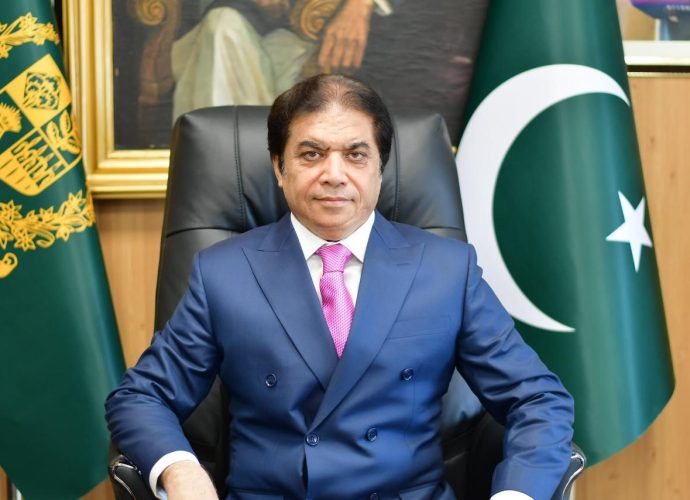
ISLAMABAD, Jul 23 (APP):Federal Minister for Railways Muhammad Hanif Abbasi has said that Pakistan Railways generated a record revenue of Rs115 billion during fiscal year 2025-26, registering a 24.2 per cent increase in overall earnings.
Addressing a roundtable conference organised under the Uraan Pakistan Forum, the minister said the government had accorded top priority to upgrading railway tracks, modernising infrastructure and transforming Pakistan Railways into a financially sustainable and technology-driven organisation.
He said the operating ratio had improved from 96 per cent to 84 per cent.
The minister said the revival and modernisation of Pakistan Railways was not merely a transport initiative but a key driver of national economic growth, as the government accelerated reforms and infrastructure development under the Uraan Pakistan programme.
Federal Minister for Planning, Development and Special Initiatives Ahsan Iqbal also addressed the forum, highlighting the government’s broader economic vision and reaffirming its commitment to transforming Pakistan into a one-trillion-dollar economy by 2030.
Hanif Abbasi thanked Ahsan Iqbal for organising the forum and said it was an honour to present Pakistan Railways’ vision and future development plans.
He said a significant portion of the railway network was still operating on tracks that had exceeded their economic and technical lifespan, while decades of underinvestment had adversely affected railway infrastructure.
The minister said neighbouring countries had invested heavily in railway development over the past two decades and stressed that Pakistan must move swiftly in the same direction to improve connectivity and support economic growth.
He said freight revenue had increased from Rs32 billion to Rs41 billion, while income from railway land and property had risen by 113 per cent, reflecting the success of ongoing institutional reforms.
The minister said the Ministry of Railways had prepared a comprehensive Strategic Roadmap 2033, focusing on the implementation of the ML-1 and ML-3 projects, regional connectivity, digital transformation and modern railway infrastructure.
He informed the participants that around 60 per cent of the work on the Thar Coal Railway Connectivity Project had been completed and the project was expected to be completed by December 2026.
Hanif Abbasi said Pakistan Railways was introducing digital ticketing, smart stations, train tracking systems, enterprise resource planning (ERP) solutions, command and control centres and other advanced technologies to improve operational efficiency, passenger services and financial performance.
He added that the department was also focusing on workforce development, greater private sector participation and institutional reforms to enhance service quality and administrative efficiency.
The minister emphasised that timely funding was essential for the successful completion of railway projects, saying investment in the railway sector should be viewed as an investment in Pakistan’s future rather than an expenditure.
Speaking on the occasion, Ahsan Iqbal said the government was implementing comprehensive reforms across multiple sectors to achieve its goal of transforming Pakistan into a one-trillion-dollar economy by 2030.
He acknowledged that Pakistan Railways had suffered due to inadequate investment in previous decades but said the current government was fully committed to its revival and modernisation.
The minister appreciated the leadership of Hanif Abbasi, saying visible improvements were being witnessed in Pakistan Railways and that ongoing reforms were gradually producing positive results.
Referring to the Main Line-1 (ML-1) project, Ahsan Iqbal said the railway corridor had originally been constructed before the independence of the subcontinent and had not received the required attention for several decades.
“We recognise the shortcomings of the past, and the groundbreaking of the ML-1 project will be carried out during the current fiscal year,” he said.