The Pakistan Poverty Alleviation Fund (PPAF) concluded its two-day international conference on inclusive and resilient economic empowerment and growth in Islamabad on Wednesday, with Senate Chairman Syed Yousuf Raza Gilani attending as the chief guest and calling for practical measures to ensure families escaping poverty could sustain their progress.
ISLAMABAD, Oct 14 (APP):The Pakistan Poverty Alleviation Fund (PPAF) concluded its two-day international conference on inclusive and resilient economic empowerment and growth in Islamabad on Wednesday, with Senate Chairman Syed Yousuf Raza Gilani attending as the chief guest and calling for practical measures to ensure families escaping poverty could sustain their progress.
More than 1,000 participants and delegates from 12 countries attended the conference to discuss poverty graduation, sustainable livelihoods and inclusive economic development.
The concluding day was attended by Federal Minister for Poverty Alleviation and Social Safety Syed Imran Ahmad Shah, Federal Minister for National Heritage and Culture Aurangzeb Khan Khichi, Minister of State for Federal Education and Professional Training Wajiha Qamar, and Dr. Nafisa Shah, Member of the National Assembly and Chairperson of the National Assembly’s Special Committee on Gender Mainstreaming.
Several other parliamentarians also attended, including Syeda Amnah Batool, Member of the National Assembly of Pakistan, alongside national and international delegates.
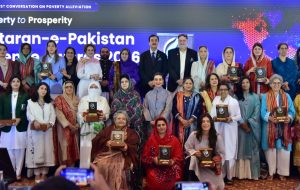
Held under the theme “From Poverty to Prosperity”, the conference concluded with a declaration calling for a National Poverty Graduation Policy to help households move beyond cash transfers and other forms of assistance towards sustainable livelihoods and economic independence.
In his concluding remarks, Gilani stressed that poverty graduation should be measured by lasting improvements in people’s lives rather than simply moving households above the poverty line.
“Moving a family out of poverty is only the beginning. The real measure of success is whether that family can build a secure livelihood, withstand shocks and remain out of poverty,” he said.
He emphasised that social protection, skills development, productive assets, access to finance and markets, and resilient communities must work together to secure sustainable progress.
The declaration identified poverty graduation, micro, small and medium-sized enterprise (MSME) development, green growth, climate resilience, youth economic empowerment, financial inclusion, sustainable investment and partnerships as key priorities. It also highlighted the role of community institutions, improved market access and expanded opportunities for women and young people.
PPAF Chief Executive Officer Nadir Gul Barech called for the conference to become a regular platform for reviewing progress, strengthening partnerships and translating commitments into practical measures to ensure people not only escape poverty but remain out of it and lead secure, productive and dignified lives.
The conference featured discussions on poverty graduation and sustainable livelihoods, MSME development and value addition, green growth, youth economic empowerment, financial inclusion and the cultural economy’s role in strengthening national cohesion.
During the youth economic empowerment session, Chairman of the Prime Minister’s Youth Programme Rana Mashhood Ahmad Khan stressed that national development depended on providing resources and opportunities to marginalised and excluded communities.
“Our country cannot grow and develop, regardless of how much investment we make, unless we promote volunteerism and uplift the neglected, marginalised and excluded segments of society,” he said, calling for a level playing field for disadvantaged groups.
A key feature of the conference was the launch of PPAF’s Climate Change and Green Growth Strategy 2025–2030, which focuses on community-level climate adaptation, resilience, mitigation and green growth to support climate-resilient livelihoods.
Exhibitions featuring micro, small and medium-sized enterprises from all provinces and regions showcased local products and entrepreneurship, highlighting the potential of community-based businesses to create livelihoods and strengthen links between producers and markets.
The programme also featured the Pakistan launch of Weaving My South Asian Tapestry by Chandni Joshi. The author introduced the book and read a chapter reflecting on her decades of work on women’s rights, gender equality and development across South Asia.
PPAF and the Centre of Excellence for National Cohesion and Outreach (CENCO) signed a memorandum of understanding to promote collaboration in economic empowerment, social inclusion, community engagement and national cohesion.
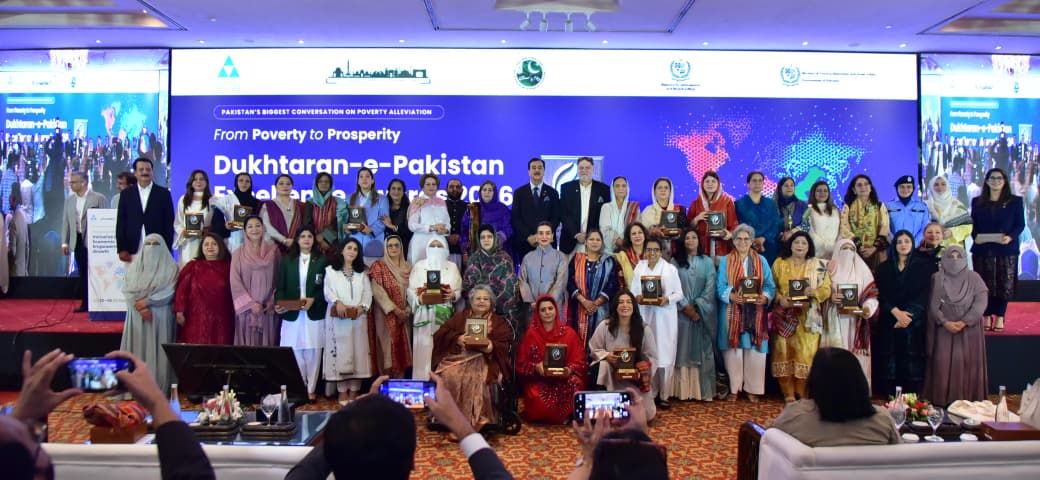
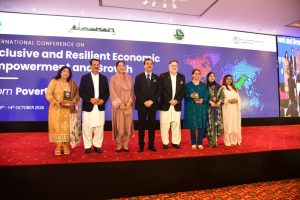
The Dukhtaran-e-Pakistan Excellence Awards recognised women’s achievements across diverse fields. Wajiha Qamar presided over the ceremony, while Aurangzeb Khan Khichi presented the awards. The programme also featured Youth Excellence and Media Excellence Awards recognising contributions to youth engagement and media.
Federal Minister for Poverty Alleviation and Social Safety Syed Imran Ahmad Shah said the conference brought together government representatives, development partners, civil society, the private sector and grassroots voices to translate policy into tangible improvements in people’s lives.
The conference concluded with a call for stronger partnerships, coordinated action and sustained investment to advance poverty graduation and enable vulnerable households to build productive livelihoods, withstand economic and climate-related shocks and achieve lasting economic security.