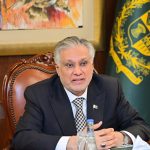
ISLAMABAD, Jul 23 (APP):Coordinator to the Prime Minister on Commerce Rana Ihsaan Afzal on Thursday stressed the need for deep structural reforms to put Pakistan's economy on the path of sustainable growth. He was speaking at the relaunch of Sustainable Policy Economic Bulletin: Budgeting the Unbudgeted here at Sustainable Development Policy Institute (SDPI) on Thursday, said a press release. The government has corrected key economic imbalances while pursuing trade liberalization, …
PM’s coordinator for deep structural reforms to streamline economy

ISLAMABAD, Jul 23 (APP):Coordinator to the Prime Minister on Commerce Rana Ihsaan Afzal on Thursday stressed the need for deep structural reforms to put Pakistan’s economy on the path of sustainable growth.
He was speaking at the relaunch of Sustainable Policy Economic Bulletin: Budgeting the Unbudgeted here at Sustainable Development Policy Institute (SDPI) on Thursday, said a press release.
The government has corrected key economic imbalances while pursuing trade liberalization, tariff rationalization and digital transformation, he said, adding that meaningful economic reforms require informed public debate based on facts rather than political narratives and misconceptions.
The PM’s coordinator said despite challenging economic and geopolitical circumstances, the government has initiated its reforms agenda, including renegotiation of Independent Power Producers (IPP) agreements, rationalization of electricity tariffs, privatization of Pakistan International Airlines (PIA), reduction in customs tariffs and implementation of a comprehensive tariff policy aimed at improving industrial competitiveness.
Rana Ihsaan said the government had reduced tariffs on raw materials and semi-finished goods to enhance exports and industrial productivity, and about Rs400 billion in tariffs would be phased out under the new tariff policy to strengthen Pakistan’s manufacturing sector. He expressed confidence that the ongoing IMF programme would be completed successfully, unlike many previous arrangements.
Referring to fiscal reforms, he acknowledged that expenditure-side restructuring remained one of Pakistan’s biggest challenges, particularly in the power sector, state-owned enterprises and subsidies.
The coordinator said sustainable economic growth requires coordinated efforts by the federation and provinces, stronger local governments and greater ownership of development priorities at the provincial and district levels. He noted that improving governance, strengthening institutional capacity and aligning national and provincial economic policies were essential to boosting exports, attracting investment and creating employment.
Emphasizing the importance of evidence-based discussions on economic policy, he said reforms should be evaluated on facts rather than political rhetoric. He sought constructive public debate to build wider support for long-term reforms necessary for Pakistan’s economic stability and growth.
Senior Economist, Dr Khaqan Hassan Najeeb, called for comprehensive expenditure-side reforms, restructuring of the National Finance Commission (NFC) framework, greater fiscal decentralization and long-term institutional reforms to ensure sustainable economic growth.
He urged policymakers to move beyond short-term fiscal measures and undertake comprehensive structural reforms to place Pakistan’s economy on a sustainable growth trajectory. He argued that Pakistan’s recurring economic crises stemmed primarily from weaknesses in public expenditure management rather than revenue generation alone. He said repeated reliance on taxation without addressing structural spending inefficiencies could not deliver lasting economic stability.
Dr Najeeb stressed that reforms in the National Finance Commission (NFC) Award should be a national priority, noting that delays in revising the NFC framework had created persistent fiscal imbalances between the federation and the provinces. He maintained that expenditure-side reforms, rather than additional taxation, offered the greatest opportunity to improve Pakistan’s fiscal position.
According to him, clearer division of responsibilities would reduce duplication, improve governance and save hundreds of billions of rupees in public spending.
Turning to the energy sector, Dr Najeeb advocated targeted subsidies through the National Socio-Economic Registry (NSER) instead of blanket tariff subsidies. He also proposed deregulating electricity distribution, encouraging competition among distribution companies and introducing market-based pricing to improve efficiency and reduce the circular debt burden.
Dr Najeeb suggested integrating Pakistan’s energy governance framework by establishing a unified energy ministry to oversee electricity, petroleum and gas policy. Such an approach, he said, would improve coordination, strengthen regulation and facilitate a more efficient transition towards a modern and competitive energy sector.
Earlier, SDPI Deputy Executive Director (Policy) Dr Shafqat Munir said the institute had revived its Economic Bulletin after a gap of 10 years to provide concise, research-based analysis bridging the gap between newspaper opinion pieces and lengthy academic studies. He said future editions would focus on themes such as climate change, trade and emerging economic challenges.
Director SDTV and editor of the bulletin, Tahir Dhindsa, said the revival of the Sustainable Policy Economic Bulletin after a decade marked an important step towards making economic research more accessible for policymakers, media and masses. He said facts and credible data remained the foundation of sound economic policymaking, observing that “numbers don’t lie” and provide the most accurate picture of an economy.