ISLAMABAD, Aug 24 (APP):Prime Minister Muhammad Shehbaz Sharif on Monday formally launched Pakistan's National Olive Value Chain Policy, describing the country's growing olive sector as a rare success story capable of transforming national agriculture and easing the pressure of a multi-billion-dollar edible oil import bill. Addressing farmers, growers, diplomats and young entrepreneurs at a ceremony here organised in collaboration with the Italian government, the prime minister said Pakistan currently spends …
PM launches National Olive Value Chain Policy to cut import bill
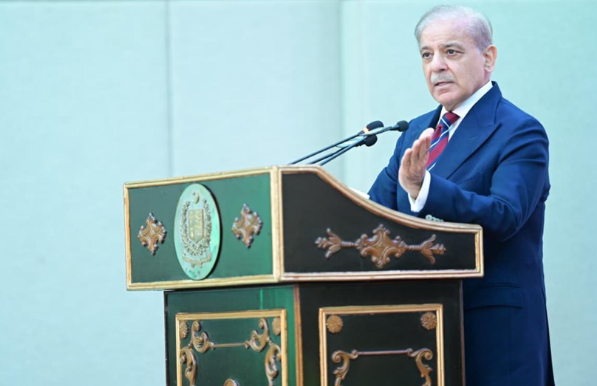
ISLAMABAD, Aug 24 (APP):Prime Minister Muhammad Shehbaz Sharif on Monday formally launched Pakistan’s National Olive Value Chain Policy, describing the country’s growing olive sector as a rare success story capable of transforming national agriculture and easing the pressure of a multi-billion-dollar edible oil import bill.
Addressing farmers, growers, diplomats and young entrepreneurs at a ceremony here organised in collaboration with the Italian government, the prime minister said Pakistan currently spends around four billion dollars annually importing crude edible oil, a burden – he noted the country could significantly reduce by expanding domestic olive cultivation.
“Olive oil is among the healthiest fruits available, and if we produce it ourselves, even saving a fraction of that import bill would be an enormous service to the nation,” the prime minister said, adding that with sustained effort Pakistan could become self-sufficient in edible oil within a few years.
PM Shehbaz Sharif paid tribute to farmers who pioneered olive cultivation despite early scepticism from their own families and communities, singling out growers from Balochistan and Khyber Pakhtunkhwa whose orchards have since won international awards in New York, London and Dubai.
He said their perseverance proved that “if you are determined and have passion in your heart, such revolutions can be brought about,” and congratulated provincial governments for supporting farmers through the process.
The prime minister also thanked Italy for decades of cooperation with Pakistan, recalling the two countries’ seven-decade partnership spanning archaeology, agriculture, trade and industry.
He announced that Pakistan would fund the training of 100 young agriculture graduates in Italy, covering olive cultivation, processing and marketing, so they can return to strengthen the local value chain.
He said his government remained committed to expanding edible oil crops more broadly, including palm and sunflower cultivation, alongside the olive initiative, calling on farmers and officials to keep working together in the field rather than “only on paper.”
The prime minister, in his closing address, personally thanked Italian Prime Minister Giorgia Meloni, calling her a wonderful leader and expressing gratitude for Italy’s support to Pakistan.
He recalled that Pakistan-Italy trade ties stretched back to his early years as a businessman in the 1960s and 1970s, when Pakistan was a major importer of Italian textile machinery, which he said was outstanding equipment, and noted that tractor manufacturing was another area where cooperation between the two countries had been excellent.
The new policy sets out a roadmap to expand olive production, processing, quality control, branding and marketing, positioning Pakistan as a regional hub for olive oil in South, Central and Eastern Asia.
The officials at the event said the number of olive trees in the country has grown from roughly 500,000 in 2016 to more than seven million today, spread across Punjab, Khyber Pakhtunkhwa, Balochistan and Sindh, with orchards now covering some 60,000 acres nationwide.
Earlier in the ceremony, the officials noted that Pakistan secured a permanent seat at the International Olive Council this year during the body’s 123rd session in Portugal, and that the country’s first Olive Sensory Evaluation Lab has been established in Islamabad.
Minister for National Food Security and Research, Rana Tanveer Hussain said the policy was designed to move Pakistan’s olive sector beyond raw production toward processing, packaging, branding and export-oriented growth.
He said that the government was not merely implementing a policy but “setting a new limit for agriculture.”
He said the real competition in agriculture today lay in quality, value addition, packaging, branding and market access, not just production, and credited the Prime Minister’s leadership with securing Pakistan’s permanent seat at the International Olive Council after Islamabad had first sought membership in 2014.
Secretary, Ministry of National Food Security and Research, Amir Ali Ahmed briefed the audience on the objectives of the policy, saying it would make Pakistan an important centre for olive oil production in South, Central and Eastern Asia.
He said the Prime Minister’s guidance had been that the sector should not be limited to planting alone but should build a full system of processing, value addition, branding and marketing. He also announced that Pakistan had become a regular member of the International Olive Council this year and that the country’s first Olive Sensory Evaluation Lab had been established in Islamabad.
Italian Ambassador, Ugo Ciarlatani thanked the Prime Minister and the Ministry of National Food Security and Research, calling the policy the result of a long partnership between Italy and Pakistan dating back more than 70 years.
The Ambassador said Italian cooperation had helped establish sensor and phytosanitary laboratories, trained plant pathologists and chemists, seven notified nurseries, and 36 business development groups led by women and youth, and cited the €20 million Professional Capacity Building and Extension Agriculture Programme as the latest example of that partnership.
Ambassador Ciarlatani also spoke of the personal and cultural significance of olive oil in Italy, saying it remained “part of our identity, our traditions and our way of life.”
The event also featured testimonies from farmers and entrepreneurs who have built olive businesses from Loralai in Balochistan to Mardan in Khyber Pakhtunkhwa, several of whom were honoured on stage by the Prime Minister for their contribution to the sector’s growth.
Coordinator to the Prime Minister, Ahmed Umair, moderated a dialogue segment with farmers from across the country, saying the aim was to introduce the audience to “the people who are actually behind this success in remote areas of Pakistan.”
Abdul Jabbar, an olive farmer from Loralai, Balochistan, said he began growing olives in 2011 despite his family’s scepticism, whereas his orchard, supported by the Olive Culture project and local officials, began production in 2017 and has since grown into tens of thousands of plants, some of which produced the olive oil that won Pakistan awards in New York and London.
Dr. Qurat-ul-Ain Irfan, described as one of Pakistan’s leading female olive farmers, said she planted more than 14,000 olive trees on over 600 canals of land in Mardan after an Italian government survey identified the region’s potential in 2008-09.
Yaqub Izhar, who runs Pakistan’s largest private-sector olive nursery, said he became interested in olives after visiting an exhibition in Istanbul around 2007-08, despite having no background in agriculture or horticulture.
Dr. Marco Marchetti, described as an internationally recognised agronomist and one of the foremost architects of Pakistan’s olive sector, was invited on stage during the awards segment alongside farmers Dr. Qurat-ul-Ain Irfan and Hassan Tareem, a grower from Loralai, both of whom were honoured by the Prime Minister for their contributions.
Earlier, Gianmarco, an Italian expert affiliated with the Mediterranean Agronomic Institute described as having worked in Pakistan for 45 years, said his organisation was providing technical assistance to federal and provincial authorities to help establish the olive value chain.