
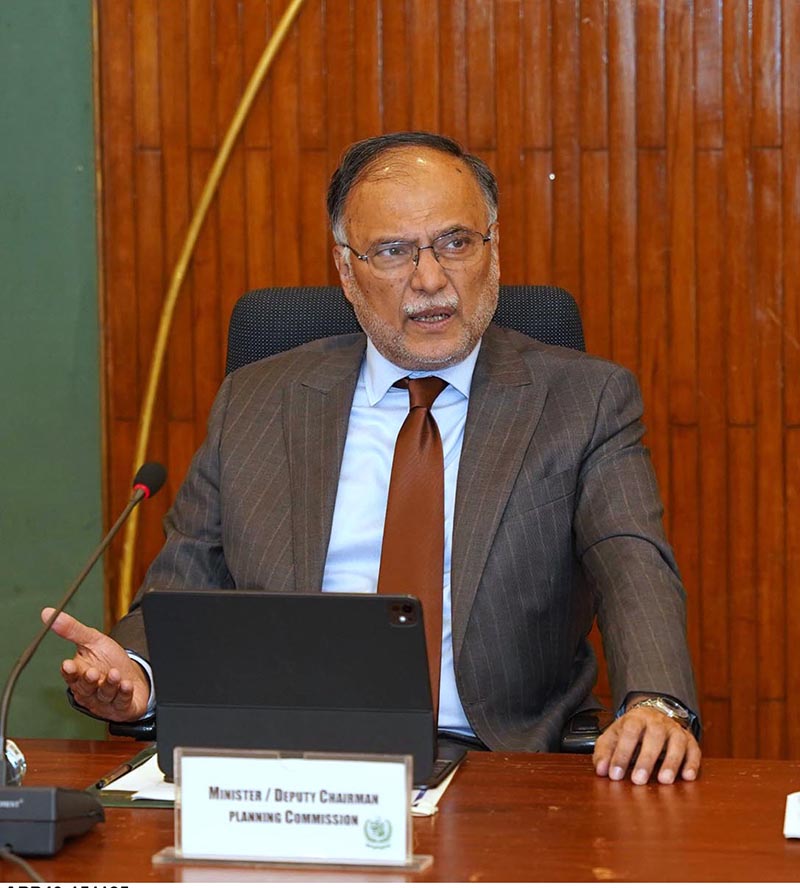
ISLAMABAD, Dec 29 (APP): Federal Minister for Planning, Development and Special Initiatives Prof Ahsan Iqbal on Monday reviewed Rs 2.1 trillion power, hydel power portfolio and sought three-year completion plan.
The Minister has chaired a high-level meeting to review critical Public Sector Development Programme (PSDP) projects in the power and hydel energy sectors, directing the Power Division to prioritise important near-completion projects, rationalise future financing, and put in place a realistic three-year execution framework along with financial requirements from PSDP to ensure timely delivery of strategically important projects, said a release.
The meeting was attended by Secretary Planning, Chief Economist Dr Imtiaz Ahmad, Member IRC and senior officers from Power, EAD and Finance Divisions along with senior officials from the relevant line ministries.
The Minister was briefed on the overall portfolio and financial position of major power and hydel sector projects.
Thirty-Seven critical power sector projects with a combined approved cost of Rs 1.7 trillion were reviewed and of this, Rs 1.1 trillion had been spent up to June 2025 while throw-forward stood at Rs 492.4 bn, he said.
He said that the allocation for 2025-26 is Rs 104.7 bn. An additional demand of around Rs 175 bn was indicated during the first quarter of the current fiscal year.
Prof Iqbal observed that periodic portfolio reviews were essential to ensure that scarce public resources were aligned with national priorities, that cost overruns and implementation delays were identified early, and that projects with the highest economic and social returns were completed without slippages.
He directed the Power Division to prepare a project-wise break-up of critical schemes and submit a yearly financing and execution plan for the next three years for each project.
He further instructed that near-completion projects be prioritised so that sunk investments could be converted into operational assets at the earliest.
“The objective is to reduce the throw-forward and complete priority projects within defined timelines,” the minister said, adding that delays not only escalate costs but also defer the economic benefits of infrastructure, including improved energy availability, industrial productivity, and investor confidence.
The Minister said that among the key power sector projects reviewed were the 2x660MW coal-fired power plant at Jamshoro (Rs177bn), the Power Distribution Enhancement Investment Programme (Tranche-I) Advanced Metering Infrastructure project (Rs16.9bn), the Electricity Distribution Efficiency Improvement Projects in MEPCO (Rs10.2bn) and HESCO (Rs8.1bn), the 500kV Matiari–Moro–Rahim Yar Khan transmission line (Rs188.5bn), and another Electricity Distribution Efficiency Improvement project costing Rs11.7bn.
Major hydel and transmission-related projects also came under discussion, including the Dasu transmission lines, Ghazi-Barotha Hydropower Project, the upgradation and extension of NTDC’s telecommunications and SCADA system at the National Power Control Centre, and evacuation of power from the 2,160MW Dasu Hydropower Project (Stage-I), he said.
The minister directed the Secretaries of the Ministry of Planning, Finance, EAD, Power and the Ministry of Water Resources to jointly identify bottlenecks, whether financial, technical, or administrative, and resolve them on a fast-track basis through coordinated action and engagement with all stakeholders.
Ahsan said that a disciplined three-year rolling plan, he said, would help the government to avoid the accumulation of incomplete projects, contain fiscal pressures, and ensure public investments into tangible improvements in energy security and economic growth.
The meeting concluded with instructions to finalise a list of the most critical projects in order of priority for the next three years and work out the bare minimum annual PSDP requirements needed to complete them within stipulated timelines.