
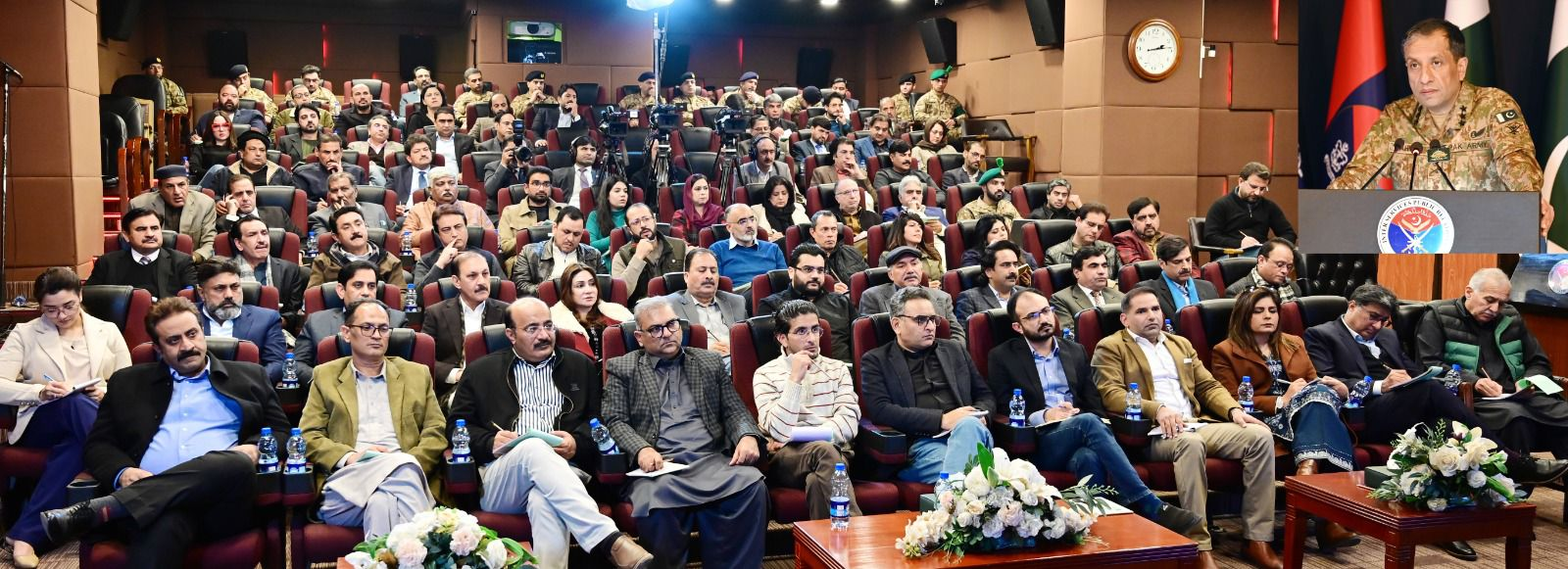

DG ISPR Lt Gen Ahmed Sharif said that after assuming power, the Afghan Taliban made three commitments, including not allowing Afghan soil to be used for terrorism, ensuring women’s rights, and establishing an inclusive and representative government. However, no practical progress has been seen on any of these fronts.
He said the absence of an inclusive government in Afghanistan has encouraged terrorism, turning the country into a safe haven for militants. The security situation deteriorated after the Doha Agreement, with direct consequences for Pakistan’s internal security, he added.
The DG ISPR said global terrorist outfits, including Al-Qaeda and ISIS, are operating there, while leadership and training centres of the Tehreek-e-Taliban Pakistan (TTP) and the Balochistan Liberation Army (BLA) are also based on Afghan soil.
He said that groups such as the East Turkestan Islamic Movement (ETIM), targeting China, and the Islamic Movement of Uzbekistan (IMU), targeting Central Asia, are also active in Afghanistan. Militants from multiple ethnicities and regions are present, with foreign terrorists shifting to the region following recent developments in Syria, he added.
He said the Afghan Taliban built a fake narrative, boasting that they forced the US and international coalition forces to flee Afghanistan. “On the basis of that, they start further polluting the minds of youngsters, the youth, and religious-minded people,” he said, adding that they present themselves as the flag-bearers of Islam and increase their recruitment.
The DG ISPR said the Afghan Taliban spread war in the form of terrorism across the entire region. India is using the Afghan Taliban as proxies and is providing them with financial and other assistance, he added.
He said that after Pakistan defeated India during a four-day conflict in May 2025, a surge in terrorism was witnessed. After its defeat, “Indians immediately put efforts into non-state actors.”
The base of operations for those incidents was Afghanistan, he said, adding that Pakistan repeatedly urged Kabul to end cross-border terrorism.
He said Pakistan carried out strikes on terrorists on the Pak-Afghan border in October, not on the Afghan Taliban or their posts. “And what did the Afghan Taliban regime do, who is acting as proxies and a base of operations for Indians? they attacked Pakistani posts. They came in direct support of the terrorists,” he said.
The DG ISPR said that the State of Pakistan did what was necessary. “Dozens of Afghan posts were obliterated within hours, and a hard message was sent.” The border was closed after that, and terror incidents and facilitation of terrorists declined, he added.
He said that in May 2025, India targeted Pakistani citizens, but Pakistan did not target Afghans in October. “We targeted our own citizens who were present there and involved in terrorism in Pakistan. They have training centres there. We knew the TTP was present there. Did we target TTA (Tehreek-e-Taliban Afghanistan)? No, we did not,” he said.
The DG ISPR said Pakistan had been pressing the Afghan Taliban for the constitution of a verifiable mechanism, adding that Pakistan had evidence of where and to whom the Afghan Taliban had been providing refuge.
After playing confessional statements by some terrorists, Ahmed Sharif said that 16 of the terrorists killed in 2025 could be clearly identified as high-value targets. They included Amjad Ali, who was the second-in-command in the TTP’s Shura.
The DG ISPR said the world witnessed India’s embarrassment during “Marka-e-Haq” and that, following this setback, India aggressively fueled terrorism.
He said India targeted women and children during the so-called Operation Sindoor, questioning India’s authority to target any Pakistani citizen.
He said no one has given India the right to harm any Pakistani civilian or infrastructure, adding that the stain of Operation Sindoor still remains on India’s record.
He said the people of Pakistan now have clarity on what Fitna-al-Khawarij and Fitna-al-Hindustan are, on the India–Afghan Taliban terrorism nexus, on other external sponsors of terrorism, on the international acknowledgement and acceptance of Pakistan’s stance on terrorism, and on internal facilitators — most of whom were found in politics — of terrorism.
On the occasion, the DG ISPR also played recorded statements and conversations of terrorists, saying that arrested
militants had confessed to Afghanistan’s involvement. He said that Afghan nationals are being trained for terrorist activities inside Afghanistan.
Ahmed Sharif said that terrorists had started using armed quadcopters, adding that 405 quadcopter attacks by terrorists were reported from KP alone.
He said India provides funds, technical inventory, and other assistance to terrorists. The terrorists also use mosques, public places, and houses as human shields, he said.
The DG ISPR said that law enforcement agencies, including the police and armed forces, were using drones only for technical surveillance. Even the KPK government had provided law enforcement agencies with quadcopters, as terrorists had been using them, he added.
He said that law enforcement bodies did not use quadcopters in any built-up or populated area and ensured that there was no collateral damage.
The DG ISPR said that development in KPK is only possible after peace. KPK remains the worst-affected province by terrorism, accounting for nearly 71 percent of terrorist incidents.
In light of these facts and figures, he said the question that came to mind was why the majority of terror incidents took place in KPK.
“The primary reason for this, is the politically conducive environment that is being provided there, and the political–terror nexus that is flourishing there,” he said. Any resistance to counter-terrorism efforts directly benefits extremist elements, he added.
The DG ISPR said that it is the duty of the Pakistan Army to protect Pakistan’s security, adding that terrorism is not a provincial issue but a national threat.
He pointed out that terrorists carried out an attack on a mosque in KPK, after which the Field Marshal personally visited Peshawar and stood on the rubble of the mosque to convey a clear stance against terrorism.
The DG ISPR said the last year also saw “how the National Action Plan (NAP) was reinvigorated and how it was being implemented.”
In this connection, he also mentioned that the vision for Azm-i-Istehkam — a counter-terrorism operation launched by the military in 2024 — was drawn from the revised NAP, and that all political parties and segments of society had reached a consensus that the implementation of the NAP was necessary to eliminate terrorism.
Regarding illegal mining in KPK, he questioned who issued more than 5,000 mineral licenses in the province. False statements are often made from the floor of the assembly, while claims of dollar inflows are misleading, he said.
Earlier, tribute was also paid to the “martyrs,” including the people of Pakistan and personnel of the police, armed forces, and the Federal Constabulary, who lost their lives in terror incidents.
Lt Gen Ahmed Sharif went on to say that the army is a federal force and works under the instructions of the federal government. “We are constitutionally bound to ensure Pakistan’s territorial integrity and security,” he said.
The DG ISPR said another important facet of the revised NAP was the repatriation of Afghans. Punjab had just one Afghan refugee camp, which had been cleared, similarly, all 10 refugee camps in Balochistan had also been cleared.
He said that out of a total 43 refugee camps in KPK, only five had been cleared. Around 150,000 refugees had been repatriated from KPK, he added.
Regarding the revised NAP, he said kinetic action detailed under it was already being taken by security forces. The other NAP provisions had to be fulfilled by society, political parties, and provincial, federal, and district governments — not the army, he added.
The DG ISPR said the Balochistan chief minister constituted district-level coordination committees, which include local MPAs, deputy commissioners (DCs), district police officers (DPOs), and representatives of the army and intelligence agencies.
He said that 472 meetings of these committees had been held between February and November 2025 since their constitution.
“Funds of Rs23 billion from the Balochistan government and Rs8 billion from the federal government have been made available to these committees at the district level,” he said, adding that locals were included in the committees and identified projects that needed to be executed.
Ahmed Sharif said that 127 projects have been completed and 949 have been planned under this plan. Moreover, 54,000 social activities and engagements have been carried out under it, in which government and law enforcement agencies, army representatives, and political functionaries engaged with the people, he said.
The DG ISPR said the Balochistan government had separately allocated Rs5 billion for training the police and the Counter-Terrorism Department as part of this effort.
He said that a Pakistan Land Port Authority had been established, which would contribute to the reinvigoration of the NAP. The body would facilitate coordination among agencies operating at land ports, he added.
The National Intelligence Fusion and Threat Assessment Centre had also been established and termed it a “fusion of multiple agencies in one place,” he added.
The DG ISPR said a major terrorist attack had recently been averted in Karachi.
He said the authorities had managed to curb the smuggling of Iranian oil in Balochistan in a bid to combat the political–terror–criminal nexus.
He said that the high number of pending terrorism cases in courts in KPK and the low conviction rate were another reason behind the failure to eradicate terrorism from the province.