The bilateral ties and cooperation were discussed during the 8th session of the Pakistan-Oman Joint Ministerial Commission (JMC), co-chaired by Deputy Prime Minister and Foreign Minister Senator Ishaq Dar and Foreign Minister of Oman Sayyid Badr bin Hamad bin Hamood Albusaidi here.
Pakistan, Oman reaffirm commitment to strengthen multi-sphere ties, including trade, connectivity
ISLAMABAD, Oct 14 (APP): Pakistan and Oman on Wednesday reaffirmed their commitment to further strengthen bilateral cooperation across a broad spectrum of fields, including trade, investment, connectivity, logistics, energy, food security, tourism, and technology.
The bilateral ties and cooperation were discussed during the 8th session of the Pakistan-Oman Joint Ministerial Commission (JMC), co-chaired by Deputy Prime Minister and Foreign Minister Senator Ishaq Dar and Foreign Minister of Oman Sayyid Badr bin Hamad bin Hamood Albusaidi here.
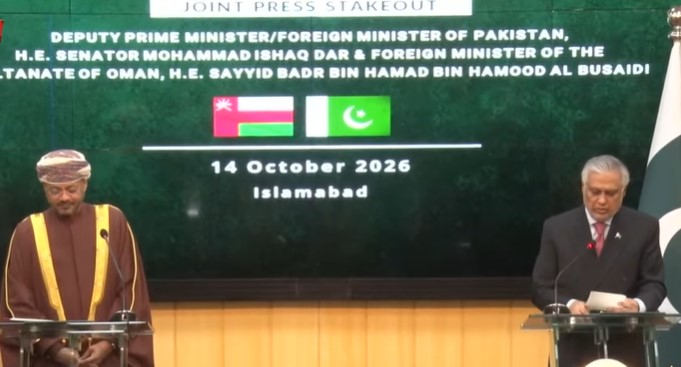
Addressing a joint press stakeout following the meeting, the two leaders told the media that a key outcome of the session was the strengthening of the institutional framework through the establishment and operationalisation of several joint working groups on trade and investment, agriculture, oil and gas, and labour and human resource development, with a view to ensuring regular engagement.
They welcomed closer engagement between the business communities of both countries and encouraged greater investment in special economic zones and free zones, besides agreeing to hold a business-to-business investment forum in Pakistan in the very near future.
The two leaders announced that later in the day, both countries would sign the protocol of the 8th session of the JMC, along with an agreement on mutual visa exemption for holders of diplomatic and official passports. Additionally, a memorandum of understanding (MoU) and several bilateral agreements would be inked during the Omani foreign minister’s visit, covering communication and technology, historical documentation, records and archives management, and media cooperation.
Acknowledging the valuable contribution of the Pakistani community in Oman, both sides reaffirmed their commitment to strengthen cooperation in labour mobility, vocational training, and human resource development, as well as to create new opportunities for skilled Pakistani professionals and workers.
The two leaders exchanged views on the evolving situation in the Gulf, underscoring the importance of restraint, de-escalation, dialogue, and diplomacy. They highlighted the need to ensure the safety and freedom of navigation through the Strait of Hormuz and Bab-el-Mandeb, given their critical importance to regional and global food and energy security.
The deputy prime minister reiterated that Pakistan remained committed to contributing constructively to diplomatic efforts aimed at promoting peace and stability in the region. As both sides discussed the recent Houthi attacks on Saudi Arabia, he conveyed Pakistan’s strongest condemnation of the attacks.
Calling the attacks against civilians and civilian infrastructure totally unacceptable, he reaffirmed Pakistan’s full solidarity with the leadership and people of Saudi Arabia, as well as its unwavering commitment to the Kingdom’s sovereignty, territorial integrity, and security in accordance with the Makkah Joint Defence Agreement.
As the two sides discussed the grave situation in Palestine, Deputy Prime Minister Dar reiterated Pakistan’s principled and unwavering support for the Palestinian people and their inalienable rights, calling for the unhindered delivery of humanitarian assistance to the people of Gaza.
Dar also raised the Jammu and Kashmir issue and reiterated Pakistan’s call for a just and peaceful solution in accordance with the relevant UN Security Council resolutions.
On Afghanistan, he stressed the imperative of ensuring that Afghan territory is not used to carry out any activities against Pakistan.
Discussing the Indus Waters Treaty, he emphasised that the Indian unilateral decision to hold it in abeyance constituted a breach of international law and represented a dangerous attempt to weaponise shared water resources, threatening the water, food, and energy security of Pakistan’s 250 million people.
The two leaders agreed to convene the 9th session of the JMC in Oman next year.
In his remarks, Foreign Minister Sayyid Badr bin Hamad bin Hamood Albusaidi said that both sides reaffirmed the strength of the long-standing ties between the two countries, founded on shared history, geographical proximity, mutual respect, and enduring connections between their peoples.
He noted that both sides recognised the importance of translating the considerable potential in these sectors into tangible opportunities for businesses, investors, and the wider economy.
He added that during the meeting, the importance of sustained institutional engagement, closer private sector partnerships, and enhanced cooperation in education, science, technology, and people-to-people exchanges was highlighted.
Discussing the regional situation, the Omani foreign minister emphasised the importance of dialogue, diplomacy, and constructive engagement in addressing regional challenges. Both nations attached great importance to dialogue and diplomacy as essential means to ease tensions and promote peace and stability.
He stated that constructive engagement, mutual understanding, and sustained diplomatic efforts were vital to resolving differences and preventing further escalation, while appreciating Pakistan’s constructive role in facilitating dialogue and supporting diplomatic efforts in the region, including its role in negotiations between Iran and the United States.
Replying to a question, DPM Dar said both sides shared the view that dialogue and diplomacy were the only way forward, as conflict is no solution to any issue in the world.
“So we are both on the same page. We have agreed to continue to work hard for the stability of this region,” Dar added.
Calling Oman a great partner, he said the country’s location and proximity to Pakistan made it a natural gateway for Pakistan to Gulf Cooperation Council (GCC) countries.
Responding to another query, the Omani foreign minister said bilateral ties were on a positive trajectory and expressed hope that trade and investment volumes would increase further, particularly in view of the upcoming free trade agreement (FTA) between the GCC countries and Pakistan.
Deputy Prime Minister Dar told the media that the Pakistan-GCC FTA would certainly help expand business activities between both sides, adding that the agreement was in its final stages.
Referring to his meeting with the Secretary-General of the GCC in New York, he noted that, barring one country, all member states had now consented, and that he would work closely to bring the remaining country on board so the agreement could be signed at the earliest.