ISLAMABAD, Feb 4 (APP): Pakistan and Kazakhstan on Wednesday agreed to elevate their bilateral relations to a Strategic Partnership, marking a major diplomatic milestone during the state visit of Kazakh President Kassym-Jomart Tokayev to Pakistan after a gap of 23 years. The understanding was formalized through a Joint Declaration signed in Islamabad during President Tokayev’s two-day visit (February 3–4) at the invitation of Prime Minister Muhammad Shehbaz Sharif. The leaders …
Pakistan, Kazakhstan elevate ties to strategic partnership after 23 years
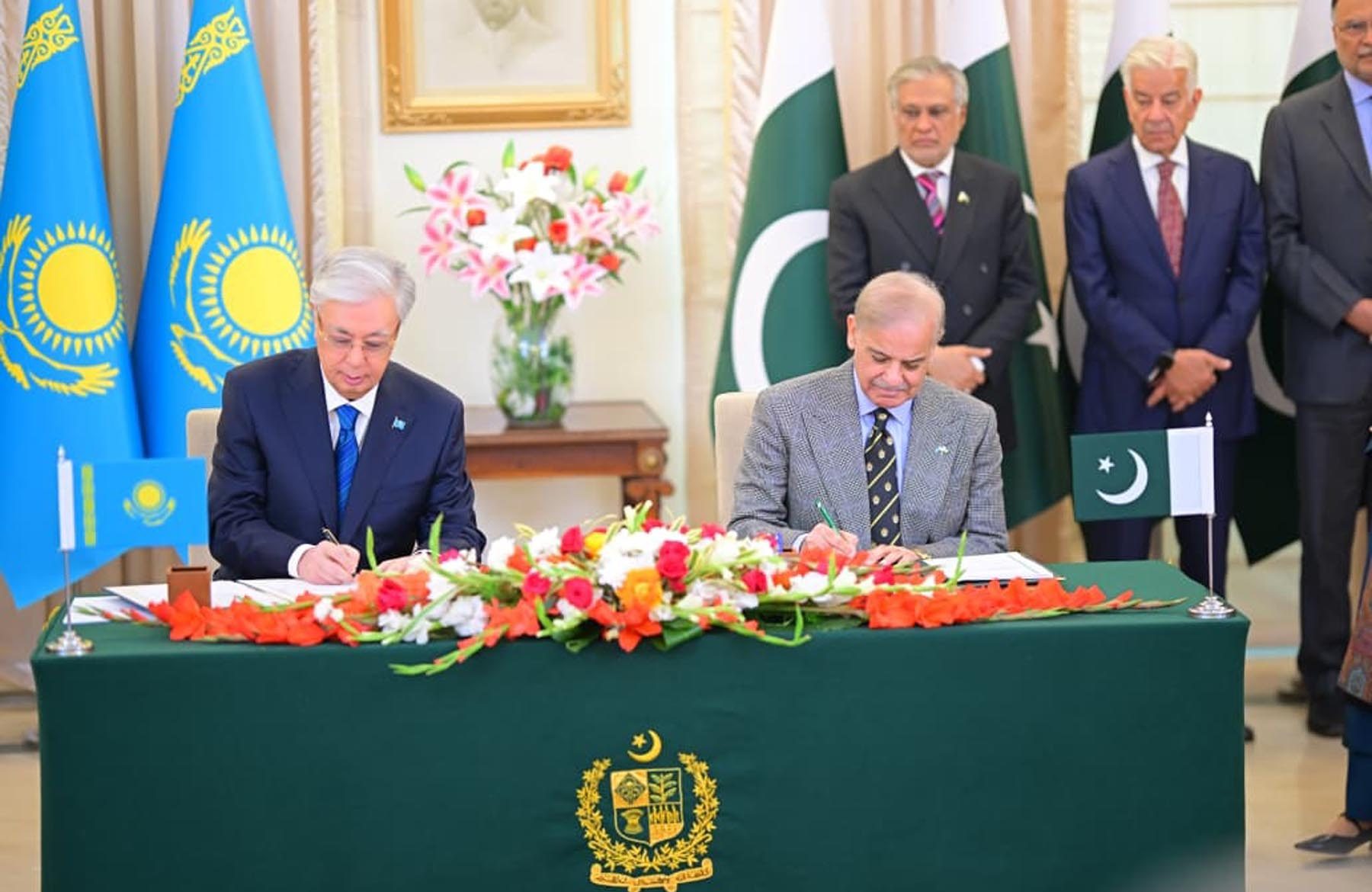
ISLAMABAD, Feb 4 (APP): Pakistan and Kazakhstan on Wednesday agreed to elevate their bilateral relations to a Strategic Partnership, marking a major diplomatic milestone during the state visit of Kazakh President Kassym-Jomart Tokayev to Pakistan after a gap of 23 years.
The understanding was formalized through a Joint Declaration signed in Islamabad during President Tokayev’s two-day visit (February 3–4) at the invitation of Prime Minister Muhammad Shehbaz Sharif. The leaders described the visit as historic, opening a new chapter of cooperation rooted in long-standing friendly, cultural and fraternal ties between the two countries, the Ministry of Foreign Affairs news release said.
Both sides reaffirmed their commitment to sovereignty, territorial integrity and non-interference, noting that Pakistan was among the first countries to recognize Kazakhstan’s independence in 1991. They expressed satisfaction over the steady growth of bilateral relations since the 1992 declaration on principles of relations.
Under the Strategic Partnership, Pakistan and Kazakhstan agreed to deepen cooperation across eight priority areas, including political dialogue, security and defence, trade and investment, transport and logistics, education and information technology, culture and tourism, climate change and environmental coordination, and cooperation at regional and international fora.
On the political front, the leaders agreed to regular high-level reciprocal visits and the establishment of a biennial Strategic Dialogue at the level of Deputy Prime Minister/Foreign Minister. They also emphasized enhanced parliamentary exchanges and welcomed the signing of an Action Plan for cooperation between the two foreign ministries for 2025–26. Both sides agreed to work towards facilitating travel, including the possible inclusion of Pakistan in Kazakhstan’s e-visa regime.
In the area of security and defence, the two leaders stressed peaceful resolution of disputes and agreed to strengthen cooperation against terrorism, extremism, organized crime, cybercrime and other emerging threats. They welcomed the signing of key agreements on extradition, combating crimes, and joint deployment in UN peacekeeping missions, and agreed to continue military exercises and training exchanges.
Highlighting economic cooperation as a cornerstone of the partnership, the leaders set an ambitious target to increase bilateral trade to USD 1 billion in the coming years. They agreed to expand collaboration in sectors such as agriculture, energy, textiles, pharmaceuticals, finance and technology, and welcomed agreements on transit trade, customs cooperation, financial market regulation and agricultural research. Cooperation through platforms such as the Astana International Financial Centre and Pakistan’s Special Investment Facilitation Council was also encouraged.
Recognizing the importance of connectivity, Pakistan and Kazakhstan reaffirmed their commitment to developing multimodal transport and logistics corridors linking Central and South Asia, including routes passing through Afghanistan and China. The leaders also agreed to consider relaunching direct flights and welcomed cooperation between ports, postal services and logistics companies.
In education, science and IT, both sides agreed to expand academic exchanges, joint research and digital cooperation. The leaders welcomed the establishment of cultural and academic centers at leading universities in Pakistan and encouraged collaboration in emerging technologies, including artificial intelligence, e-governance, fintech and cybersecurity.
Cultural, media, sports and tourism cooperation was identified as a key driver of people-to-people ties. Several memoranda were signed between media organizations, cultural institutions and sports bodies, while the leaders welcomed sister-city agreements between Turkestan and Lahore, and Shymkent and Faisalabad.
On climate change and environmental cooperation, the two countries pledged joint efforts on climate resilience, water security, glacier protection and renewable energy. They supported initiatives including the proposal to mark April 22 as the International Day for Planetary Greening, the establishment of a UN Water International Organization, and Pakistan’s Cross-Regional Glacier Resilience Initiative.
At the regional and international level, the leaders agreed to strengthen coordination at the United Nations, OIC, SCO and ECO, and discussed regional peace and security, including the situations in South Asia and Afghanistan. They reiterated that a peaceful settlement of the Jammu and Kashmir dispute in accordance with UN Security Council resolutions is essential for lasting peace in South Asia.
President Tokayev thanked the government and people of Pakistan for their warm hospitality and invited Prime Minister Shehbaz Sharif to visit Kazakhstan, an invitation that was accepted.
The Joint Declaration was signed in Islamabad on February 4, 2026, in Kazakh and English, formalizing a comprehensive roadmap for long-term cooperation between Pakistan and Kazakhstan.