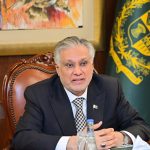
The bilateral ties and cooperation were discussed as Pakistan and Bahrain held the 3rd Joint Ministerial Commission, co-chaired by Deputy Prime Minister and Foreign Minister Ishaq Dar and visiting Bahraini Foreign Minister Abdullatif bin Rashid Al Zayani.
Pakistan, Bahrain vow to take bilateral trade to new heights, finalise FTA with GCC
ISLAMABAD, Oct 8 (APP): Pakistan and Bahrain on Thursday agreed to strengthen bilateral cooperation in multiple areas, including trade, investment, industries, agriculture and food security, higher education, information technology, logistics and maritime affairs, besides committing to finalise the Free Trade Agreement with the Gulf Cooperation Council (GCC).
The bilateral ties and cooperation were discussed as Pakistan and Bahrain held the 3rd Joint Ministerial Commission, co-chaired by Deputy Prime Minister and Foreign Minister Ishaq Dar and visiting Bahraini Foreign Minister Abdullatif bin Rashid Al Zayani.
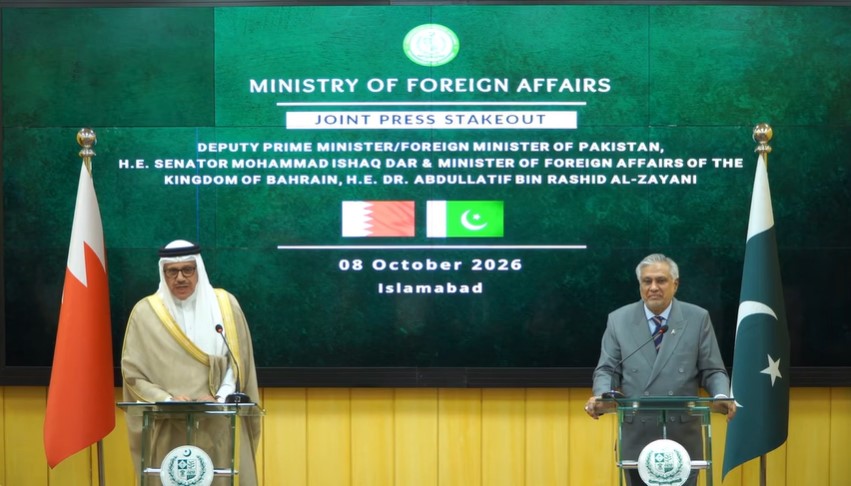
Following the ministerial commission’s meeting, both leaders told the media at a joint press stakeout that two sides reaffirmed their shared commitment to further strengthening bilateral cooperation across a broad spectrum of sectors, including energy, sports, tourism, and business-to-business dealings, besides achieving the target of doubling trade in three years.
Deputy Prime Minister Dar said the two countries signed the protocol of the third session of the 3rd Joint Ministerial Commission and committed to holding the 4th ministerial commission’s meeting within a year.
He said that the key outcome of the “very comprehensive and productive” meeting was the strengthening of the institutional framework through the operationalisation of several joint working groups for regular engagement and effective implementation of the decisions.
He said both sides welcomed the closer engagement between the business communities of the two countries, and acknowledged the contribution of the Pakistani community in Bahrain, serving as a strong bridge between the two countries.
Both sides reaffirmed their commitment to strengthening cooperation in labour mobility, vocational training and human resource development, with a view to creating new opportunities for skilled Pakistani professionals and workers.
The deputy prime minister told the media that the two sides also exchanged views on the evolving situation in the Gulf and emphasised the importance of restraint, de-escalation, dialogue and diplomacy, besides discussing the need to ensure the safety and freedom of navigation through the Strait of Hormuz and the Bab-ul-Mandeb.
Reiterating Pakistan’s commitment to playing a constructive role in supporting diplomatic efforts for peace and stability in the region, he also reaffirmed the principled support for the Palestinian people and their inalienable rights.
Two sides also stressed the urgent need for unhindered humanitarian assistance to the people of Gaza and reiterated their support for a just and lasting solution in accordance with the relevant UN resolutions.
Discussing the Indus Waters Treaty, Deputy Prime Minister highlighted that India’s unilateral decision to place the treaty in abeyance constituted a breach of international law and represented a dangerous attempt to weaponise shared water resources and jeopardise the water, food and energy security of Pakistan’s 250 million people.
On Afghanistan, Dar underscored the need to ensure that foreign territory is not used against Pakistan.
In his remarks, the Bahraini foreign minister said next week, on 14th of October, both countries would mark 55 years of diplomatic relations, bonds of brotherhood, trust, and solidarity, that have gained fresh momentum with the official visits to Bahrain by Prime Minister Shehbaz Sharif in November 2025 and President Asif Ali Zardari in January 2026.
He appreciated Pakistan’s principled positions during ongoing crises, including its support for Security Council resolutions and for its efforts alongside other partners to facilitate dialogue and de-escalation, including by hosting talks between the United States and Iran.
He reaffirmed Bahrain’s strong condemnation of the terrorist attacks on Abha International and King Khaled International Airports, and of the Houthi terrorist militia’s attacks on civilians and civilian facilities in Saudi Arabia, particularly the assault on Makkah al-Mukarrama and al-Madinah al-Munawwarah.
Foreign Minister Al Zayani said that his visit reaffirmed the strategic nature of bilateral relations, as both sides were determined to work on the outcomes of JMC for the peace, stability, and prosperity of the two countries, the region, and beyond.
Replying to a question, DPM Dar told the media that they had been in constant contact during the Pakistan-India war as well as Pakistan’s mediation efforts between the US and Iran, besides frequently meeting on the margins of international platforms.
Asked about the bilateral relations, the visiting foreign minister said that Pakistan-Bahrain ties were very closely entwined and were highly valued by Bahraini people.
Appreciating the contribution of over 140,000 Pakistanis living in Bahrain, he said both countries had a “very truthful” relationship as both sides understood each other’s constraints and that the ties were growing consistently.