
ISLAMABAD, Jan 27 (APP):Speakers at a public talk hosted by the Institute of Strategic Studies Islamabad (ISSI) on Tuesday said that Europe is witnessing a decisive shift toward power-based politics, with the Nordic region assuming growing strategic importance amid evolving global security challenges. The public talk, titled “Europe, the Nordics, and the New Reality of Power Politics,” was organized by the Centre for Strategic Perspectives (CSP) at ISSI and featured …
Nordic region assumed greater strategic relevance in contemporary security landscape: Experts
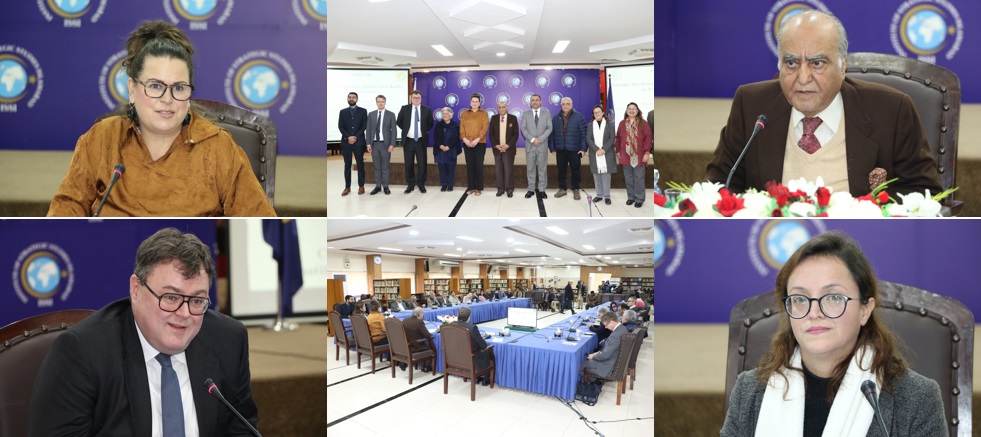
ISLAMABAD, Jan 27 (APP):Speakers at a public talk hosted by the Institute of Strategic Studies Islamabad (ISSI) on Tuesday said that Europe is witnessing a decisive shift toward power-based politics, with the Nordic region assuming growing strategic importance amid evolving global security challenges.
The public talk, titled “Europe, the Nordics, and the New Reality of Power Politics,” was organized by the Centre for Strategic Perspectives (CSP) at ISSI and featured Ms. Hedda Langemyr, Founder of UTSYN – Centre for Security and Resilience, Norway, as the guest speaker, said a press release.
In her introductory remarks, Dr. Neelum Nigar, Director CSP, welcomed the guest speaker and participants, highlighting the increasing relevance of European security dynamics and Nordic strategic thinking in the changing international environment. Dr. Neelum appreciated Ms. Hedda Langemyr for visiting ISSI and sharing her expertise on a timely and critical subject, noting that such engagements contribute meaningfully to informed policy discourse and broader understanding of emerging geopolitical realities.
In his welcome remarks, the Chairman, Board of Governors (BoG), ISSI, Ambassador Khalid Mahmood, warmly welcomed Ms. Langemyr and the participants, and appreciated CSP for convening a timely and thought-provoking discussion. He noted that global politics is witnessing an intensified return of power-based competition, strategic uncertainty, and evolving security challenges.
He observed that Europe’s long-standing assumptions of stability and institutional security are being tested, prompting a reassessment of deterrence, sovereignty, and strategic autonomy.
He further observed that the Nordic region has assumed greater strategic relevance in the contemporary security landscape. Historically known for diplomacy, social stability, and rules-based cooperation, the Nordics are now adapting to a transformed environment marked by renewed concerns relating to territorial defence, crisis preparedness, resilience, and non-traditional threats such as hybrid warfare, cyber operations, and information threats. He noted that developments in Europe, the Arctic, the Baltic, and the North Atlantic are increasingly consequential for wider global stability, with important implications beyond Europe, including for South Asia.
Delivering her keynote address, Ms. Hedda Langemyr thanked ISSI for hosting her and expressed her appreciation for the opportunity to engage with scholars and practitioners in Pakistan. She observed that international politics is shifting away from a system largely shaped by diplomatic reassurance and institutional routines, toward an environment in which actions, leverage, and power are increasingly determining outcomes.
Ms. Langemyr discussed how geography and history continue to shape Nordic security thinking, particularly for Norway as a small state located in close proximity to Russia and strategically sensitive northern waters. She recalled Norway’s early role in NATO and explained how its Cold War security posture combined deterrence with reassurance through strategic self-restraint and calibrated defence planning. She also highlighted how the Arctic, previously peripheral in political terms, has now acquired major geopolitical significance due to climate-driven transformation, economic competition, and the growing strategic interest of major powers.
Highlighting the rapidly changing security landscape, Ms. Langemyr pointed to emerging challenges involving critical infrastructure, undersea cables, hybrid pressure, cyber threats, and disinformation, noting that ambiguity and uncertainty often remain central features of such pressure. She emphasized the increasing relevance of “total defence” approaches, which focus on whole-of-society preparedness and robust coordination among civilian authorities, industries, and defence institutions, an approach that has gained renewed urgency across the Nordics and Europe.
She concluded by stressing that while Europe possesses significant economic and technological strength, its key challenge lies in cohesion and strategic coordination. She underscored the importance of greater cooperation among small and medium-sized states and called for deeper engagement, research collaboration, and sustained dialogue between Europe and other regions, including South Asia.
In the end, Ms. Hedda Langemyr was presented with an ISSI memento by Chairman BoG ISSI Ambassador Khalid Mahmood.