
The National Judicial (Policy Making) Committee (NJPMC) on Tuesday approved, in principle, a National Judicial Reform Framework aligned with the World Justice Project (WJP) Rule of Law Index to introduce evidence-based reforms aimed at strengthening accessibility, transparency and predictability in Pakistan’s judicial system through measurable performance standards, internationally recognised benchmarks and continuous performance evaluation.
NJPMC approves national judicial reform framework aligned with global rule of law standards
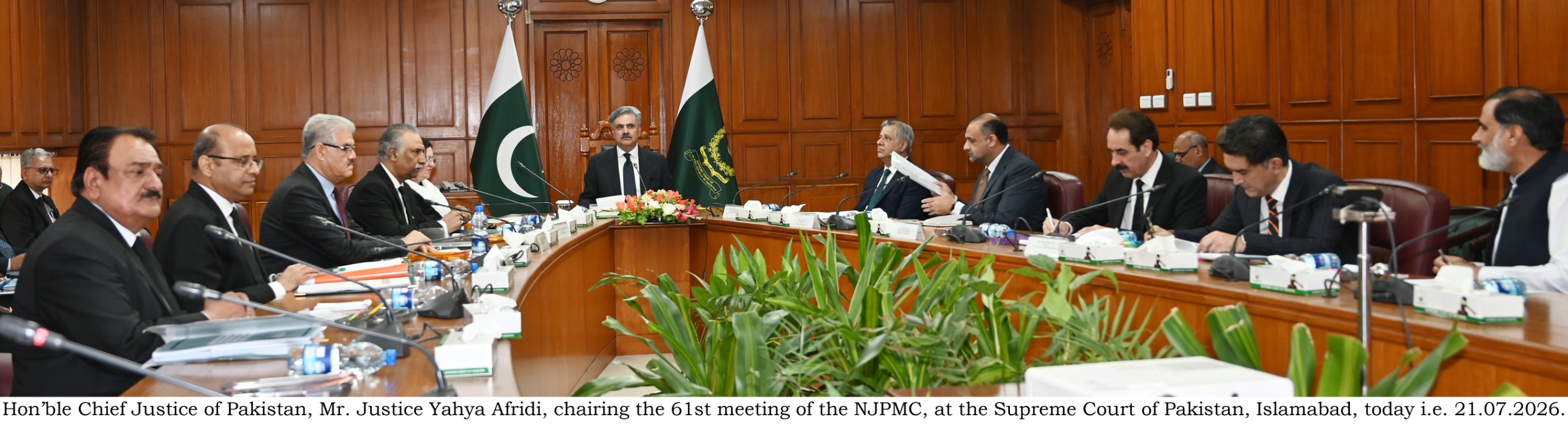
ISLAMABAD, Jul 21 (APP):The National Judicial (Policy Making) Committee (NJPMC) on Tuesday approved, in principle, a National Judicial Reform Framework aligned with the World Justice Project (WJP) Rule of Law Index to introduce evidence-based reforms aimed at strengthening accessibility, transparency and predictability in Pakistan’s judicial system through measurable performance standards, internationally recognised benchmarks and continuous performance evaluation.
The decision was taken at the 61st meeting of the NJPMC, chaired by the Chief Justice of Pakistan at the Supreme Court.
The meeting was attended by the chief justices of the high courts, while the federal minister for law and justice and the law secretary participated on special invitation.
Representatives of the Pakistan Bar Council and the Supreme Court Bar Association also attended to ensure an inclusive policy-making process.
The committee resolved that the high courts may adopt the National Judicial Reform Framework along with the Self-Assessment Checklist of the International Framework for Court Excellence (IFCE), with necessary modifications. It directed the high courts to establish institutional mechanisms for periodic assessment and submit quarterly reports on reform progress.
The committee also decided that the Secretariat of the Law and Justice Commission of Pakistan (LJCP), in coordination with the Ministry of Law and Justice, would establish a dedicated cell to map reforms under the framework and present its progress at the next NJPMC meeting scheduled for October 8, 2026.
The LJCP Secretariat was further tasked with identifying and validating appropriate rule of law indicators, in consultation with the high courts and other justice sector institutions, for phased integration into the National Judicial Analytics Dashboard (NJAD). In collaboration with the National Information Technology Board (NITB), it will also develop a technology platform for periodic progress reports, coordinate capacity-building initiatives and conduct annual assessments of Pakistan’s performance in the World Justice Project Rule of Law Index.
The committee observed that judicial reforms should increasingly be driven by objective data, measurable outcomes and internationally accepted standards to strengthen institutional performance, improve public confidence and ensure better delivery of justice.
The meeting also reviewed progress on the federal government’s proposed Commission on Enforced Disappearances.
The federal law minister informed the committee that former Supreme Court judges were being considered to head the commission and said its composition and terms of reference would be finalised soon. The committee appreciated the progress and stressed strict compliance with legal requirements for producing detained persons before competent courts within the prescribed time.
The meeting concluded with the committee reaffirming its commitment to sustained judicial reforms, stronger institutional coordination and improved access to justice through innovation, evidence-based governance and technology-enabled service delivery.

