Nasim Ashraf’s book “Ring Side” launched at IPRI
Nasim Ashraf’s book “Ring Side” launched at IPRI
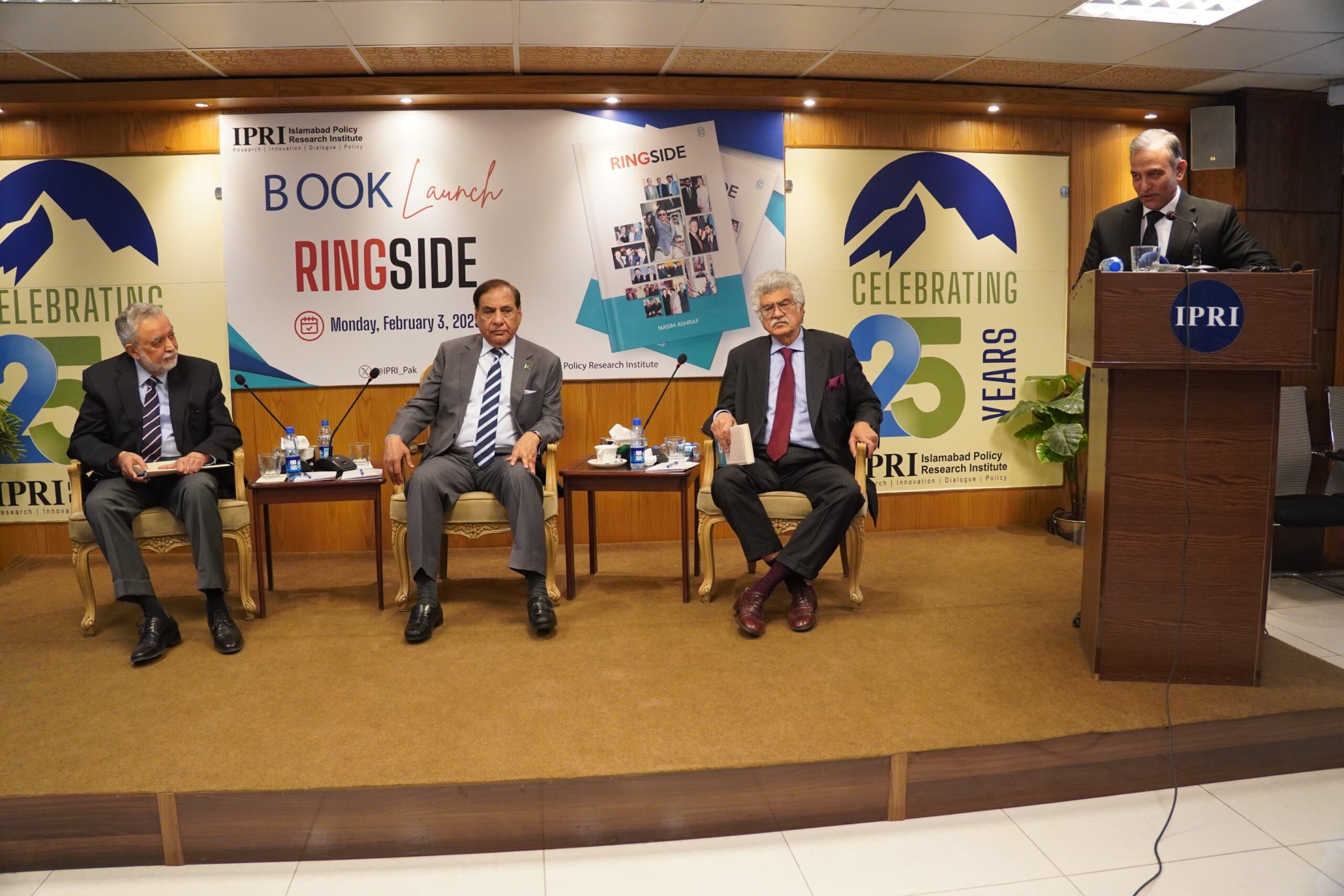
ISLAMABAD, Feb 03 (APP): A book by Nasim Ashraf, a prominent Pakistani American physician and former PCB chairman, titled “Ring Side” was unveiled on Monday at Islamabad Policy Research Institute (IPRI).
Prominent other guests on the panel were Lt Gen. Ehsan ul Haq, former Chairman Joint Chiefs of Staff Committee of Pakistan and Amb. Zamir Akram, former permanent representative of Pakistan to the United Nations and other international organizations in Geneva, said a press release.
The autobiography, RINGSIDE, is a first-hand account of one of the most consequential periods in Pakistan’s tumultuous history. The author had a critical role at the center of power during President Pervez Musharraf’s tenure, and has documented his personal experiences in statecraft as well as Pakistan-United States relations to which he was quite privy.
Covering a vast span of events from Pakistan’s role as America’s indispensable partner in the War on Terror to the grassroots of human development in Pakistan, the author presents a primary source account of the country’s external and internal policies. He remains more concerned on human development and takes no qualms in saying that Pakistan had not done enough in this realm.
The book also entails an evocative and fascinating account of military coup, palace intrigues and vested interests that have accented Pakistan’s history. Amidst all those obstacles, the book pins that the author was able to implement a basic health and literacy scheme at the grassroots.
The book nail-bitingly accounts for the events that unfolded in diplomacy after September 11, 2001, attacks, and the outcome it had on the diplomatic mosaic with Pakistan.
Nasim Ashraf made it a point to say that having worked closely with American authorities, he learnt the reality that citizens’ rights are placed well above even those of the President of the United States. This is where we have to learn as we go on to buoy human confidence in the state, he observed.
In a one-liner on US-Pakistan ties, he said it has been infected with “trust deficit”, and there is a need to overcome this dilemma.
He said that Pakistani diaspora is the single largest asset in the US, and that needs to be tapped in national interest and for furthering inter-state relations.
He was of the view that there is a thin line between national security and human security, and the more investment is made in social indicators such as trade, commerce and human development, the better.
President IPRI Amb Dr Raza Muhammad said that Pakistan-US relations are in a paradigm shift, and there is a lot that is in need of being done to graduate it to new heights for the collective benefit of both the nations.