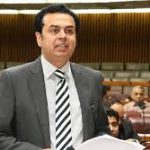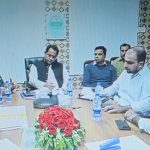
Minister of State for Law and Justice Barrister Aqeel Malik and Prime Minister’s Coordinator for Information in Khyber Pakhtunkhwa Ikhtiar Wali Khan on Monday rejected allegations that the imposition of emergency and governor’s rule in the province was aimed at taking control of its mineral resources, saying the constitutional measures were intended to restore law and order, address security challenges and protect the lives and property of citizens.
KP governor’s rule aimed at restoring peace, not seizing minerals: officials

ISLAMABAD, Oct 19 (APP):Minister of State for Law and Justice Barrister Aqeel Malik and Prime Minister’s Coordinator for Information in Khyber Pakhtunkhwa Ikhtiar Wali Khan on Monday rejected allegations that the imposition of emergency and governor’s rule in the province was aimed at taking control of its mineral resources, saying the constitutional measures were intended to restore law and order, address security challenges and protect the lives and property of citizens.
Addressing a joint press conference here, the two officials said the measures had been approved by a majority after detailed deliberations in both Houses of Parliament and a joint sitting under Articles 232 and 234 of the Constitution.
They described Jamiat Ulema-e-Islam-Fazl (JUI-F) chief Maulana Fazlur Rehman’s allegations concerning mineral resources as unfounded and contrary to facts.
Barrister Aqeel Malik said the provincial government had abandoned its constitutional responsibilities and remained focused on sit-ins, long marches and confrontation rather than addressing governance and security issues.
Citing official figures, he said the number of mining leases or concessions in the province had increased from 482 in 2010 to 1,762 in 2020, reaching 3,962 by February 2024 and 4,917 by October 2026.
He said the increase had taken place during successive Pakistan Tehreek-e-Insaf (PTI) governments in the province over the past 13 years, rejecting allegations that the federal government was seeking to take control of mineral resources or issue licences to foreign powers, including the United States.
He challenged those making the allegations to present evidence or documentary proof to substantiate their claims.
Referring to the security situation, Barrister Aqeel Malik said Maulana Fazlur Rehman had himself acknowledged on the floor of Parliament that the state’s writ was eroding after sunset in several districts, including his native Dera Ismail Khan, with police stations rendered ineffective.
He said security personnel, police officers and civilians were losing their lives on a daily basis, making intervention necessary to protect the public and restore the authority of the state.
The minister regretted that Maulana Fazlur Rehman had remained absent from the joint sitting of Parliament when the issue was discussed, adding that no such allegations had been raised by his party’s members during the proceedings.
He said the federal government had taken the step in accordance with constitutional requirements and that an 11-member advisory council was working to improve the province’s affairs.
Ikhtiar Wali Khan said the previous provincial government had left several districts vulnerable to militant activity, while the police had been pushed to the point of considering a strike.
He urged Maulana Fazlur Rehman, whom he described as a senior national political leader, to exercise restraint in his public statements and avoid remarks that could hurt the people of the province and the families of security personnel and other martyrs.
Rejecting the mineral-resource allegations, Ikhtiar Wali Khan said no emergency had been imposed in mineral-rich districts, including Buner, Swat, Malakand, Hazara and Kohat, arguing that this demonstrated that the measures were driven by security concerns rather than an interest in mineral wealth.
He further alleged that the PTI government had distributed mining leases on preferential terms among close associates, ministers and advisers. He accused the former provincial administration of bringing the province’s economy, industry, healthcare and education systems to the brink of collapse.
Calling for a united effort to rebuild the province, Ikhtiar Wali Khan urged political leaders to set aside personal differences and stand alongside state institutions and the Pakistan Army.
Wali said restoring peace was essential for the province’s reconstruction, development and public welfare.