
ISLAMABAD, Nov 25 (APP):Federal Minister for National Heritage and Culture, Aurangzeb Khan Khichi on Wednesday announced that Iqbal Academy Pakistan has completed the Urdu translation of the entire Persian poetry of Allama Muhammad Iqbal, while its English translation is also nearing completion. The English translation of Allama Iqbal’s Urdu poetry is also scheduled for publication soon, while a selected collection of his poetry is being published with translations in Arabic, …
Iqbal Academy completes Urdu translation of Persian poetry, English versions near completion: Minister
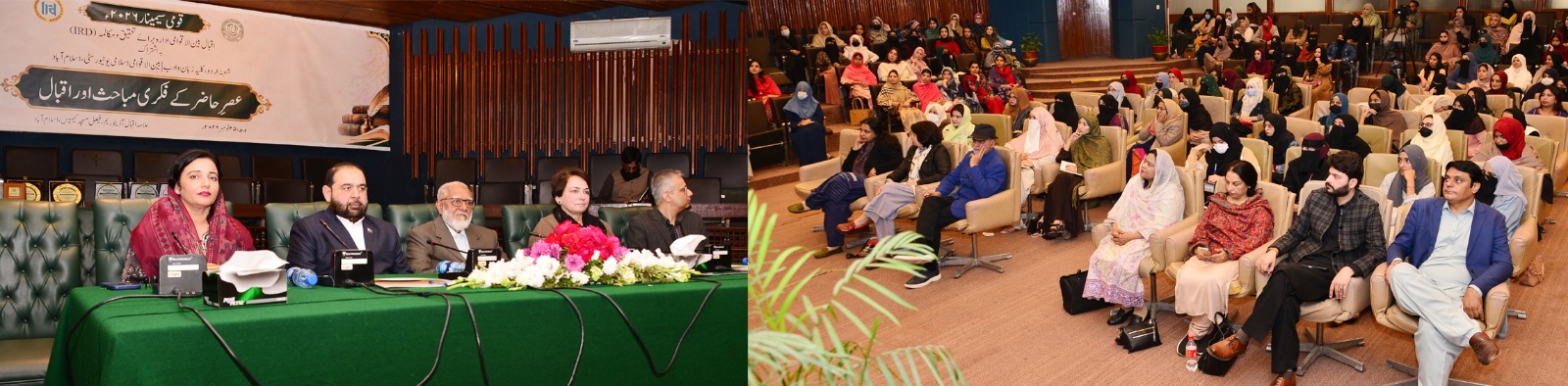
ISLAMABAD, Nov 25 (APP):Federal Minister for National Heritage and Culture, Aurangzeb Khan Khichi on Wednesday announced that Iqbal Academy Pakistan has completed the Urdu translation of the entire Persian poetry of Allama Muhammad Iqbal, while its English translation is also nearing completion.
The English translation of Allama Iqbal’s Urdu poetry is also scheduled for publication soon, while a selected collection of his poetry is being published with translations in Arabic, Persian and English to introduce his literary and philosophical message to a wider international audience.
The minister made these remarks while addressing a national seminar titled “Iqbal in Contemporary Discourse: Perspectives, Perceptions and Reinterpretations” as chief guest, organized by the Iqbal International Institute for Research and Dialogue (IRD), International Islamic University Islamabad (IIUI), in collaboration with the Department of Urdu, Faculty of Languages and Literature, at the Allama Iqbal Auditorium, Faisal Masjid Campus.
He highlighted that Iqbal Academy Pakistan, working under the Ministry of National Heritage and Culture, played a significant role in conducting research on Allama Iqbal’s life, philosophy and intellectual legacy, besides promoting his message at national and international levels.
He said that Iqbal Academy Pakistan, in collaboration with Iran, had already published the Persian Kulliyat-e-Iqbal, calligraphed by renowned Iranian calligrapher Amir Falsafi. He noted that further academic, literary and cultural initiatives in Iqbal studies could be advanced through enhanced cooperation with Iran.
Expressing his commitment to strengthening institutional collaboration, the minister proposed signing a Memorandum of Understanding (MoU) between the Ministry of National Heritage and Culture and the Iqbal International Institute for Research and Dialogue to promote joint research and expand academic work on Allama Iqbal.
He emphasized that Iqbal’s thought should not remain confined to ceremonial tributes and commemorative events but should become an integral part of contemporary academic, philosophical and societal discourse.
He said preserving national heritage was not limited to historical monuments, manuscripts and cultural artefacts but also encompassed safeguarding intellectual and literary traditions and transmitting them to future generations.
The minister stressed the need to promote Iqbal’s intellectual legacy through academic research, translations and modern digital technologies to enable younger generations to understand and engage with his ideas in the context of contemporary challenges.
He also announced that national and international celebrations marking the 150th birth anniversary of Allama Muhammad Iqbal commenced on November 8 and 9 under the auspices of Iqbal Academy Pakistan.
As part of the celebrations, various competitions based on Iqbal’s thought were organized among students of educational institutions across the country, with participating students and institutions demonstrating outstanding performance.
He said the concluding ceremony of these competitions would be held on November 26 at Aiwan-e-Iqbal.
The seminar also featured a keynote address by eminent Islamic scholar and Judge of the Shariat Appellate Bench of the Supreme Court of Pakistan, Prof. Dr. Muhammad Khalid Masud.
The other speakers included Dr. Saira Batool, Prof. Dr. Humaira Ishfaq, Director General, IRD, and Prof. Dr. Fauzia Janjua, Dean, Faculty of Languages and Literature.
The seminar was part of IRD’s ongoing academic initiatives aimed at promoting Iqbal studies, encouraging interdisciplinary research and fostering dialogue between the Islamic intellectual tradition and contemporary knowledge.