
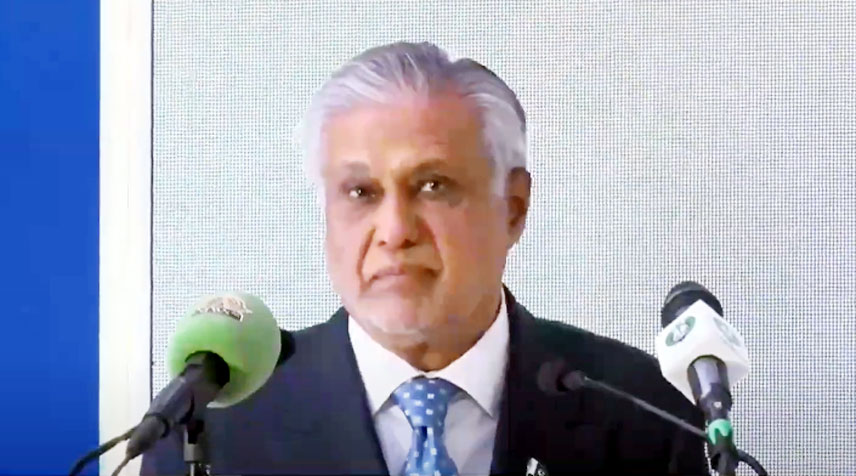

ISLAMABAD, Dec 19 (APP): Deputy Prime Minister and Foreign Minister Senator Ishaq Dar on Friday said that India’s unlawful and unilateral abeyance of the Indus Waters Treaty (IWT) clearly exemplified the weaponization of water, which had all the potential to trigger a humanitarian crisis in Pakistan.
The deputy prime minister, addressing the members of the diplomatic corps here, expressed serious concerns over the “unusual and abrupt” variations and unilateral release of water in the River Chenab by India twice this year during April 30 to May 21, 2025 and in the past week from December 7 to 15.
“India’s manipulation of water, at a critical time of our agriculture cycle, directly threatens the lives and livelihoods, as well as food and economic security of our citizens…Such illegal and irresponsible Indian conduct has all the potential to trigger a humanitarian crisis in Pakistan,” Dar said.
He told the diplomatic community that India had also halted sharing advance information, hydrological data, and joint oversight required by the Treaty, which had exposed Pakistan to floods and droughts.
Highlighting India’s unilateral abeyance of the Treaty in gross contravention of international law, especially Article 26 of the Vienna Convention on the Law of Treaties, the deputy prime minister said that Pakistan was currently witnessing “material breaches” by India striking at the heart of the IWT with escalating consequences both for regional stability and sanctity of international law.
He said that India had released water without any prior notification or any data or information sharing with Pakistan, as required under the treaty.
“India’s manipulation of water has prompted our Indus Water Commissioner to write a letter to his Indian counterpart seeking clarification on the matter, as provided for under the Indus Waters Treaty (IWT), asking India to respond to the queries and refrain from any unilateral manipulations of river flows.
Ishaq Dar said that India had consistently attempted to undermine the Treaty in a systemic manner, by constructing hydropower projects such as Kishanganga and Ratle in violation of IWT’s technical specifications.
“India continues to build illegal dams in sheer disregard of the Treaty obligations, to impose ‘fait accompli.’ With building of dams, Indian capacity to store and manipulate water is also increasing, which endangers Pakistan’s security, economy and livelihood of 240 million people of Pakistan.”
He said that allowing India to violate Treaty obligations with impunity would set a dangerous precedent as the country was subverting the Treaty’s own dispute resolution mechanism by refusing to participate in the Court of Arbitration and Neutral Expert Proceedings.
The deputy prime minister highlighted that IWT was a binding legal instrument and any unilateral violation would threaten the inviolability of international treaties and pose serious threats to regional peace and security, principles of good neighborliness and norms that govern inter-state relations.
He said that Permanent Court of Arbitration, in its recent decisions of June and August 2025, reaffirmed the continuing validity of the IWT and its binding dispute-resolution mechanisms.
“These rulings leave no ambiguity. The Indus Waters Treaty is alive, and its provisions remain binding on the parties. Indian impunity must not be accepted by the international community.”
Dar reiterated that Pakistan’s National Security Committee had declared that any attempt to stop or divert the flow of water to Pakistan under the Treaty would be considered as an “Act of War”.
He urged the international community to take notice of India’s continued disregard of a bilateral treaty and counsel India to act responsibly in accordance with international law and established norms.
He said that the belligerent statements coming from the Indian leadership clearly demonstrated Indian intentions and designs to weaponize water aimed at inflicting harm on Pakistan, which was also repeatedly conveyed to the UN Security Council, UN Secretary General as well as the President of the UN General Assembly to play their due role.
“Let me reassure you that Pakistan remains committed to peaceful resolution of disputes and issues with India, but will not compromise on the existential water rights of its people,” he said.
The deputy prime minister urged the international community, especially the UN Security Council members, to take immediate steps to address this situation and call on India for the immediate restoration of the Treaty, stop weaponization of water, uphold international law and treaty obligations, and refrain from undermining peace and stability of South Asia.